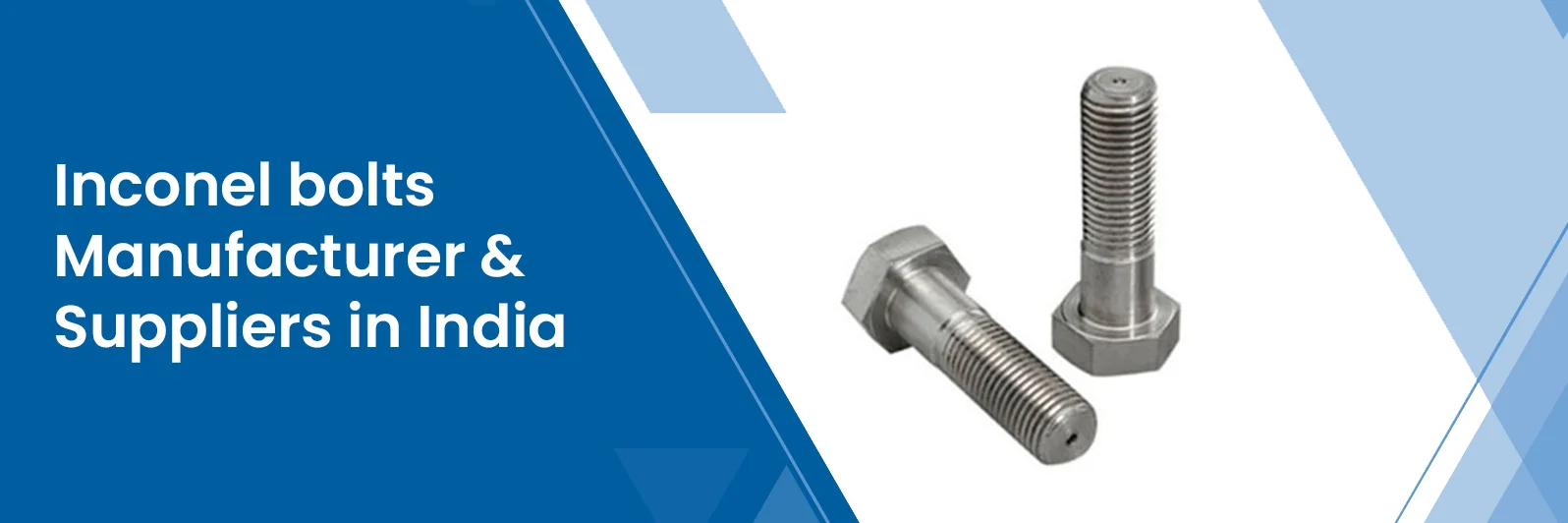
Five Inconel Bolting Grades, and How to Tell Which One Your Joint Needs
Inconel bolts are not one product. It is a family of nickel-based superalloy fasteners whose members differ from one another more than stainless steel differs from carbon steel. An Inconel 718 bolt yields at 150 ksi but should not be trusted much above 704°C. An Inconel 601 bolt yields at 30 ksi yet keeps forming a protective oxide scale at 1250°C. Specifying the wrong one costs you either a failed joint or four times the necessary spend. At Unifit Fastener, we manufacture the full bolting range in all five common grades — 600, 601, 625, 718 and X-750 — as hex bolts, heavy hex bolts, socket head cap screws, stud bolts, anchor bolts and drawing-specific specials, from M3 to M100 and 3/16" to 4", to ASTM B166, B637, B564 and F467/F468. Every lot is PMI-verified and released with an EN 10204 3.1 mill test certificate. Use the comparison matrix below to narrow the grade, then follow the link to that grade's page for full chemistry, dimensions and torque data — or send us the drawing and service conditions and we will confirm the selection before quoting.
What Are Inconel Bolts?
Inconel bolts are threaded fasteners manufactured from nickel-chromium superalloys developed for service conditions that defeat stainless steel: sustained high temperature, thermal cycling, chloride and acid attack, and combinations of all three. The family name is a registered trademark of Special Metals Corporation; the generic designations are Alloy 600 / 601 / 625 / 718 / X-750 and their corresponding UNS numbers.
Two Strengthening Mechanisms, Two Very Different Bolts
Everything about grade selection follows from one metallurgical distinction, and it is worth understanding before reading the matrix.
| Mechanism |
Grades |
What It Means for a Bolt |
Solid solution strengthened |
Inconel 600, 601, 625 |
Strength comes from the alloying elements themselves. Moderate strength, but stable indefinitely at temperature — no ageing, no over-tempering, no property loss after long hot holds. |
Precipitation hardened (age hardened) |
Inconel 718, X-750 |
Strength comes from a controlled heat treatment that precipitates fine particles through the matrix. Very high strength, but the precipitate coarsens above roughly 700°C and the bolt loses its advantage. |
So the rule of thumb is straightforward: if the joint is hot, use a solid-solution grade; if the joint is highly loaded, use a precipitation-hardened grade. Where it is both, the compromise is usually 625 or X-750, and that is a conversation worth having with an engineer rather than a catalogue.
Browse the wider Inconel fasteners range, the parent nickel alloy fasteners catalogue, or our general bolts manufacturer capability.
Inconel Bolt Grade Comparison Matrix
This is the fold the page exists for. Every figure is a specification minimum in the standard supply condition, not a typical mill result — design against these.
| Grade |
UNS |
Standard |
Min Tensile |
Min Yield |
Service Ceiling |
Specify It When |
Inconel 600 |
N06600 |
ASTM B166 |
550 MPa / 80 ksi |
240 MPa / 35 ksi |
~1090°C |
Furnaces, heat exchangers, chloride and caustic streams |
Inconel 601 |
N06601 |
ASTM B166 |
550 MPa / 80 ksi |
205 MPa / 30 ksi |
~1250°C oxidising |
The hottest cycling oxidising zones; carburising atmospheres |
Inconel 625 |
N06625 |
ASTM B446 / F468 |
827 MPa / 120 ksi |
414 MPa / 60 ksi |
~982°C |
Seawater, acids, subsea — corrosion-led duty with good strength |
Inconel 718 |
N07718 |
ASTM B637 |
1275 MPa / 185 ksi |
1034 MPa / 150 ksi |
~704°C |
Highest strength: turbines, downhole, cryogenic, aerospace |
Inconel X-750 |
N07750 |
AMS 5698/5699 |
~1100 MPa / 160 ksi |
~690 MPa / 100 ksi |
~704°C |
Springs, retaining hardware, moderate-strength hot service |
Adjacent Grades Worth Considering
Buyers searching "Inconel bolts" often end up specifying an Incoloy grade, because the duty is corrosion rather than heat. These sit in the same family and we manufacture them all.
| Grade |
UNS |
Min Yield |
Service Ceiling |
Specify It When |
Incoloy 800 / 800HT |
N08800 / N08811 |
205 MPa / 30 ksi |
~982°C |
Cost-balanced high-temperature process hardware |
Incoloy 825 |
N08825 |
241 MPa / 35 ksi |
~540°C |
Sulphuric and phosphoric acid, sour service, chlorides |
Incoloy 925 |
N09925 |
~758 MPa / 110 ksi |
~540°C |
Sour service where 825 strength is insufficient |
ASTM A453 Gr 660 (A286) |
S66286 |
585 MPa / 85 ksi |
~650°C |
Cost-effective alternative to 718 below 650°C |
Grade pages: Inconel 600 · Inconel 601 · Inconel 625 · Inconel 718 · Inconel X-750 · Incoloy 800/800HT · Incoloy 825 · Incoloy 925 · ASTM A453 Gr 660
Grade Selection Guide: Answer Three Questions
If the matrix has not settled it, work through these in order. The first question that gives a decisive answer is usually the one that governs.
Question 1 — What is the sustained service temperature?
| Temperature Band |
Grades That Qualify |
Notes |
Above 1100°C | Inconel 601 | The aluminium addition is what keeps the oxide scale adherent through cycling |
870 – 1100°C | Inconel 600, 601 | Both solid-solution; 601 for cycling, 600 for chemistry |
700 – 870°C | Inconel 625, 600, Incoloy 800HT | Precipitation-hardened grades start losing their advantage here |
Below 700°C | All five, plus Incoloy 825/925 | Strength and corrosion, not temperature, will decide |
Cryogenic | Inconel 718, 625, 600 | No ductile-to-brittle transition in any of them |
Question 2 — What is attacking the bolt?
| Environment |
Best Grade |
Why |
Dry oxidising heat, thermal cycling | Inconel 601 | Dual alumina + chromia oxide film resists spalling |
Chlorides, caustics, reducing media | Inconel 600 | 72% minimum nickel content |
Seawater, pitting and crevice attack | Inconel 625 | PREN around 45 — the highest in the Inconel family |
Sulphuric and phosphoric acid | Incoloy 825 | Copper addition handles reducing acids |
Sour gas (H₂S) | Inconel 718 or Incoloy 825/925 | Procure to NACE MR0175 / ISO 15156 explicitly |
Carburising furnace atmospheres | Inconel 601, Incoloy 800HT | Both resist carbon pickup at temperature |
Question 3 — What load must the joint carry?
- Up to 35 ksi yield — any grade will do; choose on temperature and chemistry alone.
- 35 to 60 ksi yield — Inconel 625 is the natural answer, and brings excellent corrosion resistance with it.
- 60 to 100 ksi yield — Inconel X-750, or ASTM A453 Gr 660 if the budget is tight and the temperature is below 650°C.
- Above 100 ksi yield — Inconel 718, solution treated and double aged. Nothing else in the family reaches it.
Preload and Torque Vary Enormously by Grade
This is the point most Inconel bolt pages miss entirely, and it causes real damage on site. A single "nickel alloy torque chart" applied across grades will either badly under-clamp an 718 joint or take a 601 bolt past yield. The correct preload differs by a factor of five across the family.
Worked Comparison at 65% of Minimum Yield
Using T = K × D × F, with K = 0.20 dry and 0.15 lubricated, and target preload at 65% of each grade's specification minimum yield on the tensile stress area.
| Grade |
Min Yield (ksi) |
1/2"–13 Preload (lbf) |
1/2"–13 Torque Dry (ft-lb) |
3/4"–10 Preload (lbf) |
3/4"–10 Torque Dry (ft-lb) |
Inconel 601 | 30 | 2,767 | 23 | 6,513 | 81 |
Inconel 600 | 35 | 3,228 | 27 | 7,599 | 95 |
Incoloy 825 | 35 | 3,228 | 27 | 7,599 | 95 |
Inconel 625 | 60 | 5,534 | 46 | 13,026 | 163 |
Inconel X-750 | 100 | 9,224 | 77 | 21,710 | 271 |
Inconel 718 | 150 | 13,835 | 115 | 32,565 | 407 |
For lubricated or PTFE-coated threads, multiply the dry torque by roughly 0.75 (K = 0.15) or 0.55 (K = 0.11) respectively.
Assumptions and limits. Calculated for the standard supply condition of each grade — annealed for 600, 601, 625 and 825; solution treated and double aged for 718; annealed and aged for X-750 — with clean undamaged threads at ambient temperature. Reduce the target preload for service above roughly 60% of the grade's temperature ceiling, for gasketed flanges with a specified seating stress, for reused fasteners, and for any joint governed by a code calculation. Where preload accuracy genuinely matters, use bolt elongation measurement or a tensioner rather than torque. Unifit Fastener will supply a joint-specific calculation on request — send us the drawing. |
Inconel Bolt Types We Manufacture
Every profile below is available in all five Inconel grades and the adjacent Incoloy grades. Standards shown are the usual dimensional reference; we also work to customer drawings.
Hex and Structural Bolts
| Bolt Type |
Standard |
Typical Use Case |
Hex bolts / hex head bolts | ASME B18.2.1, DIN 931 / 933 | General flange and structural bolting — the volume product |
Heavy hex bolts | ASME B18.2.1 | Pressure-boundary flanged joints and high-preload assemblies |
Hex head cap screws | ASME B18.2.1 | Machined assemblies requiring a controlled under-head radius |
Hex flange bolts | DIN 6921 | Vibration-prone joints without a separate washer |
12-point flange bolts | OEM drawing | Maximum torque in restricted-access aerospace and turbine work |
Square head bolts | ASME B18.2.1 | Traditional plant and refractory anchor work |
Tap bolts and machine bolts | DIN 933 / custom | Tapped-hole assemblies |
Socket and Precision Screws
| Type |
Standard |
Typical Use Case |
Socket head cap screws | ASME B18.3, DIN 912 | Valve internals, turbine casings, compact assemblies |
Countersunk / flat head socket screws | DIN 7991, ISO 10642 | Flush-mounted covers, liners and tank internals |
Button head socket screws | ISO 7380 | Low-profile guards and panels |
Torx and security screws | ISO 14579 | Tamper-resistant and precision assemblies |
Shoulder bolts | ISO 7379 | Precision location under load |
Set screws and grub screws | DIN 913 – 916 | Shaft and collar location at temperature |
Studs, Anchors and Formed Bolts
| Type |
Description |
Fully threaded stud bolts | Continuous thread both ends — the standard ASME B16.5 flange stud |
Double-ended studs (tap-end / nut-end) | Plain centre body with threaded ends for tapped-hole assemblies |
Reduced-shank stud bolts | Waisted body for controlled elongation and improved fatigue life |
Threaded rods / all-thread | DIN 976, cut to length or in standard bar lengths |
Anchor bolts, sleeve and wedge anchors | Equipment and foundation anchoring in hot or corrosive plant |
U bolts, J bolts, hook bolts | Pipe support, tube clamping and restraint hardware |
Eye bolts and lifting hardware | DIN 580 — lifting points in corrosive or hot environments |
Foundation and elevator bolts | Structural and conveyor hardware |
Carriage bolts | DIN 603 — through-bolted plate, lining and cladding work |
For the full studs range see Inconel stud bolts and the general stud bolts page. Matching hardware: Inconel washers and nickel alloys nuts.
Size Range, Threads and Finishes
| Parameter |
Specification |
Bolt diameter range | M3 – M100 | 3/16" to 4" | larger to drawing |
Length range | 3 mm to 200 mm as standard; longer studs and threaded rod to order |
Thread types | UNC, UNF, UN, 8UN, BSW, BSF, metric coarse, metric fine, left or right hand |
Thread tolerance classes | ASME B1.1 2A/3A inch unified; ASME B1.13M 6g metric |
Thread production | Rolled wherever section permits (superior fatigue life); cut or ground for large or precision sections |
Head styles | Hex, heavy hex, square, round, flange, countersunk, socket, button, T-head, triangular |
Point / end styles | Chamfered, cone, cup, flat, dog point, rolled end |
Surface finish | Bright / self-colour, pickled and passivated, black oxide, phosphate |
Anti-galling coatings | Xylan, PTFE / Teflon, electroless nickel, zinc-nickel, silver plating |
Tolerance | OEM / ODM to drawing; ±0.03 mm achievable on machined features |
Marking | Heat number, grade and manufacturer identification stamped as standard |
Coating pages: Xylan coated fasteners and PTFE / Teflon coated fasteners. Background reading on fastener coatings, types and standards.
Galling: The Problem Every Inconel Bolt User Meets
If you have used nickel alloy bolting before, you have probably seized a joint. It is worth understanding why, because the fix is cheap and the failure is expensive.
Nickel alloys are highly ductile and carry a tenacious, self-repairing oxide film. Under the contact pressure of a tightening thread, that film is scraped through, exposing clean metal to clean metal — which cold-welds instantly. The weld then tears, roughening both surfaces, and the process accelerates until the nut seizes solid on the stud. It is not a manufacturing defect and it is not specific to any one grade; it is inherent to the material class, and the risk rises with preload, so 718 joints gall more readily than 601 joints.
What Actually Prevents It
- Use a nickel-based anti-seize compound on the threads and under the nut face. This is the single most effective measure and the cheapest.
- Slow the assembly speed. Galling is a frictional heating phenomenon; impact wrenches on nickel alloy threads are a reliable way to seize a joint.
- Specify an anti-galling coating — Xylan or PTFE. These also give a far more predictable and repeatable torque-to-preload relationship, which matters as much as the galling protection itself.
- Avoid mixing hardnesses. A nut significantly harder or softer than the bolt raises the risk. Matched sets from one heat are the safest route.
- Do not reuse a galled fastener. Once the thread flanks are torn, the damage is permanent regardless of how it cleans up visually.
Standards by Grade
One reason Inconel bolt certificates get queried at inspection is that the governing standard differs by grade and by product form. This table resolves it.
| Standard |
Applies To |
Scope |
ASTM B166 / ASME SB166 | Alloy 600, 601 | Nickel-chromium-iron alloy rod, bar and wire — the base stock standard |
ASTM B446 / ASME SB446 | Alloy 625 | Nickel-chromium-molybdenum-columbium alloy rod and bar |
ASTM B637 / ASME SB637 | Alloy 718, X-750 | Precipitation-hardening nickel alloy bars and forgings for high-temperature service |
ASTM B425 / ASME SB425 | Incoloy 825 | Nickel-iron-chromium-molybdenum-copper alloy rod and bar |
ASTM B408 / ASME SB408 | Incoloy 800 / 800HT | Nickel-iron-chromium alloy rod and bar |
ASTM B564 / ASME SB564 | All grades | Nickel alloy forgings — heavy hex heads, anchors and forged specials |
ASTM F467 / F468 | All grades | Nonferrous nuts, bolts, hex cap screws and studs for general use |
ASTM F2281 | All grades | Nickel alloy fasteners for high-temperature service |
AMS 5662 / 5663 / 5664 | Alloy 718 | Aerospace heat treatment conditions — solution treated, double aged |
AMS 5698 / 5699 | Alloy X-750 | Aerospace conditions for spring and hot hardware |
NACE MR0175 / ISO 15156 | 718, 825, 925 | Sour service qualification — must be specified explicitly at enquiry |
ASME B18.2.1 / B18.2.2 / B18.3 | All grades | Dimensional standards for inch bolts, nuts and socket screws |
DIN 931 / 933 / 912 / 976 | All grades | Metric bolt, screw and threaded rod dimensions |
EN 10204 3.1 | All grades | Mill test certificate from the manufacturer's independent inspection function |
More context in our fasteners standards reference and the guide to ISO fastener standards.
Applications & Industries Served
| Industry |
Typical Bolting Duty |
Usual Grade |
Heat treatment & furnaces | Muffle and retort hardware, basket assemblies, door fixings | Inconel 601, 600 |
Petrochemical & refining | Reformer bolting, cracking furnace hardware, hot flanged joints | Inconel 600, 601, Incoloy 800HT |
Aerospace & gas turbine | Engine casings, exhaust hardware, airframe fittings | Inconel 718, X-750 |
Oil & gas — downhole and sour | Wellhead bolting, packers, tool joints | Inconel 718, Incoloy 925 |
Subsea & offshore | Connector bolting, riser hardware, splash-zone fixings | Inconel 625, 718 |
Power generation | Boiler and turbine bolting, superheater supports, ducting | Inconel 600, 601, 718 |
Nuclear engineering | Reactor internals, steam generator hardware, fuel handling | Inconel 600, 718 |
Chemical & acid plants | Reactor, evaporator and pipe support bolting | Incoloy 825, Inconel 625 |
Marine & desalination | Seawater heat exchangers, condenser and pump hardware | Inconel 625, 600 |
Cryogenic & LNG | Transfer line clamps, vacuum jacket hardware | Inconel 718, 625, 600 |
Pollution control & FGD | Absorber internals, ducting and damper hardware | Incoloy 825, Inconel 625 |
Further reading: applications and uses of Inconel fasteners, advantages of nickel alloy fasteners and why Inconel 718 bolts are preferred for high-temperature environments.
Inconel Bolts vs Other High-Performance Fastener Materials
| Material |
Min Yield |
Temperature Ceiling |
Corrosion Profile |
Relative Cost |
Inconel (600 – 718 range) | 30 – 150 ksi | 704 – 1250°C | Excellent across chlorides, caustics, oxidising heat | High |
Stainless steel 316L | 30 ksi | ~870°C (scaling) | General service; poor chloride SCC resistance | Low |
Duplex / super duplex | 65 – 80 ksi | ~300°C | Excellent chloride pitting resistance; limited temperature | Medium |
Monel 400 | 25 ksi | ~540°C | Outstanding in seawater and hydrofluoric acid | High |
Hastelloy C-276 | 41 ksi | Moderate | The most aggressive wet corrosion, including hot HCl | Very high |
Titanium Gr 5 | 120 ksi | ~400°C | Excellent seawater performance at low weight | High |
Alloy steel B7 / B16 | 105 / 95 ksi | ~450 / 540°C | Requires coating; no inherent corrosion resistance | Low |
Compare with stainless steel fasteners, duplex steel fasteners, super duplex fasteners, Monel 400 fasteners, Hastelloy fasteners, titanium fasteners and high tensile fasteners.
Our Manufacturing & Quality Process
The route differs between solid-solution and precipitation-hardened grades, and that difference is where most quality problems originate.
| Stage |
Solid Solution Grades (600, 601, 625) |
Precipitation Hardened Grades (718, X-750) |
Material verification | PMI and spectro analysis on every incoming lot | Same, with particular attention to niobium and titanium |
Forming | Cold heading for volume sizes; hot forging for heavy heads | Hot forging within a tighter temperature window |
Heat treatment | Solution annealing to dissolve carbides and relieve stress | Solution treatment plus a full two-stage ageing cycle, chart-documented |
Thread production | Rolled after annealing wherever section permits | Rolled after ageing wherever section permits — sequence is critical |
Critical acceptance check | Hardness and dimensional | Hardness on the finished part — the only reliable proof of complete ageing |
Testing We Perform
| Test |
Purpose |
Availability |
Positive Material Identification (PMI) | Confirms alloy grade before dispatch | 100% of lots |
Chemical analysis (spectro) | Verifies composition against the grade standard | Per heat |
Tensile, yield, elongation and RA | Confirms mechanical class | Per lot / per heat |
Hardness survey | Confirms condition — critical for aged 718 and X-750 | Per lot, on finished parts |
Ultrasonic testing (UT) | Internal flaw detection in billets and large studs | On request / per spec |
Dye penetrant (DP) testing | Surface crack detection | On request |
Intergranular corrosion test | Confirms freedom from sensitisation | On request |
Stress rupture testing | Validates creep performance for AMS-route material | On request |
Dimensional and thread gauging | Go/no-go and profile verification | 100% sampling plan |
Third-party inspection | TÜV, BV, SGS, Lloyd's witness inspection | On request |
Why Buy Inconel Bolts From Unifit Fastener
Across five grades, the value a supplier adds is not stock availability — it is telling you which grade you actually need, including when that answer costs us margin.
| EEAT Pillar |
What Unifit Fastener Delivers |
Experience | Production and export experience across furnace, refinery, turbine, subsea, nuclear and acid plant bolting — including shutdown supply where the outage date, not the price, is the constraint. |
Expertise | In-house metallurgists who will review your service conditions and confirm the grade, condition, thread class, preload method and anti-galling strategy before quoting. |
Authoritativeness | Manufacturing to ASTM, ASME, AMS, DIN, ISO, JIS, BS and IS across all five Inconel grades; dual certification; acceptance by third-party inspection agencies and EPC approvals. |
Trustworthiness | Heat-number traceability, EN 10204 3.1 certification as standard, the correct standard cited by grade and product form, and published technical data that matches what we ship. |
Global Supply Footprint
We supply Inconel bolts across India — Mumbai, Pune, Ahmedabad, Chennai, Hyderabad, Bangalore, Coimbatore, Jamnagar, Vadodara, Kolkata, Vizag and Pimpri-Chinchwad — and export to the UAE, Saudi Arabia, Qatar, Oman, Kuwait, Bahrain, Singapore, Malaysia, Thailand, Indonesia, Vietnam, South Korea, Japan, Australia, the United States, Canada, Mexico, Brazil, the United Kingdom, Germany, Netherlands, Italy, Turkey, Egypt, Nigeria and South Africa.
Packing & Dispatch
- Bulk items in cartons on palletised loads; precision and aerospace items individually separated
- VCI paper and moisture-barrier wrapping for sea freight
- Fumigated wooden crates conforming to ISPM-15 for export
- Heat number, grade and size marked on every package
- Air, sea and courier dispatch with export documentation handled end-to-end
Inconel Bolt Price
Price varies more across the Inconel family than most buyers expect, and grade choice is usually the largest single lever available to you.
| Cost Driver |
Effect on Price |
Grade selection | The dominant variable. An 718 bolt typically costs several times a 600 bolt of the same size, driven by niobium content and the 18-hour heat treatment |
LME nickel, chromium, molybdenum and niobium | Raw material is typically 60–70% of finished cost and moves with the metals market |
Heat treatment route | Solution annealing is a short cycle; the 718 and X-750 solution-plus-double-age cycle is an unavoidable line item |
Machining difficulty | Aged 718 is hard on tooling; finishing operations after ageing cost significantly more than on annealed grades |
Size and section | Large-diameter studs consume disproportionately more bar stock and furnace capacity |
Standard vs custom geometry | Catalogue DIN/ASME items cost far less than drawing-specific specials requiring new tooling |
Specification route | AMS, API 6A718 or NACE-qualified material carries additional testing and documentation cost |
Coating and testing | Xylan, PTFE, UT, DP or witnessed inspection add cost and lead time |
Order quantity and urgency | Volume runs are materially cheaper per piece; expedited shutdown supply carries a premium |
Before you accept a quotation on a premium grade, it is worth asking whether the duty genuinely requires it. We will run that check for you at no cost — send the drawing and the service conditions.
Which Inconel grade is best for bolts?
There is no single best grade — it depends on the duty. Inconel 718 is the strongest at 150 ksi minimum yield but limited to about 704°C. Inconel 601 is the most heat-resistant, forming a protective oxide scale to about 1250°C, but yields at only 30 ksi. Inconel 625 is the best all-rounder at 60 ksi yield with excellent seawater and acid resistance. Inconel 600 suits chloride and caustic service to about 1090°C. Work through the three questions in the selection guide above, or send us your conditions.
What is the strongest Inconel bolt?
Inconel 718 in the solution treated and double aged condition: a minimum of 1275 MPa (185 ksi) tensile and 1034 MPa (150 ksi) yield per ASTM B637 and AMS 5663. That is comparable to a quenched-and-tempered alloy steel bolt, but retained at 1200°F and with full ductility down to cryogenic temperatures.
What temperature can Inconel bolts withstand?
It ranges from about 704°C for Inconel 718 and X-750 up to about 1250°C for Inconel 601 in oxidising service. The precipitation-hardened grades are limited because their strengthening precipitate coarsens with heat; the solid-solution grades keep going. This is why "Inconel" alone is not a temperature specification — always state the grade.
What is the difference between Inconel 625 and 718 bolts?
625 is solid-solution strengthened; 718 is precipitation hardened. That gives 718 roughly double the yield strength (150 ksi versus 60 ksi) but a lower temperature ceiling (704°C versus 982°C). 625 also offers superior pitting and crevice resistance, with a PREN around 45. Choose 718 for load, 625 for corrosion and heat.
Are Inconel bolts stronger than stainless steel bolts?
At room temperature, only some of them are — an annealed Inconel 600 bolt at 35 ksi yield is comparable to 316L stainless. The real difference is what happens at temperature and in corrosive media: stainless scales, relaxes and cracks under chloride attack where Inconel holds its properties. Inconel 718 is stronger than any austenitic stainless bolt by a wide margin.
Tell Us the Duty. We Will Tell You the Grade.
Send us the service temperature, the media, the load and the drawing — our engineering team will confirm the right Inconel grade, condition and thread class before quoting. If a cheaper grade will do the job, we will say so. That conversation takes ten minutes and regularly saves multiples of the order value.
Get a Grade Recommendation + Quote →