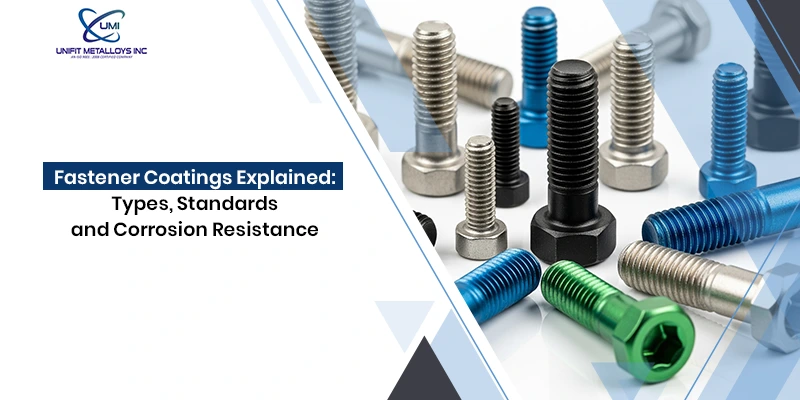
Fastener coatings are engineered surface layers applied to bolts, nuts, studs and washers to combat corrosion, control friction and extend service life. The right coating improves clamp consistency, reduces galling and seizure, and helps parts survive harsh environments from offshore platforms to automotive underbodies. Unifit Fastener manufactures and supplies coated fasteners at scale, matching fastener coating standards and project specs across global markets. This guide breaks down fastener coating types so you can align performance, cost and compliance with your application.
Why Fastener Coatings Are Important?
Coatings slow down electrochemical attack, keep threads free-moving and stabilize torque–tension so joints stay tight. That translates to fewer shutdowns, safer assemblies and longer maintenance cycles. Construction, oil and gas, automotive and marine applications all rely on fastener coatings and corrosion resistance to survive salt, chemicals, heat and UV.
Salt-spray methods like ASTM B117 and ISO 9227 are commonly used for comparative corrosion screening. In high-vibration joints and corrosive zones, engineers routinely coat fasteners to stabilize preload and reduce galling.
Example: On offshore pipe supports, coat fasteners with zinc-flake or PTFE over a barrier layer to resist salt fog and achieve a stable K-factor for repeatable preload. ISO 16047 testing confirms friction and clamp-force performance before production rollout.
Types of Fastener Coatings
- Zinc Coated Fasteners: Economical sacrificial layer protecting steel in mild to moderate environments. Reliable corrosion resistance with tight thread tolerances for general fabrication and building hardware.
- PTFE / Teflon Coated Fasteners: Very low friction and strong chemical resistance. Ideal for oil & gas, chemical and marine bolting where corrosion, temperature and galling control matter.
- Geomet Coating Fasteners: Chromium-free zinc flake system with high corrosion protection at thin films. Avoids hydrogen embrittlement, making it suitable for high-strength bolts in automotive, construction, wind and offshore sectors.
- Powder Coated Fasteners: Tough, colored barrier layer with UV and impact resistance. Often applied over stainless steel or zinc base for outdoor, architectural and consumer product applications.
- Xylan Coated Fasteners: Fluoropolymer dry-film systems offering low friction, chemical resistance and wide temperature capability. Used in valves, flange joints and critical bolting in energy and chemical plants.
- Teflon Coated Studs: Low-friction, corrosion-resistant surface for repeatable tightening and easy removal in harsh environments. Common in refinery and petrochemical flange joints.
Coating Techniques and Processes
- Electroplating: Electric current deposits zinc or zinc-alloy for thin, uniform coatings ideal for tight-tolerance threads.
- Hot-Dip Galvanizing (HDG): Immersion in molten zinc for thick, robust zinc-iron layers; ASTM F2329 governs fasteners.
- Dip-Spin Coating: Bulk basket dip and spin-off for zinc-flake systems like GEOMET; avoids hydrogen embrittlement.
- Powder Coating: Electrostatic powder spray followed by oven cure for durable color and barrier protection.
- Spray Coating (PTFE/Xylan): Resin-bonded fluoropolymers sprayed and baked to create low-friction, chemical-resistant films.
Fastener Coating Standards
| Standard | Description |
|---|---|
| ASTM B633 | Zinc electrodeposited coatings on iron/steel with defined thickness classes and corrosion requirements. |
| ISO 4042 | Electroplated coating systems for fasteners, including zinc, zinc-nickel and zinc-iron; includes measures to minimize hydrogen embrittlement. |
| ISO 10683 | Zinc flake coatings (non-electrolytic) for fasteners, with or without topcoats or lubricants. |
| ASTM F2329 | Hot-dip zinc coating for bolts, nuts, washers and threaded fasteners. |
How Fastener Coatings Are Tested?
- Salt Spray: ASTM B117 and ISO 9227 for comparative corrosion resistance.
- Friction/Torque: ISO 16047 to validate K-factor and clamp force repeatability.
- Thickness: ISO 2178 (magnetic) and ISO 2360 (eddy-current) for non-destructive film checks.
Unifit Fastener supplies to these standards and can certify salt-spray hours, coefficient of friction and dry-film thickness per order.
How to Choose the Right Coating for a Fastener?
Match the coating to environment, temperature and assembly requirements. For high preload accuracy on subsea flanges, PTFE or Xylan coated fasteners offer low friction. For structural steel outdoors, HDG or zinc-flake systems are proven workhorses. When appearance and UV resistance are priorities, consider powder coated fasteners as a topcoat over a corrosion-resistant base layer.
| Coating | Corrosion Resistance* | Temperature Tolerance | Cost-Effectiveness | Application Suitability |
|---|---|---|---|---|
| Zinc Plated (ASTM B633) | Low–Medium (thickness dependent) | Up to ~120°C | High | Indoor hardware, general fabrication |
| HDG (ASTM F2329) | High | ~200°C | Medium | Outdoor structural, anchors |
| Zinc-Flake / GEOMET | High–Very High (thin DFT) | ~150–200°C | Medium | Automotive, marine, wind, construction |
| PTFE / Teflon | High with topcoat | Up to ~260°C | Medium | Oil & gas, chemical, subsea studs |
| Xylan | High with system | Wide range; high-temp families | Medium | Valves, bolting, chemical service |
| Powder Coat | Barrier; depends on substrate | Up to ~200°C | Medium | Architectural, outdoor equipment |
*Relative performance based on typical system design and thickness.
Conclusion
Picking the right coating is the fastest way to boost fastener performance, manage torque-tension and fight corrosion. From zinc coated fasteners to geomet coating fasteners, PTFE coated fasteners, teflon coated fasteners, xylan coated fasteners and powder coated fasteners, Unifit Fastener delivers to spec with full documentation.
Zinc Coated Fasteners, PTFE Coated Fasteners, Teflon Coated Studs, Geomet Coating Fasteners, Powder Coated Fasteners, Xylan Coated Fasteners, ASTM B633, ISO 4042, ISO 10683, ASTM F2329 coatings supplier, OEM & exporter – Unifit Fastener, Mumbai, India.
Frequently Asked Questions About Fastener Coatings
What is the most corrosion-resistant fastener coating?
Zinc-flake systems like GEOMET often deliver very high salt-spray hours at thin films and avoid hydrogen embrittlement. In severe marine or offshore service, fluoropolymer systems (PTFE or Xylan) over suitable primers combine strong barrier protection with low friction for reliable assembly.
Are Teflon and PTFE coatings the same?
“Teflon™” is a brand name for PTFE and related fluoropolymers. In industrial bolting, PTFE coated fasteners and Teflon coated fasteners typically refer to similar low-friction, high-temperature coatings applied as sprayed, baked films.
What is Geomet coating used for?
Geomet is a water-based, chromium-free zinc-flake coating used widely on fasteners for automotive, heavy truck, wind energy and marine applications. It provides high corrosion resistance with thin films and stable friction, and is ideal for high-strength fasteners.
How does powder coating compare to zinc coating?
Zinc plating is thin, economical corrosion protection for hardware. Powder coating is a thicker organic barrier with excellent color, UV and impact durability, usually applied over a corrosion-resistant base layer.
Which industries prefer Xylan coated fasteners?
Oil and gas, chemical processing, power generation and marine maintenance teams specify Xylan coated fasteners for low friction, chemical resistance and temperature capability in demanding bolting applications.