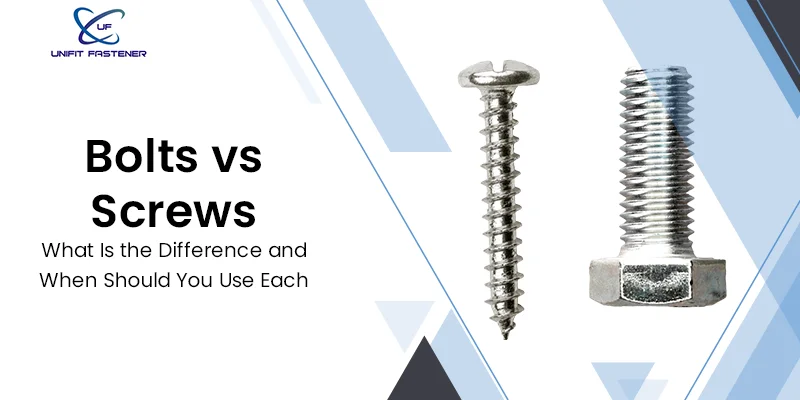
Ask ten people on a shop floor what separates a bolt from a screw and you will probably hear ten slightly different answers. One says the nut. Another says the thread. A third shrugs and says it hardly matters as long as it holds. They are all a little bit right, and that is exactly why the bolts vs screws question causes so many wrong orders, stripped holes and joints that loosen a month after they were tightened. Knowing the real difference between bolts and screws stops most of that.
The main difference is how they are tightened. A bolt passes through clearance holes and is tightened by turning a nut. A screw threads into a tapped hole, or cuts its own thread, and is tightened by turning its head. Use bolts when you can reach both sides of the joint. Use screws when you can only reach one.
This guide is written for people who buy, specify or install fasteners for real work. If you only need the basics, our short guide to the bolt vs screw difference covers them. Here we go further: where the definitions blur, what the standards actually say, how strength grades change the answer, and how to write an order that gets you the right part the first time.
Quick Comparison: How a Bolt and a Screw Differ
Here is the quick comparison most buyers are looking for. Read across a row to see how a bolt and a screw behave on that point.
|
Feature |
Bolt |
Screw |
|
Standard definition (ASME B18.2.1) |
Made for insertion through holes in the assembled parts and normally tightened by turning a nut |
Can mate with a preformed internal thread or form its own, and is tightened by turning the head |
|
Tightened by |
The nut, normally |
The head |
|
Hole |
Unthreaded clearance hole |
Tapped hole, or a pilot hole for self tapping and wood screws |
|
Access needed |
Both sides of the joint |
One side is enough |
|
Nut and washers |
Nut plus one or two washers |
Usually none |
|
Thread |
Partial or full. Thread length is not the deciding test |
Shaped for the base material, fine for machine screws and coarse for wood |
|
Clamp load |
High and controllable through the nut |
Depends on thread engagement in the base material |
|
Strength marking |
Property class such as 8.8, 10.9 or 12.9, or SAE and ASTM grades |
Machine screws and socket head cap screws carry classes too. Wood and sheet metal screws follow their own specifications |
|
Reuse |
Good, if it has never been stretched past yield |
Tapped threads wear, especially in soft metal |
|
Typical uses |
Structural steel, flanges, machinery, vehicles |
Wood, drywall, sheet metal, electronics, machine housings |
Treat this table as the rule. The next section explains the exceptions, because on a real parts list the exceptions turn up all the time.
Why the Same Part Can Be Called a Bolt or a Screw
The formal definitions are clear enough. Under ASME B18.2.1, a bolt is designed to pass through holes in the assembled parts and is normally tightened by turning a nut. A screw can mate with a preformed thread or form its own, and is tightened by turning the head. The trouble starts with parts that could be either.
Standards bodies deal with this by naming a part after its design, not its habits. The table below shows how one hex head shape turns up under different names.
|
Standard |
Name used in the standard |
Thread |
What to know |
|
ISO 4014 |
Hex head bolt |
Partly threaded |
Modern equivalent of DIN 931 |
|
ISO 4017 |
Hex head screw |
Fully threaded |
Modern equivalent of DIN 933 |
|
DIN 931 |
Hexagon head bolt |
Partly threaded |
Older standard, still common in the trade |
|
DIN 933 |
Hexagon head screw |
Fully threaded |
Older standard, still common in the trade |
|
ISO 4762 |
Hexagon socket head cap screw |
Partly or fully threaded, depending on length |
Driven by the socket, commonly supplied in property class 12.9 |
|
ISO 4029 |
Hexagon socket set screw with cup point |
Fully threaded |
Holds by tip pressure, not by clamping under a head |
|
ASME B18.2.1 |
Square and hex bolts and screws, including lag screws (inch series) |
Varies by product |
The source of the bolt and screw definitions |
So a fully threaded hex part made to ISO 4017 is officially a screw, yet plenty of catalogues sell it as a bolt. Ours does too: our Grade 8.8 bolts range lists DIN 933 items under the bolt name. That is not an error. It is the trade using the words loosely, which is why the standard number matters more than the label on the box. Our guide to ISO fastener standards explains how to read those numbers.
Hex Bolt vs Hex Cap Screw
This is the pair that confuses buyers most. The heads look the same and the sizes overlap. In ASME B18.2.1 both finished hex bolts and hex cap screws are covered, with near identical head dimensions. The practical difference is intent. A hex cap screw is made to tighter tolerances and is meant to be driven by its head into a tapped hole. A hex bolt is meant to go through a clearance hole and be tightened at the nut. If you plan to use a nut, order a bolt. If you plan to tap the hole, order a cap screw.
Machine Screw vs Bolt
A machine screw is a small screw with a uniform thread, made to go into a tapped hole or a nut. Put a nut on it and it works as a bolt. That is the whole story behind the phrase machine screw vs bolt: the same part can do either job, and what it is called depends on how it is used in the joint. Machine screws also tend to be smaller, with slotted, Phillips, Torx or socket drives instead of a wrench head.
Lag Bolt vs Lag Screw
These are the same fastener. A lag screw has a coarse wood thread and a hex head, and you drive it with a wrench or socket. Because it cuts its own thread in the timber, it is technically a screw, but the name lag bolt stuck in the trade and both are in common use. You will see both terms on our types of nuts, bolts and screws page.
Carriage Bolts, Set Screws and Studs
A carriage bolt has a square neck under a domed head, so it cannot turn in the hole. Because you can only tighten it at the nut, it is a bolt. A set screw is headless and threaded along its whole length. It holds a collar or pulley on a shaft by pressing with its tip. A stud, or threaded rod, has no head at all and takes a nut at each end, which is why you see studs on flanges. Our ASTM A193 B16 studs and fasteners are a good example of that use.
Four quick tests when a part could be either
- Can the head be turned during assembly? If it cannot, the part is a bolt.
- Does the design need a nut to work? If yes, it is a bolt.
- Does the thread form make it impossible to fit a nut? If yes, it is a screw.
- Is it made to be tightened by its head into a tapped or preformed hole? If yes, it is a screw.
These tests follow the guide US Customs and Border Protection published,Distinguishing Bolts from Screws, which is built on ASME B18.2.1. If the tests do not settle it, go by the standard number on the drawing.
Are Bolts Stronger Than Screws? Strength, Grades and Load
Not by definition. A fastener gets its strength from its material, its size and its property class, not from being called a bolt or a screw. A hex bolt in class 4.6 is far weaker than a socket head cap screw in class 12.9, even though the cap screw carries the softer sounding name. When people say bolts are stronger than screws, they usually mean that bolted joints are designed for high clamp load and are easier to inspect. That part is true.
|
Property class |
Tensile strength (MPa) |
Yield strength (MPa) |
Typical use |
|
4.6 |
400 nominal |
240 nominal |
Low load, general purpose fastening |
|
8.8 |
800 nominal |
640 nominal |
General structural work and machinery |
|
10.9 |
1000 nominal |
900 nominal |
Automotive and heavy machinery |
|
12.9 |
1220 nominal |
1100 nominal |
Critical joints and socket head cap screws |
|
Stainless class 70 (A2, usually 304) |
700 minimum |
450 minimum |
General corrosion resistance |
|
Stainless class 80 (A4, usually 316) |
800 minimum |
600 minimum |
Chemical and marine environments |
Values are the minimums in ISO 898 for carbon and alloy steel and in ISO 3506 for stainless steel. Some limits change with diameter, so always confirm against the mill test certificate for the batch you receive.
How to Read a Property Class
Take 8.8. The first number times 100 gives the nominal tensile strength in megapascals, so 8 becomes 800. The second number is the yield to tensile ratio in tenths, so 0.8 of 800 gives 640. Apply the same maths to 12.9 and you get 1220 tensile and 1100 yield, which is exactly the figure on our Grade 12.9 bolts page. For a full picture of the heat treated alloy steels behind these classes, see our AISI 4140 fasteners.
Bolts and Screws Under Tension and Shear
A bolted joint clamps the parts together with tension in the bolt, and friction between the parts carries most of the sideways load. If the joint does slip, the unthreaded shank of a partly threaded bolt is a better shear member than the thread root, because it has more steel in the cross section. That is one real reason engineers like partly threaded bolts in structural work. A screw in a tapped hole depends on how many threads are engaged, and pull out strength is limited by the base material as much as by the screw.
When to Use Bolts and When to Use Screws
The simplest way to settle when to use bolts vs screws is to ask four questions in order. Stop at the first one that gives you a clear answer.
- Can you reach both sides of the joint? If not, use a screw into a tapped hole. If yes, keep going.
- Will the joint be taken apart often, or does it need a controlled preload? If yes, use a bolt and nut. Tapped threads wear, and a nut can be replaced.
- What load will it carry? For heavy tension, shear or vibration, use a bolt with a suitable washer and locking method. For light loads a screw is usually enough.
- What is the base material? Wood, drywall and thin sheet metal suit screws made for those materials. Thick steel sections suit bolts or cap screws into tapped holes.
|
Application |
Usually best |
Why |
|
Structural steel connections |
Bolts |
Controlled preload, easy to inspect, both sides reachable |
|
Pipe flanges and pressure equipment |
Stud bolts and nuts |
Even clamp load around the gasket, specified by material grade such as ASTM A193 |
|
Machinery frames and equipment |
Bolts, or cap screws, into tapped holes |
Choose by access. Use cap screws where the backside is blocked. |
|
Automotive engines and chassis |
Both |
Cap screws go into tapped blocks; bolts and nuts hold brackets. The torque specification decides |
|
Wood framing and decking |
Screws and lag screws for heavy timber |
The thread bites into the wood, and no nut is needed |
|
Sheet metal and thin panels |
Self-tapping or self-drilling screws |
Fast to install from one side |
|
Drywall |
Drywall screws |
Made for the material and its thickness |
|
Electronics and small assemblies |
Machine screws |
Small sizes into tapped holes or inserts |
|
Joints that are opened often |
Bolts and nuts |
Tapped threads in soft metal wear out with repeated removal. |
Can You Use a Screw Instead of a Bolt?
Sometimes. A cap screw in a tapped hole can replace a bolt and nut when the far side is blocked, provided the class is right and enough thread is engaged. As a starting point, many designers allow engagement of about one screw diameter in steel and more in softer metals such as aluminium, and the joint designer sets the final figure. Never swap a screw for a bolt in a structural, lifting or pressure retaining joint without an engineering check. Going the other way, a bolt with a nut can replace a screw only if you can get a nut and a wrench on the far side.
Materials and Finishes: Choosing Beyond Bolt or Screw
Once you know whether the joint needs a bolt or a screw, the material and finish decide how long it lasts. The table below shows where each of our main product families fits.
|
Product family |
Where it fits |
Unifit page |
|
Carbon steel Grade 8.8 |
General structural and machinery work. Supplied to DIN 933, BS 3692 and EN 15048 for non-preloaded structural assemblies, in sizes M2 to M100 |
|
|
Alloy steel Grade 10.9 |
High strength for automotive and heavy machinery, with minimum tensile of 1040 MPa and minimum yield of 940 MPa |
Grade 10.9 bolts |
|
Alloy steel Grade 12.9 |
Highest common strength class, with 1220 MPa tensile and 1100 MPa yield, for critical joints and heavy machinery |
|
|
AISI 4140 alloy steel |
Heat-treatable chromium-molybdenum steel for high stress, wear and fatigue |
|
|
ASTM A193 Grade B8 (304 and 304L) |
Corrosion-resistant stainless for chemical storage, heat exchangers, pressure piping and marine work, in Class 1 and Class 2 |
|
|
ASTM A193 Grade B16 |
Chromium-molybdenum-vanadium alloy for strength at elevated temperatures |
|
|
Inconel 625 (UNS N06625) |
Offshore, marine, chemical, aerospace and power generation service, in sizes M3 to M100 |
|
|
Nickel 200 |
Chemical processing and food processing environments |
Match the fastener to the environment first. Standard carbon steel is fine indoors and in dry service, but marine and chemical settings call for stainless steel, duplex or nickel alloys. As a general guide, above about 400 °C standard 8.8 bolts start to lose strength, so alloys such as ASTM A193 B16 or Inconel 625 are specified instead. Two more habits save trouble: pair each bolt with a nut of matching class, and avoid joining dissimilar metals in wet conditions without isolation, because galvanic corrosion will eat the less noble part. Our guide to stainless steel fastener types and grades goes deeper on the stainless options, and the Stainless Steel 317 and 317L hex bolts page covers a higher corrosion resistance grade.
Common Mistakes When Choosing Between Bolts and Screws
- Using a wood or drywall screw in a structural joint. These screws are made for the material they were named after, not for load.
- Loading a screw in shear when a bolt shank should carry it. Keep the shear plane on the unthreaded shank where you can.
- Mixing metric and inch threads. An M10 and a 3/8-inch fastener look close, but the threads do not match, and the joint will strip or jam.
- Leaving out washers. A hardened washer spreads the load and protects the surface, especially under the nut or head of a high-class fastener.
- Over-tightening. Stripped threads and stretched bolts are the most common result. Use a calibrated torque wrench and the correct value for the class and finish.
- Pairing a high-class bolt with a weak nut. The joint is only as strong as its weakest part, so match nut class to bolt class.
How to Specify Bolts and Screws When You Order
A clear order line saves days of back and forth and stops the wrong part arriving. Include every item below.
- Product name and standard. For example, a hex head bolt to ISO 4014 or a hex socket head cap screw to ISO 4762. See our fastener standards and specifications guide.
- Size and thread. Diameter, pitch, and length, such as M16 x 2.0 x 80 mm, and whether the thread is coarse or fine.
- Property class or grade. For example, 8.8, 10.9, or 12.9, or ASTM A193 B7 or B8.
- Material and finish. Carbon steel, stainless steel, or alloy, with a plain, zinc-plated, or hot-dip-galvanised finish.
- Matching nuts and washers. State the nut class and washer type so the set arrives complete.
- Quantity and certificates. Ask for a mill test certificate to EN 10204 3.1 and positive material identification or third-party inspection if the job needs it.
A worked example: hex head bolt, ISO 4014, M16 x 80 mm, property class 8.8, hot dip galvanised, with matching class 8 hex nuts and hardened washers, quantity 500, with EN 10204 3.1 certificates. That one line leaves nothing to guess.
Not sure which line applies to your joint? Send us the drawing or the application details and we will help you match the class, standard and finish. You can start with our Grade 8.8 bolts or Grade 12.9 bolts, or see the wider range on our types of nuts, bolts and screws guide.
Frequently Asked Questions
The difference between bolts and screws is how they are tightened. A bolt goes through clearance holes and is tightened by turning a nut. A screw goes into a tapped hole or cuts its own thread, and is tightened by turning its head. In a bolt vs screw decision, access to both sides of the joint is usually the deciding factor.
Not by definition. Strength depends on the material, size and property class. A class 12.9 socket head cap screw is much stronger than a class 4.6 hex bolt. Bolted joints are usually chosen when high clamp load and easy inspection matter.
Yes, in some joints. A cap screw of the right class in a tapped hole with enough thread engagement can replace a bolt and nut when the back side is blocked. Do not make the swap in structural, lifting or pressure retaining joints without an engineering check.
Yes. Machine screws are often used with nuts. When a screw is used that way it behaves as a bolt, so the screw vs bolt label depends on how the part is used in the joint.
It is a screw. It is made to tighter tolerances and driven by its head into a tapped hole, while a hex bolt goes through a clearance hole and is tightened at the nut. The hex bolt vs hex cap screw difference is small to look at but real in the standards.
A machine screw is a smaller fastener that goes into a tapped hole or takes a nut, and is driven with a screwdriver or key. A bolt is normally larger, has a wrench head and is tightened at the nut. With a nut fitted, a machine screw works as a bolt.
There is no difference. It is one fastener with a coarse wood thread and a hex head, driven with a wrench. Because it threads into timber it is technically a screw, but lag bolt is the common trade name.
Final Word on Choosing Between Bolts and Screws
Remember one rule and one exception. The rule: a nut and a clearance hole mean a bolt; a tapped hole or a self-tapping thread means a screw. The exception: the same part can be called either, so trust the standard number, the property class, and the drawing over the name. Get those three right, and the choice usually makes itself.
Need bolts or screws for your project?
Send us your size, grade, standard, and quantity. Our team will reply with a quote and the certificates your job needs.
Request a Quote
Related Reading
Grade 8.8 bolts, Grade 10.9 bolts, Grade 12.9 bolts and types of nuts, bolts and screws