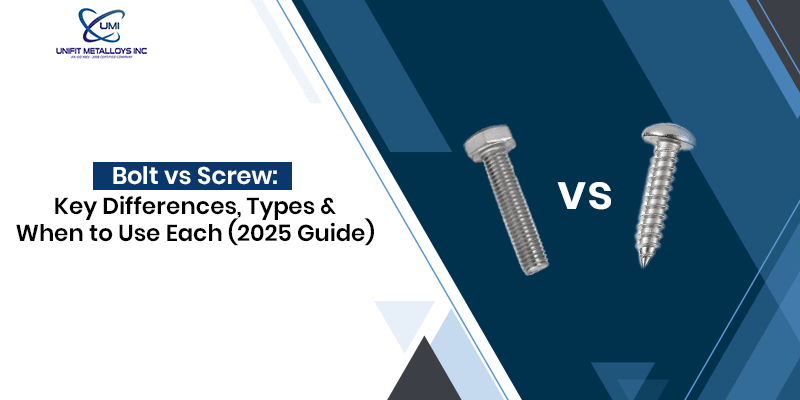
In the world of fasteners, the terms "bolt" and "screw" are often used interchangeably. While they may look similar, a fundamental difference between bolt and screw exists that is critical for engineers, builders, and manufacturers to understand. Using the wrong one can compromise the integrity, safety, and longevity of an assembly.
At Unifit Fastener, we are experts in industrial fasteners. This guide will settle the bolt vs screw debate once and for all. We'll break down their core distinctions, explore the common types of screws and bolts, and explain precisely when to use each for optimal performance.
What is the Core Difference Between Bolt and Screw ?
The primary distinction isn't the shape of the head or the presence of a pointed tip. The difference between bolt and screw lies in how they are installed and how they create clamping force.
- A Bolt is a fastener designed to be inserted through unthreaded holes in two or more components. It is then secured by tightening a nut on the opposite end. The bolt itself doesn't thread into any of the materials it is holding. Its function is to act as a pin, with the clamping force generated by the tension between the bolt head and the nut.
- A Screw is a fastener designed to be installed into a hole in one of the components being joined. This hole may have pre-formed internal threads (like in a metal plate) or the screw may form its own threads as it is driven in (like a wood screw). A screw fastens objects together by mating with the internal threads of the material itself.
Quick Comparison Table of Bolt vs Screw
| Feature | Bolt | Screw |
|---|---|---|
| Installation | Passes through clear holes; secured with a nut. | Threads directly into one of the materials. |
| Clamping Force | Generated by tightening the nut. | Generated by the screw's head against the material. |
| Torque Application | Applied to the nut to tighten. | Applied to the head of the screw to turn it. |
Exploring Common Types of Screws and Bolts
Understanding the main bolt and screw difference is the first step. Next is recognizing the various types available for specific jobs.
A Look at Common Bolt Types
Bolts are typically designed for heavy-duty structural applications where strength is paramount.
- Hex Bolts: The most common type, featuring a six-sided head. They are used in construction, machinery, and automotive applications where they can be easily tightened with a wrench.
- Carriage Bolts: These have a smooth, domed head and a square section underneath. This square neck locks into place when inserted into wood or a square hole, preventing the bolt from turning as the nut is tightened.
- Anchor Bolts: Designed to attach objects to concrete or masonry. They are embedded into the foundation to provide a secure, load-bearing connection.
- U-Bolts: Shaped like the letter "U" with threads on both ends, these are used to secure pipes, conduits, or tubing to a surface.
A Glimpse into Screw Types
Screws are incredibly versatile and come in countless configurations. Here are a few prominent screw bolt types:
- Machine Screws: These have fine, straight threads and a blunt end. They are designed to be fastened into pre-tapped holes in metal or plastic components, commonly found in electronics, engines, and industrial equipment.
- Wood Screws: Characterized by a coarse thread and a tapered, pointed tip. They are designed to displace wood fibers as they are driven in, creating a strong hold.
- Sheet Metal Screws: These feature sharp threads and a sharp point that can penetrate thin metal, plastic, or wood. They are self-tapping, meaning they create their own threads as they are installed.
Application Guide: When to Choose a Bolt vs Screw
Now for the practical part. How do you decide which fastener your project needs?
Choose a Bolt when:
- High Strength is Critical: For joining structural steel beams, engine blocks, or heavy-duty framework, the superior clamping force of a nut and bolt assembly is required.
- Access to Both Sides is Available: Since a bolt requires a nut, you must be able to reach the backside of the assembly to install and tighten it.
- The Assembly Needs to be Disassembled: Using a bolt and nut prevents wear and tear on the components' threaded holes, making it ideal for parts that may be frequently disassembled and reassembled.
- You Are Fastening Through Unthreaded Materials: If the parts you are joining have simple clearance holes, a bolt is the correct choice.
Choose a Screw when:
- You Are Fastening an Object Think of hanging a cabinet on a wall or attaching a cover plate to a machine. The screw threads into the base material.
- One Component Has Internal Threads: If you are working with a part that has pre-tapped holes, a machine screw is the perfect fit.
- Lighter-Duty Applications: For woodworking, drywall installation, or fastening thin sheet metal, screws provide sufficient holding power and are faster to install.
- Access is Limited to One Side: Since screws don't require a nut, they are perfect for blind holes or situations where you cannot reach the back of the material.
Choosing the Right Fastener with Unifit Fastener
While the bolt vs screw question seems complex, it boils down to one key concept: a bolt is paired with a nut, while a screw threads into the workpiece itself. Making the right choice is essential for the safety and reliability of your project.
At Unifit Fastener, we stock an extensive inventory of high-quality bolts, screws, nuts, and other industrial fasteners to meet any specification. If you're unsure which fastener is right for your application, our team of experts is here to help.
Contact us today to discuss your project needs or browse our comprehensive catalog of Metalloy products!
Frequently Asked Questions About Bolt vs Screws
1. What is the main difference between a bolt and a screw?
A bolt is meant to pass through unthreaded material and is secured with a nut, often featuring a partially unthreaded shank for shear strength. A screw either mates with a threaded hole or cuts its own thread and relies on torque at the head.
2. Are bolts stronger than screws?
Generally, yes. Bolts with unthreaded shanks and use of nuts and washers distribute load over a larger area, offering greater shear strength. Screws are typically fully threaded, which provides grip but less shear resistance.
3. Can I replace a screw with a bolt?
Only if both ends are accessible (to fit a nut) and material allows clearance. Otherwise, screws are preferred where you can’t access the back-side. Bolts need pre-drilled clearance holes and room for a nut on the opposite side.
4. Materials best for high-corrosion environments?
Use corrosion‑resistant materials like 316 stainless steel, silicon bronze, titanium, or nickel alloys. Washers and coatings (zinc, nickel, phosphate) also assist in resisting rust and galvanic corrosion.
5. Do screws need washers like bolts?
Washers help distribute load, protect surfaces, reduce friction, and prevent loosening—especially on soft or coated materials. They’re often used with both bolts and screws depending on material hardness and application.