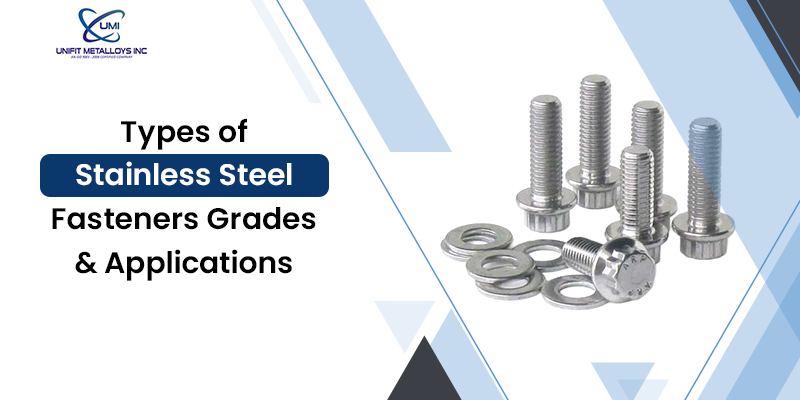
The tiniest of components will be the ones that bear the greatest weight in the industrial assembly and construction. The stainless steel fasteners are little known but they hold our infrastructure together, whether it is towering skyscrapers or elaborate machinery of the sea. We know that at Unifit Fastener, the choice of the fastener does not only pertain to the joining of two materials but also to ensure that the fastener will last, be safe, and perform.
Being the major SS Fasteners Suppliers, we are frequently asked about what grade or type would be used on a given project. This reference will subdivide types of stainless steel fasteners and assist you to locate the most suitable one to use in your application.
Why Choose Stainless Steel?
It is crucial to know what this material is like before plunging into the specifics of types. The difference between stainless steel and normal carbon steel is because of its chromium composing (typically at least 10 percent). This chromium develops an invisible layer of chromium oxide on the surface when subjected to oxygen which is passive.
This layer offers a special repairing ability. In the case that the fastener is scratched or dented, the alloy it is made of reacts with oxygen to create the protective layer once again, stopping rust further set in. This feature makes stainless steel fasteners superior in the projects that require high durability and low maintenance.
Common Stainless Steel Fasteners Types
The generic term fastener is a wide term which refers to a hardware. The most crucial stainless steel fastener types that are used in industries are listed below.
1. Stainless Steel Bolts
The most well known industrial fasteners are bolts that are normally installed with a nut. They are high tensile and heavy-duty assembly.
- Stainless steel hex bolt: This is the standard used in the industry of construction and repair. This has a 6 sided head, which can be easily tightened using a wrench. The stainless steel hex bolt is an industry standard in the motor and machinery industry due to its durable attachment and applicability.
- Carriage Bolts: The bolts have a round head that has been smooth and flat at the bottom part, which fits into the wood or metal to make sure that they are not spinning.
2. Stainless Steel Screws
Screws in contrast to bolts do not necessarily need a nut and depend upon their helical threads to pierce and hold on to the material.
- Self-Tapping Screws: These are designed to self thread when they are driven into material and reduced time is spent on pre-drilling.
- Machine Screws: These are the screws that are standard in thickness and are utilized especially in electronics of precision and metal assembly.
3. Nuts and Washers
These components may be very important in terms of stability, yet they are common.
- Nuts: Nuts are available in the form of hex, wing, and lock that is used to fix the bolt in place.
- Washers: These flat discs spread the load of the threaded fastener eliminating the possibility of damaging the surface and the bolt becoming loose after some time.
Understanding Grades: 304 vs. 316
The selection of the stainless steel grade is just as important as the choice of the type of fastener. Various grades of steel have different grades that have different levels of corrosion resistance, temperature stability, and strength.
Stainless Steel 304/304L Fasteners:
The commonest grades are stainless steel 304/304L fasteners. They have very good corrosion resistance and formability with a chromium content of about 18% and a nickel content of about 8%. These grades are applicable in general outdoor applications, kitchen equipment, and architectural as well as automotive applications. The low-carbon 304L is used in welding.
Stainless Steel 316 / 316L Fasteners:
The Stainless Steel 316/316L fasteners are composed of molybdenum that is very effective in preventing chloride and saltwater corrosion. These grades can be used in marine settings, coastal construction, chemical processing and offshore, where the corrosion risk is extreme.
Stainless Steel 317/317L Fasteners:
Stainless Steel 317/317L fasteners have a better corrosion resistance rating than that of 316 grades because of more molybdenum. They are mostly applied in chemical facilities, the pulp and paper sector and demanding industrial environments.
Stainless Steel 310 / 310S Fasteners:
The stainless steel 310/310S fasteners are used in high-temperature applications. These grades offer good oxidation strengths and high temperatures, which make them usable in furnaces and heat exchangers as well as thermal processing equipment.
Stainless Steel 321 Fasteners:
The stainless steel 321 fasteners are titanium-stabilized with a better intergranular corrosion resistance. They are suitable for high-temperature processes, including welding, like in aerospace and exhausts.
Stainless Steel 347 / 347H Fasteners:
Stainless steel 347/347H fasteners are stabilized using niobium that offers high strength and resistance to corrosion at high temperatures. These grades are normally applied in the pressure vessels, power generation equipment and petrochemical industries.
Key Industrial Applications of Stainless Steel Fasteners
The diversity of Stainless steel types of fasteners makes it possible to use them in various industries:
- Marine and Offshore: Saltwater is known to be disastrous to metals. Ship building, docks, and oil rigs require Grade 316 fasteners to avoid corrosion within the shortest time possible.
- Construction: Starting with the fastening of the steel beams to construct the architectural cladding up to the completion of the work, Stainless Steel Fasteners are essential in the support of buildings and bridges.
- Food Processing and Pharmaceuticals: Hygiene is not a compromise in these industries. Stainless steel is unfriendly to bacteria and it can withstand tough cleaning procedures using harsh chemicals and yet does not deteriorate.
- Auto: Vehicles are subjected to excessive heat and vibration. The fasteners in the exhaust systems and engines should not be prone to thermal expansion as well as rust to maintain the safety of vehicles.
Sourcing Quality Stainless Steel Fasteners
The demand of high quality of hardware globally has made the Stainless steel Fasteners manufacturers in India to be the major players in the international market. Indian manufacturers are also reputed to follow high global standards such as ISO and DIN and offer highly affordable but high quality solutions.
We pride ourselves on being dependable SS fastener suppliers for customers who need durability and reliability in their transactions. No matter your requirements be it a standard stainless steel hex bolt or a custom kind of heavy-duty solution, Unifit Fastener keeps our inventory on hand to address various industrial needs.
The appropriate choice of fastener eliminates structural failure and minimizes the cost of maintenance in the long run. With knowledge of the surroundings and loading needs of your own project, you will select the ideal stainless steel solution that will be targeted by the test of time.