What Makes Inconel 600 Fasteners the Benchmark for Extreme-Service Bolting
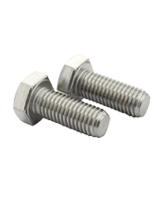
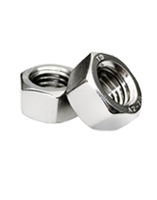
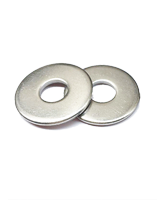
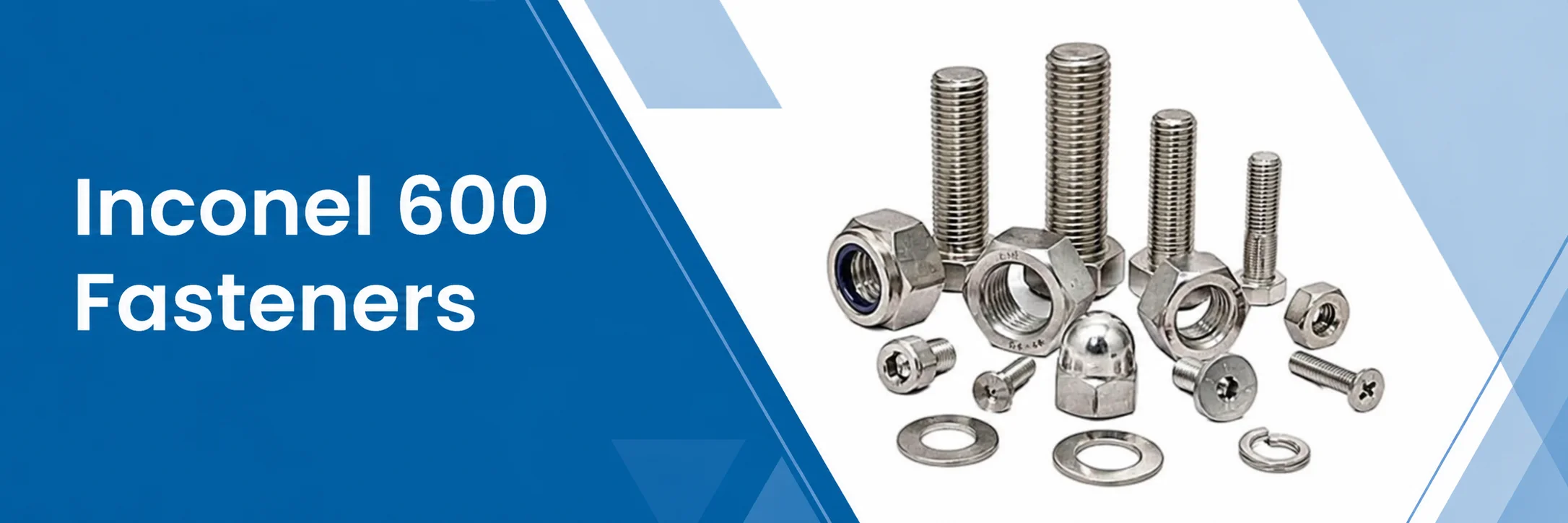
When a bolted joint has to survive glowing furnace hardware one day and cryogenic transfer lines the next, ordinary stainless steel simply gives up. Inconel 600 fasteners — known globally as Alloy 600, UNS N06600 and Werkstoff Nr. 2.4816 — are the answers engineers reach for. This nickel-chromium-iron austenitic alloy holds a minimum of 72% nickel and 14–17% chromium. The chromium forms a self-repairing oxide film that resists oxidation and carburisation in sulphur-free atmospheres, while the nickel content puts the alloy outside the composition band in which chloride stress corrosion cracking occurs. At Unifit Fastener, we manufacture the full bolting family in Alloy 600 — hex bolts, heavy hex nuts, stud bolts, threaded rods, washers, screws and anchor fasteners — from M3 to M100 and 3/16" to 4", to ASTM B166 and ASME SB166 for bar stock, ASTM B564 / ASME SB564 for forged items, and ASTM F467 / F468 for finished nuts and bolts. Every batch is PMI-verified, hardness-tested and released with an EN 10204 3.1 mill test certificate, so your inspection team never has to take our word for it. Whether you are re-bolting a hydrogen reformer, a nuclear steam generator or a food-grade evaporator, you get the right metallurgy, the right thread class and documented traceability — the first time.
What Are Inconel 600 Fasteners?
Inconel 600 fasteners are threaded fastening components machined, forged or cold-headed from a solid-solution-strengthened nickel-chromium-iron alloy. Unlike precipitation-hardened grades such as Inconel 718, Alloy 600 derives its strength from alloying itself rather than heat-treatment ageing, which gives it an unusually wide working window. It is fully ductile at cryogenic temperature and resists scaling in oxidising atmospheres to approximately 2000°F (1093°C). Load-bearing capability is the narrower limit: like every solid-solution nickel alloy, Alloy 600 relaxes under sustained load well below its oxidation ceiling, so bolted joints above roughly 650°C must be designed on creep-rupture and stress-relaxation data rather than on room-temperature yield. Tell us the metal temperature and hold time at enquiry and we will confirm whether the joint needs 600, 601 or a 718 stud.
The Metallurgy in Plain Engineering Terms
- Nickel (72% min) delivers resistance to chloride-ion stress corrosion cracking and to caustic and alkaline media — the single biggest reason Alloy 600 outperforms 300-series stainless steel fasteners in chlorinated process streams.
- Chromium (14–17%) forms the self-repairing passive oxide film that resists sulphur-free oxidising atmospheres and dry high-temperature corrosion.
- Iron (6–10%) balances cost and workability without diluting corrosion performance.
- Non-magnetic austenitic structure makes the alloy suitable for instrumentation, MRI-adjacent hardware and nuclear internals where magnetic permeability is controlled.
Why Engineers Specify Alloy 600 Over Cheaper Alternatives
Specifying Inconel 600 is rarely about raw tensile numbers — a quenched-and-tempered alloy steel bolt is stronger at room temperature. It is about retained strength and joint integrity after thousands of hours at temperature. Carbon and alloy steels scale and lose preload; austenitic stainless steels crack under chloride and caustic attack; Alloy 600 keeps its microstructure stable, keeps its clamp load, and does not embrittle when the plant is shut down and thermally cycled back up.
Commercial Benefits of Buying From Unifit Fastener
- Single-source bolting kits — matched bolts, nuts and washers from the same heat, so you avoid galling caused by mixed-supplier hardness.
- Documented traceability — heat number stamped, EN 10204 3.1 certificate issued, PMI report on request.
- Custom geometry without minimum-order pain — tab washers, ogee washers, 12-point flange bolts and reduced-shank studs made for drawing.
- Coating options in-house — Xylan coated fasteners and PTFE / Teflon coated fasteners for anti-galling and torque control.
- Export-ready packing — VCI wrap, wooden boxes and sea-worthy palletisation as standard for overseas consignments.
Technical Data
Inconel 600 Fasteners — Standard Specification Sheet
Chemical Composition of Inconel 600 Fasteners (UNS N06600)
Composition limits per ASTM B166 / ASME SB166, expressed as weight percentage.
Mechanical & Physical Properties of Inconel 600 Fasteners
*Values are typical for annealed material in fastener sections. Cold-worked and hot-finished conditions vary; certified values for your specific heat appear on the accompanying mill test certificate.*
Equivalent Grades & International Designations
Inconel 600 Bolts & Screws
Inconel 600 Fasteners Price: What Actually Drives Your Quote
Alloy 600 pricing is not a fixed per-kilogram figure, and any supplier quoting one without seeing your drawing is guessing. These are the variables that move a real quotation.
Send us the drawing, quantity, standard and test requirements and you will receive a line-itemised quotation — not a range.
Our Manufacturing & Quality Process
Alloy 600 is unforgiving of shortcuts. Hot-work it outside the correct band and you lose ductility; heat-treat it between 1200°F and 1600°F and you sensitise the grain boundaries. Our process is built around those metallurgical constraints.
Step-by-Step Production Route
- Raw material intake — certified Alloy 600 bar and wire from approved mills, verified against the mill certificate on arrival.
- Incoming PMI and chemistry check — optical emission spectroscopy confirms Ni, Cr and Fe before any material enters production.
- Forming — cold heading for volume sizes; hot forging performed between 1600°F and 2250°F, with the section brought through the carbide-precipitation band quickly rather than held in it.
- Machining and thread production — CNC turning for specials, thread rolling wherever section allows, because rolled threads give superior grain flow and fatigue life over cut threads.
- Solution annealing — restores an austenitic, stress-free structure and dissolves chromium carbides.
- Surface treatment — pickling and passivation as standard; Xylan, PTFE or black oxide where anti-galling or torque control is specified.
- Inspection and testing — dimensional, hardness, tensile and ultrasonic checks against the applicable ASTM/ASME clause.
- Marking, documentation and packing — heat number stamping, EN 10204 3.1 certificate issue, VCI wrapping and export-grade boxing.
Documentation Supplied With Every Order
- EN 10204 3.1 mill test certificate with heat number and full chemistry
- Mechanical property report — tensile, yield, elongation and hardness
- Dimensional inspection report against the applicable ASME/DIN clause
- PMI scan report on request
- Packing list, commercial invoice and country-of-origin certificate for export consignments
- Third-party inspection release note where a TPI agency is nominated
Global Supply Footprint
We supply Inconel 600 fasteners across India — Mumbai, Pune, Ahmedabad, Chennai, Hyderabad, Bangalore, Coimbatore, Jamnagar, Vadodara, Kolkata, Vizag and Pimpri-Chinchwad — and export to the UAE, Saudi Arabia, Qatar, Oman, Kuwait, Singapore, Malaysia, Indonesia, Vietnam, South Korea, Japan, Australia, the United States, Canada, Mexico, Brazil, the United Kingdom, Germany, Netherlands, Italy, Spain, Turkey, Egypt, Nigeria and South Africa.
Packing & Dispatch
- Bulk items in cartons on palletised loads; precision items in small boxes with foam separation
- VCI paper and moisture-barrier wrapping for sea freight
- Fumigated wooden crates conforming to ISPM-15 for export
- Heat number and part identification marked on every package
- Air, sea and courier dispatch with documentation handled end-to-end
Check Our Related Products
What is the maximum temperature for Inconel 600 fasteners?
Inconel 600 fasteners are suitable for continuous service up to approximately 2000°F (1093°C) in oxidising atmospheres. The alloy retains useful mechanical strength and resists scaling across that range, and it also performs down to cryogenic temperatures without a ductile-to-brittle transition.
Is Inconel 600 magnetic?
No. Inconel 600 has a fully austenitic, face-centred cubic structure, which makes it non-magnetic in the annealed condition. This is why it is accepted for instrumentation housings, nuclear internals and other assemblies with magnetic permeability limits.
Can Inconel 600 fasteners be used in seawater?
Yes, and they perform well against chloride stress corrosion cracking. However, in stagnant or crevice-prone seawater service, Inconel 625, super duplex or Monel 400 fasteners usually offer better pitting resistance for the money. We are happy to advise on the trade-off for your specific exposure.
Do Inconel 600 fasteners come with a mill test certificate?
Yes. Every consignment ships with an EN 10204 3.1 mill test certificate carrying the heat number, chemical analysis and mechanical test results. PED 97/23/EC and AD 2000 W2 documentation, PMI reports and third-party inspection releases are available on request.
What sizes of Inconel 600 fasteners do you manufacture?
Bolts and screws from M3 to M100 (3/16" to 4"), nuts and washers from M3 to M56 (3/16" to 2"), and lengths from 3 mm to 200 mm as standard. Larger diameters and non-standard lengths are produced to drawing.
Get Your Inconel 600 Fastener Quote in One Working Day
Send us your drawing, standard and quantity — our engineering team will confirm grade suitability, thread class and lead time before quoting. No obligation, no generic price lists, no guesswork.
Speak to a Materials Engineer — call or WhatsApp us today.
Not sure which grade you need? Compare Inconel 601, 625 and 718, or contact our team for a recommendation.
Request a Free Quote →