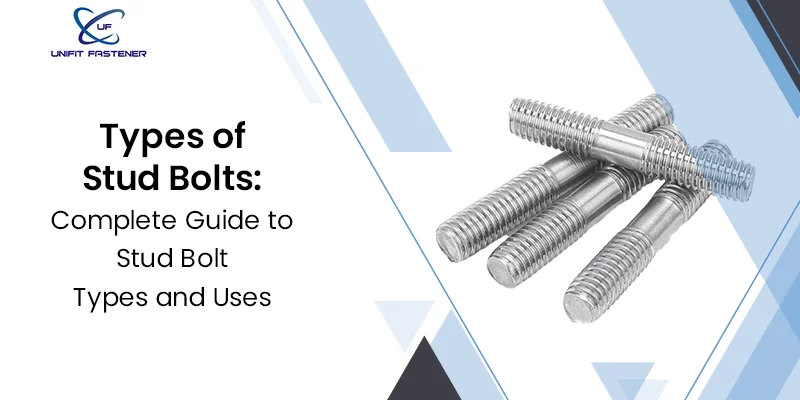
Stud bolts are commonly used to join pieces of pipe, or to secure components in industrial equipment and structure, and are headless with threads on both ends or throughout the length. They are superior to regular bolts on several points such as load distribution, maintenance, and performance in high-temperature and high-pressure areas. It is important to be aware of the various types of stud bolts in order to choose the appropriate fastener for the application. Some of the most common types of stud bolts are the double end stud bolt, the tap end stud bolt, and the fully threaded stud bolt, which serve different purposes depending on the specific installation needs. The precision engineered stud bolts produced at Finned Tubes are built to the highest of industrial requirements and expectations.
What Is a Stud Bolt?
A stud bolt is a type of threaded fastener with no head that is used to secure and reliable in industrial assemblies. Unlike normal bolts, a stud always has one or two nuts on the ends and can be attached or detached with greater ease. The stud bolts are very important to ensure the integrity of the connections in the flange, pressure vessel, pumps, valves, and other equipment that demands quality joint integrity. The studs are used to generate the clamping force due to the tightening of the nut to ensure that the components are held tightly. This helps in generating an even load distribution. They do not require any special attention and are well suited for applications where connected equipment is to be frequently inspected, disassembled or replaced.
Understanding Different Types of Stud Bolts
The stud bolts are manufactured in many different types according to the industrial requirements and all the common types of stud bolts are listed below.
Fully Threaded Stud Bolt
A fully threaded stud bolt means that there are threads throughout the entire length of the stud bolt, which makes this type of stud bolt have the highest amount of thread engagement. This is the most popular type of stud bolt, and it is characterized by a number of advantages compared to the other types of stud bolts, namely the even distribution of the load, simplicity of installation, and adjustability during the assembly process. Such characteristics make this type of stud bolt perfect for applications requiring a durable and reliable connection. Full threading stud bolts are used in numerous applications, such as pipe flanges, pressure vessels, heat exchangers, boilers, and structural connections.
Tap End Stud Bolt
A tap end stud bolt is a bolt with a tapped end at both ends, one of which is a shorter threaded end that fits into a tapped end and the other being a longer threaded end that is compatible with a nut. Secure mounting, efficient space utilisation and reliable fastening in blind hole applications is the benefits of this design. One of the most popular kinds of bolts is used for frequently maintained equipment. Typical tap end stud bolt uses are for pumps, compressors, turbines, engine blocks, and equipment mounting systems.
Double End Stud Bolt
Double end stud bolt is a stud bolt having an unthreaded center and two equal lengths of threads on each end. This design will maintain alignment, add strength, and provide precise positioning for other parts to be connected to. It is one of the most common types of stud bolt and is used in a variety of applications where accurate assembly is essential. The typical applications used for standard double end stud bolts are in structural connections, heavy duty machinery, automotive engines, mounting brackets, pumps, and industrial machinery that demands sturdy fastening.
Continuous Thread Stud Bolt
A continuous thread stud bolt is a bolt with the thread running along the entire length of the bolt and is used to position nuts and components flexibly. It provides benefits like adjustability, easy installation, and economical fasten. This type of stud bolt is generally used for low pressure and light duty applications. Common applications of stud bolts involve furniture joints, cabinet fittings, support structures and general fastening systems where adaptability and ease of replacement is essential.
Reduced Shank Stud Bolt
A reduced shank stud bolt has a smaller diameter in between the threaded ends. This is a low weight, flexible, and stress free operating design. It also provides for thermal expansion and can help to prevent fatigue failure in dynamic systems. These stud bolt types are typically employed in challenging environments with vibration and cyclic loading. Common applications of stud bolts are in aircraft engines, marine turbines, power generation plants, and heavy machinery under variable loading conditions.
Flange Stud Bolt
A flange stud bolt is a stud bolt that is primarily used to attach flanges to piping systems and pressure-containing equipment. It offers high clamping strength, superior sealing characteristics and is highly pressure and temperature resistant. It is one of the more important types of stud bolts, and is often used with nuts and gaskets to produce leak-free connections. Typical applications of common stud bolts are in oil and gas pipelines, petrochemical plants, chemical processing plants, offshore platforms and water treatment plants.
Shoulder Stud Bolt
A stud bolt with shoulder is a stud bolt with an unthreaded shoulder section that serves as stop and positioning during installation. This design guarantees accurate alignment, depth of insertion and assembly accuracy. They are used when it is important to position the components, and are preferred for these specialized stud bolt types. The most common applications for common stud bolts are in the transmission, valve bodies, gearbox housings, high precision industrial equipment that must be securely and accurately mounted, and engine applications that need repeating accurate assembly.
Welded Stud Bolt
A welded stud bolt is a piece of metal which has one end welded to a surface and the other end is threaded for a nut. This arrangement offers good adhesion, avoids holes through parts and makes installation easy in confined spaces. It is a popular choice for the industrial stud bolt types and is used in permanent holes. Common applications for stud bolts include shipbuilding, heavy steel structures, pipe support, mounting panels, and projects that require strong connections.
Double-End Stud Bolt with Unequal Thread Lengths
Double end stud bolt with unequal length threads has different thread size on each end due to the different assembly requirements. This design provides flexibility in installation, better load management and allows for use with different component thicknesses. These are the special kind of stud bolt that are usually employed in equipment that is extremely complicated in which standard studs may not be able to be used. Heavy duty engines, special flange connections, industrial machinery, and customized engineering systems are all typical uses of double end stud bolts.
Partial Thread Stud Bolt
Partially threaded is a thread stud bolt with threaded sections on both ends and plain shank in between. The unthreaded segment ensures more even wear and tear and greater shear strength and durability. It is a type of stud bolt that is commonly used in applications where the bolt is subjected to significant mechanical loads. Common applications for stud bolts include machine joints, mechanical couplings, rotation applications, structural connections and assemblies that need strength and long term reliability.
Materials Used for Manufacturing Stud Bolts
A stud bolt's material dictates strength, durability, and temperature, pressure and corrosion resistance. The selection of material is crucial for getting good performance in various industrial applications.
Carbon Steel Stud Bolts
The Carbon steel stud bolts are very strong and cost effective, thus it is suitable for all types of general industrial, construction and piping applications. These are among the most popular types of stud bolts.
Alloy Steel Stud Bolts
Alloy steel stud bolts offer improved strength, toughness and high temperature resistance. They are very common in pressure vessel applications, power plant and refinery applications.
Stainless Steel Stud Bolts
The stainless steel stud bolts are highly corrosion resistant and durable. They are generally used in the marine industry, chemical processing and offshore industries.
Duplex and Super Duplex Stud Bolts
Duplex and Super Duplex stud bolts have high strength and excellent corrosion resistance. They can be used in offshore, desalination and chemical processing industries.
Nickel Alloy Stud Bolts
Nickel alloy stud bolts are suitable for use in extreme and highly corrosive conditions. They are often found in the industrial sectors of petrochemical, aerospace and power generation.
Applications and Industrial Uses of Stud Bolts
Stud bolts find extensive application in industrial areas where high strength and reliability of the fastening process is essential. Stud bolts are able to stand up to high pressure, temperature, and vibrations.
- Oil and Gas Industry
- Petrochemical Plants
- Power Generation
- Chemical Processing
- Marine Applications
- Heat Exchangers and Boilers
- Construction and Infrastructure
- Heavy Engineering Equipment
Conclusion:
Understanding the different types of stud bolts is essential for selecting the right fastening solution for industrial applications. Various types of stud bolts are available, each with a distinct purpose in mind during application and use, including the fully threaded stud bolt, double end stud bolt, and tap end stud bolt. The operating temperature, pressure, corrosion resistance, material compatibility, thread configuration and industry standards are always to be considered when selecting a stud bolt. Choosing the right stud bolt can enhance the safety, reliability, and performance of equipment. Finned Tubes produces premium quality stud bolts to international standards for assured performance in oil and gas, petrochemical, power generation, construction and other challenging industrial applications.
Frequently Asked Questions
The main types of stud bolts include fully threaded stud bolts, double end stud bolts, tap end stud bolts, reduced shank stud bolts, and welded stud bolts.
A double end stud bolt is used in machinery, pumps, engines, and structural assemblies where precise alignment and secure fastening are required.
A tap end stud bolt has unequal thread lengths and is installed into a tapped hole, while a double end stud bolt has equal thread lengths on both ends with an unthreaded center section.
A fully threaded stud bolt has threads along its entire length, providing maximum thread engagement and installation flexibility.
Stud bolts are widely used in the oil and gas, petrochemical, power generation, chemical processing, marine, construction, and heavy engineering industries.
Yes, stud bolts often provide better load distribution and clamping force, making them suitable for high-pressure and high-temperature applications.
Stud bolts are commonly manufactured from carbon steel, alloy steel, stainless steel, duplex and super duplex stainless steel, and nickel alloys.