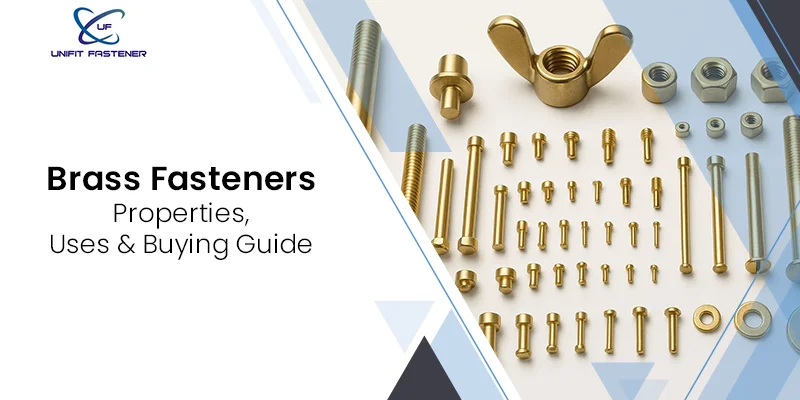
Brass fasteners come in different forms and types; some of the popular ones are screws, bolts, nuts, washers, and other materials. They are all made up of a copper-zinc alloy and contain 58 to 63 percent copper and zinc, and a small amount of lead increases the machinability of the fasteners. It’s commonly chosen for corrosion resistance, non-magnetic behaviour, electrical conductivity and a distinctive golden finish rather than for raw mechanical strength. This guide covers the properties that make brass a good or poor fit for a given joint, the common fastener-grade alloys and the standards behind them, a direct comparison against stainless steel and carbon steel, and the buying criteria that actually decide whether brass is the right material for your application, including two risks, dezincification and galvanic corrosion, that get little practical coverage anywhere else.
What are Brass Fasteners?
Brass fasteners are made of brass and they come in different forms such as screws, bolts, nuts, and other fasteners that have an important composition of copper-zinc alloy. The percentage of copper in brass fastener material is about 58% to 63%, while most of the remaining part is zinc. This composition provides a proper compromise of strength, machinability, corrosion resistance, and low price. An additional small percentage of some other materials, for instance, lead, can be included to improve the machinability of brass fasteners. These types of fasteners are preferred when the mentioned properties outweigh the greater strength of steel fasteners. They differ from the common bronze fasteners (the copper-tin alloys) and copper fasteners that are softer but are excellent conductors of electricity and heat.
Types of Brass Fasteners
The brass fasteners come in different forms and some of the most common ones are listed below.
Brass Machine Screws
Machine screws can be pan head, flat head, round head and cheese head in both metric and imperial size. They are usually utilized in electrical terminals, panel assemblies, instrumentation and light duty fastening applications requiring corrosion resistance and non-magnetic properties.
Brass Bolts
Mechanical and structural connections (where appropriate for corrosion resistance and conductivity) utilize brass in the form of hex bolts, carriage bolts, and flange bolts. Typical uses include marine hardware, outdoor assemblies and electrical connections.
Brass Nuts
Securely fastens compatible Brass bolts and screws for Hex nuts, lock nuts, wing nuts and coupling nuts. They are chosen for corrosion resistance, conductivity and non-magnetic properties for applications.
Brass Washers
Flat, spring and lock washers distribute the load of fastenings and ensure the secure connection. They are of particular use in applications involving grounding or electricity transmission where both corrosion resistance and electrical conductivity are needed.
Brass Anchors
Drop-in and expansion anchors are used to secure concrete and masonry. The corrosion resistance of Brass makes it suitable for pools, fountains and coastal installations.
Brass Threaded Rod and Studs
Brass threaded rods and studs are used for corrosion-resistant, though-bolting applications that need an adjustable fit. Common uses are electrical equipment, switchgear, transformer assemblies, and marine applications.
Brass Alloy Grades for Fasteners
The table below covers the fastener-grade brasses most commonly specified, with composition ranges independently verified against standard alloy references rather than taken from any single supplier's published figures.
|
Material Grade |
Chemical Composition |
Key Properties |
Typical Applications |
|
CW614N / CZ121 |
Cu 57–59%, Pb 2.5–3.5%, Zn balance |
Excellent machinability, moderate strength |
General-purpose screws, bolts, and nuts (most common fastener brass) |
|
CW602N / CZ132 (DZR) |
Cu 61–63%, Pb 1.6–2.5%, small arsenic addition, Zn balance |
Resists dezincification in aggressive water |
Plumbing and potable water fittings, coastal and marine hardware |
|
C36000 |
Cu 60–63%, Pb 2.5–3.7%, Zn balance |
US equivalent to CW614N, free-cutting |
Screw-machine parts, general fasteners (US-spec projects) |
|
CW510L (Lead-Free) |
Cu 58–64%, Pb < 0.1%, Zn balance, silicon or bismuth addition |
RoHS and potable-water compliant |
Food-contact and drinking-water fittings, RoHS-restricted markets |
|
C27450 (Lead-Free) |
Cu 63–67%, Pb < 0.25%, Zn balance, bismuth or selenium addition |
Low-lead, NSF/ANSI 61 style compliance |
US potable-water fittings under lead-reduction legislation |
Brass Fasteners Standards and Specifications
Brass fastener types are covered by the same DIN and ISO dimensional standards used across steel and stainless fasteners, with ASTM standards covering the raw brass rod and bar stock itself.
|
Standard / Specification |
Description & Scope |
|
DIN 84 |
Slotted cheese head screws |
|
DIN 931 / DIN 933 |
Hex bolts — partial thread (DIN 931) and full thread (DIN 933) |
|
DIN 934 |
Hex nuts |
|
DIN 125 |
Flat washers |
|
ISO 4032 |
Metric hex nuts (dimensionally aligned with DIN 934) |
|
ASTM B16 |
Free-cutting brass rod, bar, and shapes — the base material standard for machined brass fasteners |
|
ASTM B455 |
Copper-zinc-lead alloy rod and bar used in extruded brass fittings and hardware |
For the full standards library referenced across Unifit's fastener range, including DIN, ISO and ASTM equivalents beyond brass-specific items, see ourDIN fastener standards page and ourfastener standards guide.
How to Choose the Right Brass Fastener
Environment and Corrosion Exposure
Consider the application for the fastener. Depending on the type of water service, marine environments, or aggressive chemicals, different grades of brass from CW614N to DZR brass can be required.
Electrical or Magnetic Requirements
When electrical conductivity or non-magnetic properties are required, or where the connection is nearby sensitive instrumentation, brass is a suitable material to use. These properties may cause it to be a favorite choice over carbon steel or other materials.
Mechanical Load
Tensile strength of brass lies within the range of 340 MPa to 500 MPa, which is lower than certain types of structural steels. In cases where the loading on the structural joint is very high, use of other materials like stainless steel or carbon steel may be preferable.
Budget
Brass tends to be more expensive than carbon steel, due to the copper content, and may be more or less expensive than stainless steel depending on the market value of the metals.
Standard and Mating Compatibility
Ensure that the fastener is selected according to the appropriate DIN, ISO or ASTM standards and has the correct thread and dimensions for the complementary part. There should also be a check of the materials for the possibility of galvanic corrosion in both parts.
Lead-Free or RoHS Requirements
Conventional leaded brass may not be used for applications related to potable water, food contact, or EU RoHS.
Application and Industrial Uses of Brass Fasteners
Electrical
Brass fasteners are mostly used for terminal screws, grounding bolts and panel mounting hardware that require electrical conductivity and non-magnetic characteristics.
Marine
Brass has satisfactory corrosion resistance for marine hardware, e.g., deck hardware, hull fittings, and dock cleats. The fasteners exposed to the sea water for a long time are generally made of DZR brass.
Architecture
It is not uncommon to see brass used for its warm golden appearance on brass screws, hinge pins, door hardware and furniture hardware. They are good if the fastener is exposed and integral in the design.
Plumbing and HVAC
Valve bonnet bolts, flange connections, and pipe clamp hardware are all examples of hardware that can use brass fasteners. Suitable grades of DZR or lead free brass may be needed for potable water systems.
Oil & Gas and Non-Sparking Environments
In some non-sparking applications where there is a need to minimise the risk of ignition, brass fasteners can be chosen. But, the type of fastener and installation should conform to the requirements of the hazardous area and project.
Frequently Asked Questions
No. Brass typically has lower tensile strength than steel and is mainly chosen for corrosion resistance, conductivity, and non-magnetic properties.
Yes. Brass performs well outdoors, while DZR brass is preferred for prolonged marine or saltwater exposure.
Standard leaded brass may not be suitable. Lead-free grades such as CW510L and C27450 are used for drinking-water and food-contact applications.
Brass is generally suitable for continuous service up to around 200°C. Higher temperatures can reduce its mechanical strength.
Dezincification removes zinc from brass in aggressive water, weakening the material. DZR brass is preferred for chloride-rich, warm, or aggressive water conditions.
Yes, but moisture can cause galvanic corrosion. Using an insulating washer or coating can help reduce this risk.
Not as a stocked product line. Unifit currently offers Brass Tube Plugs and brass-plated finishes on selected steel bolts.
Related Pages:
- Brass Tube Plugs
- Grade 8.8 Bolts (brass-plated finish available)
- Stainless steel fasteners
- Copper nickel fasteners
- DIN fastener standards ·
- Fastener standards guide
- Fastener coatings: types and standards
- Types of fasteners explained
- Fasteners Manufacturer hub
Need a technical quote? Send your grade, standard, size, quantity, drawing (if custom) and destination.
Request a Quote