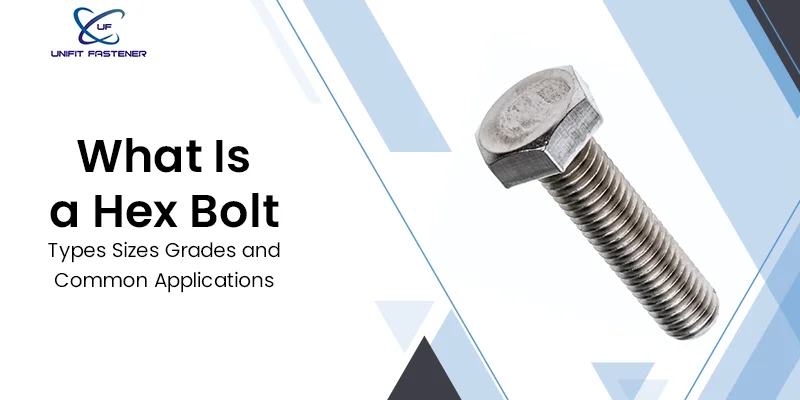
The hex bolt happens to be the most commonly used fastener in industrial and structural applications, and yet most customers only realize it when it's almost too late, after having ordered the wrong size or grade of hex bolt. The hex bolt is simply a externally threaded fastener that has a hexagonal (six sided) head and that can be loosened and tightened by means of a wrench or socket. This hexagonal head is not only an aesthetic feature of the fastener, but its ability to provide the tool with six points of grip is precisely what makes hex bolts the preferred fastener in a wide range of applications, from structural steel connections to flange joints on piping systems.
What Is a Hex Bolt?
Hex bolts, hex head bolts and hexagon bolts are synonymous. This type of bolt is comprised of three basic components: the hex head, shank (entirely or partially threaded) and the thread itself, which engages with the nut or tapped hole and creates clamping force between two or more pieces. The hexagonal shape of the head, rather than round or square, makes assembly quick and simple, and allows it to be tightened with a wrench or a socket from any of the six faces, permitting the tighten to be made with great torque. The hex bolts can be designed to be fastened with a corresponding nut, or some hex bolts can be screwed in directly in the tapped hole. Both functions are identical to attach two surfaces together by a strong clamping force.
Hex Bolt vs Hex Cap Screw vs Machine Bolt
A hex bolt is tightened by turning a nut onto its threaded shank, while a hex cap screw is tightened by turning the head itself into a tapped hole, with no nut involved. That distinction, how the fastener is actually tightened, is the cleanest way to tell the two apart.
Hex cap screws typically feature a washer face under the head and a chamfered point to help start the thread cleanly into a tapped hole, features a standard hex bolt usually does not have. A machine bolt, meanwhile, generally refers to a hex bolt made to coarser dimensional tolerances for general-purpose structural or machinery use, rather than the tighter tolerances of a precision cap screw. In practice, many suppliers and buyers use "hex bolt" and "hex cap screw" loosely, so always confirm the exact standard (see the standards section below) if the distinction matters for your application.
Different Types of Hex Bolts
By Threading
The fully threaded hex bolts have threads on the entire length of the shank from just below the head all the way to the end point.
In case of partially threaded hex bolts, there is an unthreaded section of the shank that lies below the head. This smooth section, known as the grip length or the shank length, is placed in the shear plane in many of the engineering applications. Since the unthreaded steel has more shear resistance than the threaded steel, partially threaded bolts are stronger in shear load-bearing applications.
By Material
Carbon steel is the default, general-purpose choice: cost-effective and strong enough for the large majority of structural and machinery applications where corrosion resistance is not the primary concern.
Stainless steel, across grades like 304/304L, 316/316L, 321, 347, and 310/310S, trades some raw strength for corrosion resistance, and is the standard choice anywhere moisture, chemicals, or marine exposure would attack carbon steel. Our stainless steel fasteners range covers all of these grades, and if you are weighing 316 against the more common 304, our guide to 316 vs 304 stainless steel fasteners breaks down exactly when the extra cost of 316 is worth it.
Duplex and super duplex steel combine high mechanical strength with corrosion resistance well beyond standard stainless grades, making them a common specification in oil and gas and marine environments where chloride stress cracking is a real risk. Our duplex steel fasteners are built for exactly that kind of service.
Nickel alloys, including Monel 400/K500, Inconel 600/601/625/718/X-750, and Hastelloy B2/C22/C276, are specified where temperature and chemical exposure exceed what stainless steel can handle. Our nickel alloy fasteners and Inconel 625 fasteners are both regularly specified for high-temperature and highly corrosive process environments.
Titanium, typically Grade 2 or Grade 5, offers an exceptional strength-to-weight ratio along with excellent corrosion resistance, and is the material of choice wherever weight matters as much as strength, such as aerospace and marine applications. Explore our titanium fasteners range for both grades.
By Standard
DIN 931 and DIN 933 are two of the more popular metric hex bolt standards, and the difference between the two relates to the type of threads on the bolt – DIN 931 is for partially threaded hex bolts and DIN 933 is for fully threaded hex bolts of the same nominal size. Shop all types of DIN fasteners for both.
The two standard families, ISO 4014 and ISO 4017, are the international metric equivalents of DIN 931 and 933 respectively and in practice the two families are dimensionally very close.
Bolting for high temperature use is governed by ASTM A193, and for low temperature use, ASTM A320 are commonly used and specified and applicable to oil and gas, petrochemical and power piping. These are not simply threading standards; we discuss how to select which standards to use in the section on grades below.
Hex Bolt Sizes
Metric hex bolts are sized by their M-designation, where the number after the M indicates the nominal shank diameter in millimetres. A buyer needs to specify three things to fully describe a hex bolt's size: the nominal diameter (for example M16), the thread pitch (the distance between adjacent threads, usually expressed in millimetres per thread), and the length, measured from under the head to the tip for a fully threaded bolt.
|
Size (M) |
Thread Pitch (mm) |
Width Across Flats (mm) |
Typical Length Range (mm) |
|
M6 |
1.00 |
10 |
20 to 80 |
|
M8 |
1.25 |
13 |
20 to 100 |
|
M10 |
1.50 |
16 |
25 to 120 |
|
M12 |
1.75 |
18 |
30 to 150 |
|
M14 |
2.00 |
21 |
35 to 160 |
|
M16 |
2.00 |
24 |
40 to 200 |
|
M18 |
2.50 |
27 |
45 to 200 |
|
M20 |
2.50 |
30 |
50 to 250 |
|
M22 |
2.50 |
34 |
60 to 250 |
|
M24 |
3.00 |
36 |
60 to 300 |
The width across flats, the distance between two opposite flat sides of the hex head, is what determines the wrench or socket size you need, so it is worth confirming alongside diameter and length when you place an order. For a full breakdown across every standard we manufacture to, see our fastener dimension standards and our bolt weight chart for take-off and shipping planning.
Hex Bolt Grades & Strength Classes
A hex bolt's grade tells you how much load it can carry before it yields or fails, and getting this wrong is one of the most common, and most dangerous, specification mistakes in bolted assemblies.
|
Metric Class |
Tensile Strength (MPa, min) |
Yield Strength (MPa, approx.) |
|
4.6 |
400 |
240 |
|
8.8 |
800 |
640 |
|
10.9 |
1,040 |
940 |
|
12.9 |
1,220 |
1,100 |
The metric class marking is read directly: the first number is roughly one-tenth of the minimum tensile strength in MPa (8.8 means approximately 800 MPa), and the second number is the ratio of yield strength to tensile strength (8 means roughly 80%). For side-by-side selection guidance across all three common grades, see our Grade 8.8 vs 10.9 vs 12.9 bolts comparison, along with our dedicated Grade 8.8 bolts, Grade 10.9 bolt, and Grade 12.9 bolt pages.
Coatings and Finishes
Zinc plated, also called bright zinc-plated, is a thin electroplated coating that gives general-purpose corrosion protection, suitable for indoor or mild environments.
Hot-dip galvanized coatings are considerably thicker than electroplated zinc and are the standard choice for outdoor and structural applications where long-term weather exposure is expected.
Black oxide provides only mild corrosion protection but gives a low-glare, matte black finish, often chosen as much for appearance as for protection.
See our Xylan coated fasteners and PTFE/Teflon coated fasteners for details. FE and Xylan coatings add chemical resistance and reduce friction and galling, which matters particularly for stainless fasteners that are otherwise prone to thread seizing during installation. See our Xylan coated fasteners for details.
Common Applications of Hex Bolts
Construction and structural steel: hex bolts hold together beams, columns, and bridge components, where consistent, verifiable strength grades like 8.8 and 10.9 are essential.
Oil and gas, petrochemical, and piping: flange and equipment assembly in these industries routinely calls for ASTM A193 grades like B7, matched with high-temperature or corrosion-resistant alloys depending on the service media.
Power and renewable energy: solar mounting structures and wind turbine assemblies both depend on hex bolts rated for sustained outdoor exposure and, in the case of turbines, significant cyclic vibration load.
Machinery and industrial equipment: hex bolts assemble everything from conveyor frames to pump housings, generally specified by the manufacturer's own torque and grade requirements.
Automotive and general engineering: from chassis assembly to general fabrication work, hex bolts remain the default fastener wherever a reusable, serviceable joint is needed.
How to Choose the Right Hex Bolt
Work through these questions in order, and you will land on the correct specification every time:
- What diameter and length does the joint require?
- What base material fits the environment (carbon steel, stainless, duplex, nickel alloy, or titanium)?
- What grade or strength class does the load calculation call for?
- Which standard governs the application (DIN, ISO, or ASTM)?
- What coating or finish suits the exposure conditions?
- What is the operating temperature and corrosion exposure of the final installation?
If any of these questions are hard to answer with confidence, get in touch with our team, Unifit Fastener's engineers can help you specify and source the exact grade and material your project needs.
Conclusion
A correctly specified hex bolt comes down to five decisions: the right size, the right base material, the right strength grade, the right governing standard, and the right finish for the service environment. Get those five right, and a hex bolt will do its job reliably for the life of the assembly. Explore our range of fasteners or get in touch with our team at Unifit Fastener to specify and source the right hex bolts for your next project.
Frequently Asked Questions
A hex bolt is tightened by turning a nut onto its shank, while a hex screw (or hex cap screw) is tightened by turning the head itself into a tapped hole, with no nut required.
Not always, but a washer is commonly used to spread clamping load over a wider surface, protect the base material from damage, and reduce the risk of the nut or bolt head loosening under vibration.
For high temperature, ASTM A193 Grade B7 or B16 alloy steel is common; for high corrosion, stainless grades like B8/B8M, or nickel alloys such as Monel or Inconel, are typically specified depending on the exact chemical exposure.
DIN 931 covers partially threaded hex bolts, with an unthreaded grip section under the head, while DIN 933 covers fully threaded hex bolts of the same nominal size.
Standard hex bolts can generally be reused if they show no visible damage, thread wear, or corrosion, though high-strength structural bolts subjected to full pretension are often specified as single-use per project engineering requirements.