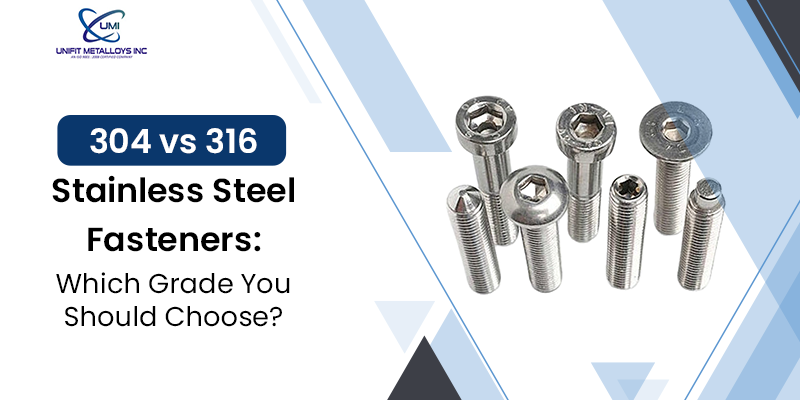
The choice of the hardware to use in your project goes beyond the size and the number of threads. The grade of the material determines durability, security and cost. The discussion in the Stainless Steel Fasteners usually boils down to two products that have become very popular; the 304 and the tough 316.
In Unifit Fastener we are aware that sometimes it is confusing to choose between these two grades. This guide will put the chemical and practical distinctions in bits to enable you to choose the most appropriate one to your particular use.
Understanding the Basics about Stainless Steel 304 Fasteners and Stainless Steel 316 Fasteners
The 304 and 316 are austenitic steels. This implies that they possess a face centred cubic crystal structure and this gives them high toughness (even when frozen) and non-magnetic when annealed. Nevertheless, they differ in their inner chemistry..
The Standard Choice: 304 Stainless Steel Fasteners
The austenitic stainless steel that is most commonly used in the world is Grade 304. It is commonly called 18-8 stainless because it contains a combination of about 18 percent chromium and 8 percent nickel which provides a good balance between strength and corrosion resistance.
Why Choose stainless Steel 304 Fasteners?
Here are the reasons to choose stainless Steel 304 Fasteners:
- Cost-Effectiveness: Stainless Steel 304 Fasteners are cheaper than 316 ones, since they do not contain molybdenum.
- Availability:304 Stainless Steel Fasteners are highly demanded so that they can be easily found in practically any shape, size, and configuration imaginable.
- Formability: This grade is very good in stamping and forming which makes it easier to produce intricate fasteners shapes.
- Best Uses: Stainless Steel 304 Fasteners will be found in household appliances, interior architectural trims, auto molding and kitchen equipment. They are very good in a place where salt or high concentration of chloride is limited.
Variants of Stainless Steel 304 Fasteners to Know:
Here are the available variants of Steel 304 Fasteners:
- Stainless Steel 304L Fasteners : The L is Low Carbon. It is the preferred variant where heavy gauge components are to be welded because it reduces the occurrence of carbide.
- Stainless Steel 304H Fasteners: The "H" is used to mean the High Carbon which is stronger in higher temperatures and usually applied in industrial heating systems.
The Marine Grade: Stainless Steel 316 Fasteners
The Stainless Steel 316 Fasteners is better where the environment becomes tough. The only difference here is that Molybdenum (typically 2-3%), is added. This one factor alone severely alters the capacity of the alloy to resist corrosion, especially that of a pitting type due to chlorides.
Why Upgrade to Stainless Steel 316 Fasteners?
Here are the reasons why Stainless Steel 316 Fasteners can be a better choice:
- Exemplary Corrosion Resistance: The molybdenum used in the alloy permits Stainless Steel 316 Fasteners to fight off assaults by saltwater, brine-solutions, and most chemical acids that promptly destroy 304.
- Chemical Durability: It is less susceptible to sulfuric acid, fatty acids and acetic acid compared to the 304 grade.
- Ideal Applications: Stainless Steel 316 Fasteners are recommended in general when dealing with marine environments, boat fittings, chemical processing equipment, and outdoor installations at the coastal regions. They are also commonly employed in the medical implants and pharmaceutical manufacturing due to the high resistance to contamination.
Variants of Stainless Steel 316 Fasteners to Know:
- Stainless Steel 316L Fasteners: Just like the 304L, this is low-carbon that is not susceptible to sensitization (carbide precipitation along the grain). It is widely applied in heavy gauge welded-parts.
- Stainless Steel 316H Fasteners: They employ the use of more carbon to resist excessive temperatures (greater than 500degC). This increases creep rupture strength and thus they are important to pressure vessels and boilers where structural integrity in the presence of heat cannot be compromised.
Comparison Breakdown: Stainless Steel 304 Fasteners vs Stainless Steel 316 Fasteners
- Corrosion Resistance:Stainless Steel Fasteners of grade 304 can withstand rain and atmospheric oxidation, but cannot withstand chlorides. When you and your friends put 304 bolts close to the ocean, you could find that tea stains or rust spots form very fast. Grade 316 can endure this form of oxidation, and therefore retains its integrity in salty air or water.
- Cost Implications: Stainless Steel 316 Fasteners are more expensive- Molybdenum and an increased nickel content increase the cost of Stainless Steel 316 Fasteners by 20 to 30 percent over 304. Nevertheless, in critical applications, the initial cost is less than the cost of replacement in the long run of corroded 304 bolts.
- Temperature Tolerance: Both grades work well within high temperatures, however, Stainless steel 304 fasteners tend to resist the oxidation at 870degC (1598degF) in intermittent service. Grade 316 is also heat resistant but it is also stronger at high temperatures than 304.
Making the Right Choice between Stainless Steel Fasteners
The decision ultimately relies on your environment.
- Choose Stainless Steel 304 Fasteners when your application is indoors or when it is out of the sea and distant. It is a rational decision in furniture, general construction and dry manufacturing facilities where costly is a key consideration.
- Choose Stainless Steel 316 Fasteners when your fasteners will be subjected to salt water, de-icing salts or other harsh industrial chemicals. The cost of Stainless Steel 316L Fasteners or the normal 316 is compensated in terms of avoiding structural failure and retaining the aesthetics with time.
The Bottom Line
Whether you need the 304 Stainless Steel Fasteners with the general purpose reliability or you need the Stainless Steel 316 Fasteners with the high level of protection, it is crucial to contend that the success of your assembly depends on your choice of grades.
In Unifit Fastener, we are dealers of high quality fasteners depending on your industrial requirement. Determine your exposure to the environment, establish your budget, and select the grade which will give your desired project longevity.