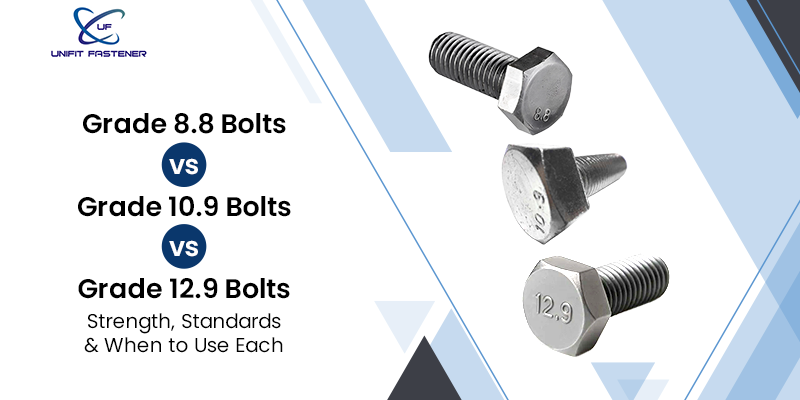
The improper choice of the bolt grade is among the most frequent reasons for joint failure in the structural and mechanical assemblies. Get the specification wrong, and the bolt creeps or even fractures under stress; get the specification too high and you stand the danger of hydrogen embrittlement in the coating in the run-up to the coating, inflated procurement and re-calculation of the torque at assembly. Be it a sourcing of high tensile fasteners in an auto subframe, steel structure or precision machine, the knowledge about the difference between Grade 8.8, Grade 10.9 and Grade 12.9 bolts is a standard requirement.
The guide will include the details of each grade, such as how to read the marking system, bolt torque specifications reference table, the DIN vs ISO standards comparison, and how frequently asked questions by engineers. To see size availability and technical specifications, see Unifit's high tensile fastener range.
How Bolt Grades Work: ISO 898-1
The ISO 898-1 regulates metric bolt grades and it stipulates the mechanical and physical characteristics of bolts, screws, and studs made of carbon and alloy steel. The property class system employs a two number system with a decimal point between them.
The minimum ultimate tensile strength (UTS) multiplied by 100 is equal to the first number. The minimum UTS of a bolt with a mark of 10 is 1,000 Mpa. Multiplication of the second number by 10 indicates the percentage yield-to-tensile ratio. When it is marked as 0.9, the yield strength will be 90 percent of the UTS.
Example: A Grade 10.9 bolt with the minimum UTS of 1,040 Mpa and the minimum yield strength of about 940 Mpa (90% of 1,040 Mpa). Grade 12.9 with minimum UTS of 1,220Mpa and yield strength of 1,100Mpa.
Proof load and tensile strength should also be differentiated. The highest tensile force that a fastener can take without permanent deformation is referred to as proof load. It is normally 90-93% of yield strength and this is what is used in the calculation of pre-load of bolts. To have a full picture of compatibility of the grades with the requirements of applications, refer to the fastener standards guide of Unifit.
Grade 8.8 Bolts: The General-Purpose Workhorse
Material and Manufacture
The Grade 8.8 bolts are currently the most common stocked metric high-strength fasteners in the world. They have enough tensile strength, are widely available, and have a competitive price, which makes them the default specification in an extremely wide range of applications.
Material and Manufacture
Grade 8.8 bolts are made out of medium-carbon steel (0.25-0.55 percent carbon). To have their mechanical properties, bolts are quenched and tempered. At sizes larger than M16, the normal through-hardening is normally provided by medium-carbon alloy steel.
Mechanical Properties
| Property | Value |
|---|---|
| Minimum Tensile Strength | 800 MPa (approx. 116,000 psi) |
| Minimum Yield Strength | 640 MPa (approx. 93,000 psi) |
| Hardness (Vickers) | 250-320 HV |
| Proof Load Stress | 580 MPa |
Common Applications
They are used in structural fabrication, light to medium machinery, agricultural machinery, civil structure, steel fabrication and body work on automativeness. The standard specification of structural bolting usage in moderate dynamic load with no extreme vibration or critical clamping needs is grade 8.8.
Coating Considerations
Grade 8.8 bolts are usually in the form of zinc-plated (electroplated), hot-dip galvanised and plain (self-colour) finishes. Its carbon content is low, such that conventional methods of electroplating have a low risk of hydrogen embrittlement, and that relief baking is not normally necessary.
Torque Reference for Grade 8.8 (Dry, K-factor approx. 0.20)
| Bolt Size | M8 | M10 | M12 | M16 |
|---|---|---|---|---|
| Torque (N-m) | 25 | 49 | 85 | 210 |
Always consult project specifications. Lubricated assemblies require 15–25% lower torque.
Grade 10.9 Bolts: The Automotive and Structural Standard
In Grade 8.8 metric fastening, Grade 10.9 Grade 10.9 is the most frequently used step up in Grade 8.8 with a tensile strength of about 30 percent more (1,040 MPa vs 800 MPa) and a high yield to tensile ratio of 0.9. The specification of choice where compact joint geometry is needed in addition to high clamping force is in use.
Material and Manufacture
Grade 10.9 The bolts are made of medium-carbon alloy steel - commonly containing chromium, boron or manganese, which offers the hardenability needed to ensure uniform through-section hardness throughout the bolt cross-section. The achievement of their mechanical properties is by quenching and tempering. Grade 10.9 can not be made out of the same plain medium-carbon material as Grade 8.8 without the additions and heat treatment necessary to through-section harden it.
Mechanical Properties
| Property | Value |
|---|---|
| Minimum Tensile Strength | 1,040 MPa (approx. 150,000 psi) |
| Minimum Yield Strength | 940 MPa (approx. 136,000 psi) |
| Hardness (Vickers) | 320-380 HV |
| Proof Load Stress | 830 MPa |
Typical Uses
Grade 10.9 is informally the OEM standard in automotive assemblies - engine brackets, suspension components, subframe connections and wheel fastening. It is also commonly given in wind turbine assemblies, heavy machinery and structural steel connections where a smaller bolt diameter is required to minimize weight or space without compromising clamping load.
Coating Considerations
Grade 10.9 bolts can be zinc plated, although electroplating needs to be countered by the relief baking so as to remove absorbed hydrogen. The choice of zinc flake coating (as in Geomet or Dacromet) is rather common when used in automotive and industrial OEM applications since it offers good corrosion resistance and no risk of embrittlement.
Torque Reference for Grade 10.9 (Dry, K-factor approx. 0.20)
| Bolt Size | M8 | M10 | M12 | M16 |
|---|---|---|---|---|
| Torque (N-m) | 35 | 69 | 120 | 295 |
Values are approximate. Always follow OEM or structural specification.
Grade 12.9 Bolts: Maximum Strength for Critical Assemblies
Grade 12.9 bolts are the upper limit in property in the standard metric fastener range. Their minimum tensile strength is 1,220 MPa and the maximum strength of the yield is at 1,100 Mpa meanwhile; they are used at joints where Grade 10.9 is unable to provide the necessary clamping force on the size of the bolts available.
Material and Manufacture
Grade 12.9 bolts are produced by use of alloy steel, that is, either chromium-molybdenum or chromium-vanadium and subjected to controlled quenching and tempering. The high levels of alloy and stringent heat treatment requirements result in very high strength levels, however, the ductility is lower than that of Grade 8.8 or 10.9. It is a very important trade-off that needs to be considered during the design.
Mechanical Properties
| Property | Value |
|---|---|
| Minimum Tensile Strength | 1,220 MPa (approx. 177,000 psi) |
| Minimum Yield Strength | 1,100 MPa (approx. 159,000 psi) |
| Hardness (Vickers) | 385-435 HV |
| Proof Load Stress | 970 MPa |
Common Uses
Grade 12.9 is now applied in pre-loaded joints in precision machining, tooling fixtures, hydraulic assemblies, high-performance car (engine internals, brake callipers) applications, and aerospace-grade load and precision (assemblies) applications. Grade 12.9 is not a universal upgrade. Its relative lack of ductility compared to Grade 10.9 decreases the strength of cyclic or impact-loaded assemblies to brittle fracture.
In systems that are of the safety critical type, bolts can be intentionally created to deform under loads so as to safeguard the other sections of the hardware. Replacing Grade 12.9 with a joint that will be structured with Grade 10.9-based deformation properties can thus circumvent the desired structural safety mechanism. Fail to upgrade grade without recalculating joints.
Coating Considerations
Grade 12.9 bolts have the greatest vulnerability to hydrogen embrittlement of any of the metric property classes. Normal electroplating (zinc or cadmium) is not to be used. Mechanical zinc plating, zinc flake systems (e.g. Geomet, Dacromet) or black oxide, which have corrosion-inhibiting oil, are preferred.
Temperature Considerations
Grade 12.9 bolts should not be used in long lasting operation above 300degC - higher temperatures decrease the hardness and stress relaxation is experienced in pre-loaded joints. In high temperature service, refer to data sheets of material specifications, and take into account alloy grades fitted to that service medium (e.g. A193 B7 studs). Grade 12.9 has a lower ductility at sub-zero temperatures, and therefore, brittle fracture may be more probable; impact-tested material should be specified when necessary.
Torque Reference for Grade 12.9 (Dry, K-factor approx. 0.20)
| Bolt Size | M8 | M10 | M12 | M16 |
|---|---|---|---|---|
| Torque (N-m) | 41 | 81 | 140 | 346 |
Values are approximate. Always follow OEM or structural specifications.
Grade Comparison Table: 8.8 vs 10.9 vs 12.9
The table below consolidates the key mechanical and application data for quick reference:
| Grade | Min. Tensile (MPa) | Min. Yield (MPa) | Hardness (HV) | Typical Application | Coating Note |
|---|---|---|---|---|---|
| 8.8 | 800 | 640 | 250-320 | General structural, light machinery, agricultural | Zinc plate and HDG commonly used |
| 10.9 | 1,040 | 940 | 320-380 | Automotive OEM, heavy machinery, wind turbines | Zinc flake preferred; relief bake if zinc plated |
| 12.9 | 1,220 | 1,100 | 385-435 | Precision tooling, critical pre-loaded joints | Avoid electroplating; use zinc flake or black oxide |
All values are minimum values per ISO 898-1. Proof load is approximately 90–93% of yield strength. Always verify against the specific bolt size, as properties can vary slightly at the extremes of the size range.
What Happens When the Wrong Grade Is Used?
Under-specification of grade (e.g. Grade 8.8 instead of Grade 10.9): The grade is less than the required one, and the clamping force reduces, and the joint either creeps to loosen or the bolt fractures at a lower load - usually with visible necking at the shank.
Grade over-specification (e.g. Grade 12.9 used in a joint intended to deform at Grade 10.9): The bolt does not creep as it is supposed to in the presence of overload, and causes stress redistribution in the joint and the structure. This may result in brittle fracture which is sudden and unexpected, not the deformation the design is based on in safety-critical designs.
The two failure modes can be avoided through appropriate grade selection during the specification stage.
Torque-to-Yield vs Standard Torque Tightening
The torque values in the above tables are the ones obtained by using the standard tightening, which is by torque. Tightening into controlled plastic deformation (reaching higher and more repeatable clamping force) is often specified in assemblies of automotive OEM (torque-angle, torque-to-yield) tightening, tightening a bolt past its elastic limit. Torque to yield bolts are one-time bolts, which should be changed with every service.
Caution: When your OEM specification contains a torque value as well as an angular rotation (e.g. 65 N+90deg), the bolt is a torque-to-yellow fastener, and should be removed at disassembling. Under no circumstances should you re-use the torque-to-yield fasteners.
Metric to SAE/ASTM Grade Equivalents
For projects that reference SAE or ASTM standards alongside ISO grades, the following cross-reference applies. Note that these are functional equivalents — dimensional and testing tolerances differ between systems.
| ISO Metric Grade | SAE Equivalent | ASTM Equivalent | Min. Tensile (MPa) | Hardness (HV) |
|---|---|---|---|---|
| 8.8 | SAE Grade 5 | ASTM A449 | 800 | 250-320 |
| 10.9 | SAE Grade 8 | ASTM A354 Grade BD | 1,040 | 320-380 |
| 12.9 | No direct SAE equivalent | ASTM A574 (socket head cap screws) | 1,220 | 385-435 |
Always confirm the applicable standard with your project specification — SAE and ISO tolerances are not identical.
Frequently Asked Questions
Can Grade 10.9 replace Grade 8.8?
Strength wise, yes - Grade 10.9 is stronger and will be able to carry loads that would strain Grade 8.8 bolt. But a direct replacement would include: recalculating torque requirements ( Grade 10.9 will need more torque to obtain the same clamping force); ensuring that the appropriate grade of mating nut ( Grade 10 nut with Grade 10.9 bolt) is being used; and making sure that the increased strength does not present any embrittlement issues due to your coating process and type of load.
Why not use Grade 12.9 everywhere?
Grade 12.9 normally costs half or a quarter as much as equivalent Grade 10.9 fasteners, and much more than Grade 8.8 - but offers only about 17-percent greater tensile strength than Grade 10.9. More importantly, Grade 12.9 has lower ductility and thus cannot be used in cyclic or impact loaded joints. It has also the highest coating requirements and is the most prone to stress corrosion cracking in some surrounding. Only specify Grade 12.9 where actual joint geometry, clamping conditions and type of load actually require it.
What does proof load mean in practice?
Maximum load taken by the axial load of the bolt before assuming permanent deformation is referred to as proof load. The aim of tightening a bolt is to attain a pre-load (clamping force) near to, but not more than, the proof load. The specifications of bolt torque are constructed based on this target with a known friction coefficient between contacting surfaces.
How do I choose between 8.8, 10.9, and 12.9 for a new design?
Begin with the joint loading requirements. In the event of standard structural loads and the joint is not safety-critical Grade 8.8 is the default. Go to Grade 10.9 whereby high clamping force is required in a very small envelope - this grade will be required in a majority of automotive and heavy machinery OEM requirements. Reserve Grade 12.9 where the clamping force the pre-loaded precision joints require is beyond the reach of Grade 10.9 at the bolts diameter size you need to use, and the limitations of the coating are manageable in your manufacturing operation.
Need Grade 8.8, 10.9, or 12.9 bolts for your project?
Unifit Fastener supplies precision-manufactured high tensile fasteners to ISO and DIN standards across a full range of sizes and finishes. Contact our technical team for specifications, volume requirements, and application advice.