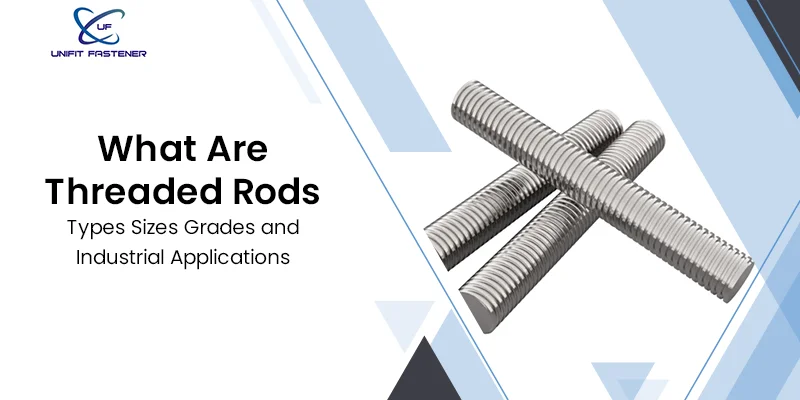
The threaded rod, also known as the all-thread rod, threaded bar, stud bar, or screw rod, is a headless fastening device, threaded along its full or partial length. The threaded rod has a wide range of uses in construction, chemical industries, pipe system installations, and industrial maintenance due to its ability to be used as a structural support component, as well as an adjustable connecting device with nuts and washers. Selecting the appropriate type of threaded rod involves an understanding of the structure of the threads, the dimensions of the rod, material grade, manufacturing process, and the finishing on the rod. Depending on the application, the choice may be made between carbon steel, stainless steel, or alloy steel threaded rod.
What are Threaded Rods?
A threaded rod is a solid cylindrical metal bar featuring standardized external threads along its surface. Unlike traditional structural bolts, a threaded rod does not possess a forged head or internal drive mechanism. Instead, it relies on nuts and washers applied to one or both ends to create high-integrity clamping forces across joined assemblies. Frequently traded under alternative industry names like redi-rod, all-thread, or continuous thread bar, these fasteners are designed to handle tension forces. Their uniform geometry allows engineers and fabricators to easily cut custom lengths on-site or specify precision pre-cut lengths for critical industrial applications.
Difference Between Threaded Rod vs Bolt vs Stud Bolt
Threaded Rod vs. Bolt:
A bolt features a built-in drive head (such as a hex or heavy hex head) and is limited to fixed standard lengths. A threaded rod has no head, can be threaded fully or partially, and can be cut to any custom length.
Threaded Rod vs. Stud Bolt:
While often used interchangeably in general hardware contexts, a stud bolt typically refers to a high-precision, shorter length of threaded bar designed specifically for flange joints and pressure boundaries. Stud bolts adhere to strict ASTM dimensional tolerances and end-chamfer requirements.
Types of Threaded Rods
Threaded rods are categorized by three main attributes: threading configuration, raw material composition, and international manufacturing standards.
By Threading Pattern
- Fully Threaded Rod: Features unbroken helical threads running from end to end. It represents the most versatile style and is easily cut to length for HVAC duct suspension, electrical cable tray supports, and general construction anchoring.
- Double-End Stud: Features threaded portions on both ends separated by an unthreaded smooth center shank. Used in structural steel connections and piping flanges where equal thread engagement on both ends is essential.
- Tap-End Stud: Features a shorter threaded section on one end designed to thread permanently into a tapped hole, while the opposite end features a longer thread length to accommodate a standard hex nut. Frequently used in engine blocks, pumps, and heavy industrial machinery casing.
- Hollow Threaded Rod: Contains a hollow central core running the length of the rod. This design permits electrical wiring, fluids, or fiber optics to pass directly through the structural fastener, making it a key component in lighting fixtures and specialized hydraulic systems.
By Material
Selecting the correct base material ensures structural integrity while mitigating environmental degradation.
- Carbon Steel: Economical and strong, carbon steel fasteners are ideal for indoor construction, light structural framing, and general fabrication where corrosion risk is minimal.
- Alloy Steel: Formulated with elements like chromium and molybdenum, alloy steel rods—such as ASTM A193 Grade B7 fasteners—offer superior tensile strength and heat resistance. They are widely used as high tensile fasteners in oil refineries and power plant equipment.
- Stainless Steel: Delivers outstanding atmospheric and chemical corrosion resistance:
- 304 / 304L: Standard grade for outdoor construction, water treatment, and food processing equipment. See details on stainless steel fasteners and stainless steel stud bolts.
- 316 / 316L: Molybdenum-bearing stainless steel providing enhanced pitting resistance against chlorides and coastal environments. Learn more about the 316 stainless steel stud bolt.
- High-Temp & Specialty Stainless: Grades like 321, 347, 310/310S, and 317L handle extreme thermal cycles and chemical processing.
By Standard
- DIN Standards: Standardized metric specifications widely used across European and international markets.
- DIN 975: Covers 1-meter and 2-meter long fully threaded bars meant to be stocked and cut to size.
- DIN 976: Defines pre-cut stud bolts manufactured with specified end chamfers and defined lengths. Explore our range of compliant DIN fasteners and review international fastener standards.
- ASTM Standards: Primary specifications governed by American standards bodies for industrial and energy infrastructure.
- ASTM A193: High-temperature, high-pressure alloy and stainless steel bolting specifications; review detailed ASTM A193 specifications.
- ASTM A320: Low-temperature alloy and stainless steel bolting specifications designed for cryogenic service.
- Thread Pitch Systems: Metric (M-designation with coarse or fine pitch) versus Imperial UNC (Unified Coarse) and UNF (Unified Fine) thread profiles.
Threaded Rod Sizes
|
Metric Diameter (Size) |
Nominal Pitch (Standard Coarse) |
Pitch (Fine Thread) |
Recommended Tapping Drill Size |
|
M6 |
1.00 mm |
0.75 mm |
5.0 mm |
|
M8 |
1.25 mm |
1.00 mm |
6.8 mm |
|
M10 |
1.50 mm |
1.25 mm |
8.5 mm |
|
M12 |
1.75 mm |
1.25 / 1.50 mm |
10.2 mm |
|
M16 |
2.00 mm |
1.50 mm |
14.0 mm |
|
M20 |
2.50 mm |
1.50 / 2.00 mm |
17.5 mm |
|
M24 |
3.00 mm |
2.00 mm |
21.0 mm |
Threaded Rod Weight Chart
Calculating component weight is essential for freight planning, structural load budgeting, and export documentation. Weight varies based on diameter, thread pitch density, and material specific gravity.
For detailed weight calculations across standard metric and imperial diameters, access our complete threaded rod weight chart or refer to the specialized stud bolts weight chart.
Coatings and Finishes
Applying the right surface finish extends hardware life and reduces maintenance overhead in aggressive environments. Review overall fastener coatings types and standards to optimize performance.
- Plain / Uncoated (Self-Color): Oiled carbon steel suitable for dry indoor applications or assemblies intended to be encased in concrete or painted post-installation.
- Electro-Zinc Plated: A thin layer of sacrificial zinc providing basic indoor rust protection and a clean, bright aesthetic.
- Hot-Dip Galvanized (HDG): A thick zinc coating formed through thermal immersion. Provides decades of outdoor atmospheric protection for utility infrastructure and structural steelwork.
- PTFE / Xylan® Coating: Fluoropolymer coatings offering exceptional chemical resistance, controlled friction co-efficients, and anti-galling protection on stainless steel and alloy fasteners. Discover our specialized Xylan coated fasteners and PTFE/Teflon coated fasteners.
Common Industrial Applications
Threaded rods perform critical fastening roles across diverse engineering sectors:
- Construction & Structural Steel: Used as chemical anchor studs embedded into concrete foundations, suspension systems for MEP framing, and tension tie-rods for roof trusses.
- Oil & Gas, Petrochemical, and Piping: Heavy hex nut flanging assemblies rely on high-yield B7/B8/B8M threaded rods and stainless steel high-temperature fasteners to contain high-pressure fluids.
- Power Generation & Renewables: Anchor structures for solar photovoltaic tracking arrays, cable management trays, and structural mounting hardware in power facilities.
- HVAC, Electrical & Plumbing: Hanging overhead ductwork, heavy pipe runs, fire suppression systems, and main cable trays using drop-in anchors and cut threaded bars.
How to Choose the Right Threaded Rod
Follow this practical selection checklist when specifying fasteners for project procurement:
- Dimensional Specs: Determine the required major diameter, thread pitch (coarse vs. fine), and overall length.
- Environmental Conditions: Identify exposure levels (indoor ambient, outdoor weather, marine salt spray, or chemical contact).
- Thermal & Load Requirements: Define maximum operating temperature, working tensile load, and pressure limits.
- Select Material & Grade: Match conditions with the appropriate base material (carbon steel, 316 SS, Duplex, or B7 alloy).
- Determine Finish: Choose an suited protective coating (zinc, hot-dip galvanized, or PTFE fluoropolymer).
- Verify Standards Compliance: Ensure the fastener meets necessary manufacturing codes (DIN 975, DIN 976, ASTM A193).
Conclusion
Selecting the ideal threaded rod requires balancing mechanical strength requirements, environmental corrosion risks, thermal demands, and dimensional standards. Whether your project requires standard DIN 975 metric rods for building suspension or specialized ASTM A193 B7 stud bars for high-pressure refinery lines, ensures reliable long-term performance. Explore our range of fasteners or get in touch with our team at Unifit Fastener to specify and source the right threaded rod for your next project.
Frequently Asked Questions
A threaded rod is a headless fastener, usually threaded along its entire length, while a bolt has a fixed head and a defined shank length.
Metric Grade 12.9 offers high tensile strength, while ASTM A193 Grades B7 and B16 are commonly used for high-temperature applications.
Yes, threaded rods can be cut using a bandsaw, cold saw, or angle grinder. Deburring the cut end helps ensure smooth nut installation.
DIN 975 covers continuous threaded rods, while DIN 976 covers pre-cut stud bolts designed for installation.
Hot-dip galvanized steel or 304 stainless steel suits standard outdoor use. Grade 316 stainless steel and duplex grades offer better corrosion resistance for marine environments.