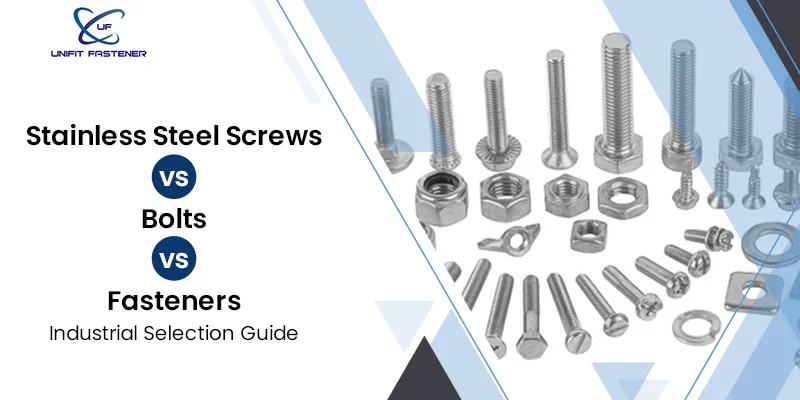
In an industrial purchasing list, “stainless steel screw” can look like a simple line item. In practice, that line can hide several decisions: whether the joint needs a screw or a bolt, whether the assembly is exposed to salt or chemicals, which thread system the drawing uses, and whether the buyer needs traceable material certificates for an international project.
For procurement teams, OEMs, EPC contractors and maintenance engineers across the Middle East, the United States, the United Kingdom and Africa, the useful question is not simply “screw or bolt?” It is: which stainless steel fastening method gives the right access, clamp, corrosion resistance and standard compliance for the job? This guide focuses on that selection decision. For the basic mechanical difference between the two fastener families, Unifit already has a dedicated Bolt vs Screw guide, so we will not repeat that topic here.
Quick answer
A stainless steel screw usually threads into a tapped hole or forms its own mating thread, while a bolt normally passes through clearance holes and is secured with a nut. For industrial projects, choose between them based on access, joint design, service load, maintenance requirements, grade and the governing ASTM, ASME, DIN, ISO or BS specification.
Where Stainless Steel Screws Fit in Industrial Assemblies
Screws are useful when the design needs fastening from one side, when one component already has an internal thread, or when a compact assembly does not leave room for a nut. Common industrial forms include machine screws, socket head cap screws, set or grub screws, self-tapping screws and shoulder screws. The drive style may be hex socket, Torx, Phillips, slotted or another form specified by the equipment drawing.
The advantage is installation efficiency and compactness. A machine cover, instrumentation enclosure, pump component or fabricated metal assembly can often be serviced without holding a nut on the reverse side. The limitation is equally important: the strength of the joint depends on thread engagement in the mating component. If the internal thread is damaged, repeatedly assembled or made in a softer material, the design may need a threaded insert, a larger engagement length or a bolt-and-nut arrangement instead.
Where Stainless Steel Bolts Are the Better Choice
Bolts are usually selected when the joint can be accessed from both sides and the design benefits from a separate nut and washer. Structural frames, flanged equipment, skids, pipe supports, heavy machinery and removable assemblies often use bolts because the clamping system can be inspected and replaced without relying on threads cut into the main component.
For high-load or critical service, the specification matters more than the word “bolt”. A buyer may need a stainless hex bolt to ISO 4014/4017, a material-controlled bolting grade under ASTM requirements, or a special alloy fastener for heat, chloride exposure or chemical service. In these cases, the purchase order should identify the material grade, standard, diameter, pitch, length, thread coverage, finish and certification rather than relying on a generic description such as “SS bolt”.
Stainless Steel Screw vs Bolt: Practical Selection Table
|
Decision factor |
Stainless steel screw |
Stainless steel bolt |
|---|---|---|
|
Access |
Useful when only one side is accessible |
Usually needs access for the nut or captive nut |
|
Threading |
Threads into tapped material or forms a thread |
Normally passes through clearance holes and pairs with a nut |
|
Serviceability |
Fast to remove, but repeated use can wear tapped threads |
Nut and bolt can often be replaced without reworking the base component |
|
Typical use |
Machine covers, precision assemblies, sheet metal, equipment |
Structures, skids, flanges, heavy equipment, supports |
|
Selection focus |
Drive, head, engagement, thread type, material |
Grade, nut/washer pairing, preload, dimensions, material |
|
International procurement |
Confirm DIN/ISO or ASME/ASTM thread and dimensions |
Confirm bolt, nut and washer standards as one compatible assembly |
Choosing the Stainless Steel Grade: 304, 316 and Beyond
Grade selection is where a stainless steel screw or bolt becomes application-specific. Stainless 304 is widely used for general corrosion resistance in indoor equipment, food-related machinery, architectural work and many non-marine environments. Stainless 316 and 316L include molybdenum and are commonly preferred where chloride exposure is a concern, including coastal infrastructure, marine equipment, desalination-related systems and many chemical environments.
More aggressive service may call for duplex, super duplex, Inconel, Monel, Hastelloy or another alloy rather than standard stainless steel. That decision should follow the project material specification, corrosion study and operating conditions. Matching the fastener material to the surrounding metals also matters because dissimilar-metal combinations can create galvanic-corrosion risks in wet environments.
Standards Matter More When You Buy Across Borders
International buyers often receive drawings that mix material and dimensional standards. A US project may reference ASTM or ASME material requirements with UNC or UNF threads. UK and European-origin equipment may reference BS, DIN or ISO metric dimensions. Middle East oil, gas, petrochemical and desalination projects frequently use a combination of ASTM/ASME material specifications and ISO/DIN dimensions depending on the EPC package. African infrastructure, mining, energy and water projects can also specify BS, ISO, DIN or ASTM systems depending on the consultant and equipment origin.
Do not assume that two fasteners with the same nominal diameter are interchangeable. Confirm thread form and pitch, tolerance class, head geometry, length measurement method and the exact revision referenced on the drawing. Unifit manufactures and supplies fasteners to ASTM, ASME, DIN, ISO and BS requirements and provides material traceability for export orders.
What to Put on an RFQ for Stainless Steel Screws or Bolts
- Fastener type and head/drive style, such as socket head cap screw, machine screw or hex bolt.
- Material grade and specification, for example SS 304/304L, SS 316/316L or a project-specified alloy.
- Diameter, thread pitch or TPI, thread system (Metric, UNC, UNF, BSW/BSF where applicable) and tolerance class.
- Overall length and whether full or partial threading is required.
- Surface condition or finish, including passivation or project-approved coating where specified.
- Quantity, packing, marking, inspection and required documentation such as EN 10204 3.1 MTC.
- Destination and project schedule so export packing and dispatch can be planned correctly.
Common Buying Mistakes That Create Rework
The most common errors are small on paper and expensive on site. A purchaser orders “316 screw” but leaves out 316L, thread pitch and head style. A maintenance team substitutes a metric screw into an inch-series tapped hole. A stainless bolt is paired with an incompatible nut. A coastal project uses a grade selected for indoor service. Or an assembly is tightened without considering stainless-to-stainless galling.
A better approach is to treat the fastener as part of the joint system. Check the drawing, operating environment, mating material, installation method and documentation before placing the order. For stainless assemblies prone to galling, the project engineer may specify appropriate lubrication, surface treatment or a suitable nut/bolt material combination.
Sourcing Stainless Steel Screws and Bolts from India
For international buyers, the value of an Indian fastener supplier is not only price. The supplier must be able to translate a BOQ or drawing into the correct material, dimensional standard, inspection plan, packing and documentation. Unifit Fastener is based in Mumbai and manufactures and exports industrial fasteners across stainless steel, duplex, super duplex and special alloys. The company states that it serves 40+ countries, supports custom sizes, and supplies mill test certificates for traceability.
That makes the purchasing conversation more useful when it starts with the application. A refinery shutdown, marine retrofit, OEM production run and construction package may all require “stainless steel screws”, but they do not require the same product.
Final Selection Checklist
- Use a screw when the joint is designed around internal threads or one-side access.
- Use a bolt-and-nut assembly when through-fastening, replaceability and joint clamping favour it.
- Choose grade from the actual environment, not only from price.
- Match the dimensional and thread standard to the drawing.
- Specify certificates, testing and traceability before ordering, not after production.
- Ask for a technical review when the fastener is safety-critical or exposed to high pressure, temperature, corrosion or cyclic loading.
Frequently Asked Questions
A screw normally threads into a tapped or self-formed mating thread, while a bolt usually passes through clearance holes and is secured with a nut. The correct choice depends on the joint design and access.
Not always. 316 offers better resistance in many chloride and marine environments, while 304 can be suitable and more economical in less aggressive service. Use the project material specification and operating environment.
Yes. Industrial screws are manufactured to many DIN and ISO dimensional standards. The purchase order should identify the exact standard, size, thread and material grade.
Include type, grade, standard, dimensions, thread, finish, quantity, documentation, inspection requirements and delivery destination. A drawing is helpful for non-standard items.
Unifit Fastener states that it manufactures standard and custom fasteners, including non-standard sizes and thread forms, with material traceability and export support.
Need a technical quote? Send your grade, standard, size, quantity, drawing (if custom) and destination.
Request a QuoteRelated resources: Bolt vs Screw guide | Stainless Steel Fastener Grades Guide