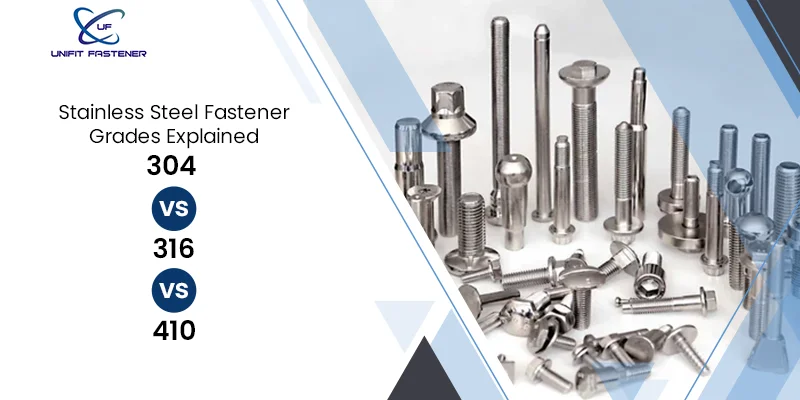
Stainless steel fasteners are among the most widely used fastening components across industrial, commercial, marine, and construction applications. These fasteners are preferred because of their excellent corrosion resistance, high strength, attractive finish, and long service life. Stainless steel fasteners are available in multiple grades, each designed for different environmental and mechanical conditions.
Among the most commonly used grades are 304 stainless steel fasteners, 316 stainless steel fasteners, and 410 stainless steel fasteners. Understanding the difference between these grades helps engineers, contractors, manufacturers, and procurement teams select the correct fastening solution for industrial projects.
What Are Stainless Steel Fasteners?
Stainless steel fasteners are bolts, nuts, screws, washers, threaded rods, anchors, and studs manufactured using stainless steel alloys containing chromium. Chromium forms a passive oxide layer on the surface, which protects the fastener from corrosion and oxidation.
These fasteners are widely used because they provide:
- Excellent corrosion resistance
- High durability
- Low maintenance
- Long service life
- Attractive appearance
- High-temperature resistance
Stainless steel fasteners are available in austenitic, martensitic, ferritic, and duplex grades.
304 Stainless Steel Fasteners
304 stainless steel fasteners are the most popular and widely used stainless steel fastening products worldwide. These fasteners contain chromium and nickel, providing excellent corrosion resistance for general industrial applications.
Features of 304 Stainless Steel Fasteners
- Excellent corrosion resistance
- Good weldability
- High durability
- Cost-effective material
- Suitable for indoor and outdoor applications
- Good resistance against oxidation
304 stainless steel bolts are ideal for applications where moderate corrosion resistance is required
Applications of 304 Stainless Steel Fasteners
- Construction projects
- Food processing equipment
- Architectural structures
- Water treatment plants
- Kitchen equipment
- HVAC systems
- General industrial assemblies
Because of their versatility and affordability, 304 stainless steel fasteners are commonly used across multiple industries.
316 Stainless Steel Fasteners
316 stainless steel fasteners offer better corrosion resistance compared to 304 grade due to the addition of molybdenum. This additional element significantly improves resistance to chlorides and harsh chemical environments.
Advantages of 316 Stainless Steel Fasteners
- Excellent corrosion resistance
- Superior marine performance
- Better chloride resistance
- High strength and durability
- Excellent resistance to chemicals
- Suitable for coastal environments
316 stainless steel fasteners are commonly called marine-grade stainless steel fasteners because they perform exceptionally well in saltwater applications.
Applications of 316 Stainless Steel Fasteners
- Marine engineering
- Offshore platforms
- Chemical processing plants
- Pharmaceutical industries
- Coastal construction projects
- Food and beverage processing
- Petrochemical industries
316 stainless steel bolts are preferred for highly corrosive and marine environments.
410 Stainless Steel Fasteners
410 stainless steel fasteners belong to the martensitic stainless steel family and are known for high strength, hardness, and wear resistance.
Unlike 304 and 316 grades, 410 stainless steel fasteners can be heat treated to achieve higher hardness levels.
Features of 410 Stainless Steel Fasteners
- High tensile strength
- Excellent hardness
- Good wear resistance
- Heat treatable material
- Cost-effective solution
- Moderate corrosion resistance
Applications of 410 Stainless Steel Fasteners
- Industrial machinery
- Automotive components
- Pump shafts
- Valve assemblies
- High-strength fastening systems
- Mechanical equipment
410 stainless steel fasteners are selected when mechanical strength is more important than corrosion resistance.
Comparison Between 304, 316 & 410 Stainless Steel Fasteners
This comparison helps industries choose the correct stainless steel fastener grade based on operating conditions.
| Property | 304 Stainless Steel | 316 Stainless Steel | 410 Stainless Steel |
|---|---|---|---|
| Corrosion Resistance | Good | Excellent | Moderate |
| Chloride Resistance | Moderate | Superior | Low |
| Hardness | Moderate | Moderate | High |
| Heat Treatable | No | No | Yes |
| Marine Applications | Limited | Excellent | Not Recommended |
| Cost | Moderate | Higher | Lower |
Corrosion Resistance Comparison
- 304 stainless steel fasteners perform well in standard industrial environments.
- 316 stainless steel fasteners are better suited for marine and chemical environments due to improved chloride resistance.
- 410 stainless steel fasteners provide moderate corrosion resistance but offer superior hardness and wear resistance.
Benefits of Stainless Steel Fasteners
Long Service Life
Stainless steel fasteners can perform for years without major corrosion or structural damage.
Low Maintenance
These fasteners require minimal maintenance compared to carbon steel fasteners.
Attractive Appearance
The polished finish of stainless steel fasteners makes them suitable for decorative and architectural applications.
Excellent Strength
Stainless steel bolts and nuts provide excellent mechanical strength for structural assemblies.
Temperature Resistance
Many stainless steel grades maintain strength at elevated temperatures.
- Long service life
- Corrosion resistance
- Low maintenance
- Attractive finish
- High strength
- Recyclable material
How to Select the Right Stainless Steel Fastener Grade
When selecting stainless steel fasteners, industries should consider:
- Environmental conditions
- Corrosion exposure
- Load requirements
- Operating temperature
- Budget considerations
- Marine or chemical exposure
For marine and coastal environments, 316 stainless steel fasteners are generally recommended.
For general industrial applications, 304 stainless steel bolts are a cost-effective option.
For applications requiring hardness and wear resistance, 410 stainless steel fasteners are suitable.
Industries Using Stainless Steel Fasteners
Construction Industry
Construction companies use stainless steel bolts and nuts for structural reliability and corrosion resistance.
Marine Industry
316 stainless steel fasteners are commonly used in shipbuilding and offshore platforms.
Food Processing Industry
Food-grade stainless steel fasteners are used for hygienic processing equipment.
Chemical Industry
Chemical processing plants require corrosion-resistant fastening systems.
Automotive Industry
Automotive manufacturers use stainless steel fasteners for durability and strength.
Frequently Asked Questions
Which stainless steel fastener grade is best for marine environments?
316 stainless steel fasteners are generally the best option for marine and coastal environments because their molybdenum content improves resistance to chlorides and saltwater corrosion.
Are 304 stainless steel fasteners suitable for outdoor use?
Yes. 304 stainless steel fasteners are suitable for many indoor and outdoor applications where corrosion exposure is moderate and chloride levels are not severe.
When should 410 stainless steel fasteners be selected?
410 stainless steel fasteners should be selected when hardness, wear resistance, and mechanical strength are more important than maximum corrosion resistance.
What is the main difference between 304 and 316 stainless steel fasteners?
The main difference is molybdenum. 316 stainless steel includes molybdenum, which improves resistance to chlorides, chemicals, and marine environments compared to 304 stainless steel.
Conclusion
304, 316, and410 stainless steel fasteners are among the most widely used industrial fastening materials. Each grade offers different advantages depending on environmental conditions, strength requirements, and corrosion exposure. Understanding the differences between these stainless steel fastener grades helps industries select the most suitable fastening solution for long-term performance and reliability.