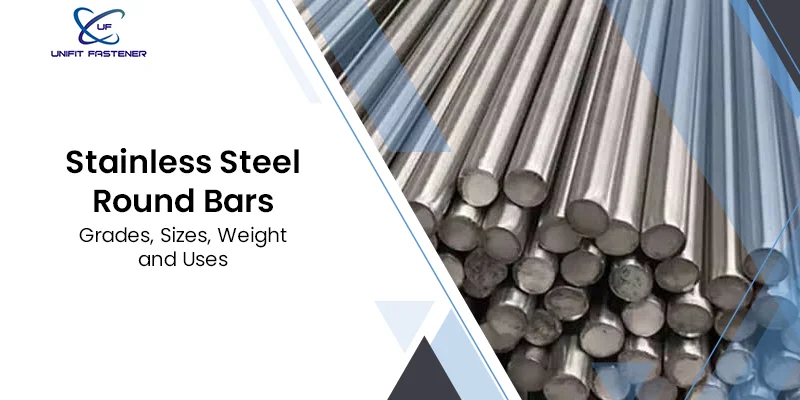
Stainless steel round bars (SS round bars) are solid bars of stainless steel alloy. They can be machined into shafts, pins, fasteners, valve stems and many other products. When choosing a round bar, you must choose the grade, standard, dimensions and tolerances, and surface finish that best suit your application. In this guide, we explain each of these factors, show how to calculate bar weight, and list what to include in your order.
What Is a Stainless Steel Round Bar?
Stainless steel contains at least 10.5% chromium, which forms a thin oxide film on the surface that stops rust from spreading. A round bar is that alloy rolled or drawn into a solid cylinder, from a few millimetres to several hundred millimetres across.
Bars are sold in two broad conditions:
- Hot-finished: rolled at high temperature, then annealed and descaled. Cheaper, with wider tolerances.
- Cold-finished: drawn, peeled or ground after hot rolling for a tighter diameter and a smoother surface.
In India and in export trade, the same product is also called an SS round bar, SS rod or stainless steel round rod.
Stainless Steel Round Bar Grades
Austenitic grades (304, 316, 321, 310): the everyday choice
- SS 304 / 304L: the general-purpose grade for food, water, architecture and general engineering. 304L has lower carbon, which matters when the part will be welded.
- SS 316 / 316L: adds 2–3% molybdenum for resistance to chlorides. Choose it for coastal, marine, chemical and pharmaceutical parts.
- 321: stabilised with titanium so it keeps its corrosion resistance after long periods at 425–815 °C. Used in exhaust and heat-exchanger parts.
- 310 / 310S: high chromium and nickel for oxidation resistance at furnace temperatures.
All austenitic grades are essentially non-magnetic when annealed and can't be hardened by heat treatment.
Martensitic and precipitation-hardening grades (410, 420, 17-4PH)
- SS 410: 12% chromium, hardenable by heat treatment. A good choice for wear-resistant shafts and valve parts in mild environments.
- SS 420: higher carbon, so it reaches higher hardness. Used for tools, cutlery and pump parts.
- 17-4PH (630): combines high strength after age hardening with corrosion resistance close to 304. It is made to ASTM A564 and is the usual choice for high-strength shafts and fasteners.
Duplex and super-austenitic grades (2205, 904L, 254 SMO)
- Duplex 2205: roughly twice the yield strength of 316, with strong resistance to chloride stress corrosion.
- SS 904L and 254 SMO: for seawater, acids and other severe environments where 316 pits.
Grade comparison at a glance
|
Grade |
UNS |
Family |
Corrosion resistance |
Hardenable |
Typical uses |
|
S30400 / S30403 |
Austenitic |
Good |
No |
Food equipment, general engineering |
|
|
S31600 / S31603 |
Austenitic |
Very good (chlorides) |
No |
Marine, chemical, pharma |
|
|
SS 321 |
S32100 |
Austenitic (Ti-stabilised) |
Good, at temperature |
No |
Exhaust, heat exchangers |
|
S31000 / S31008 |
Austenitic |
Good, high temperature |
No |
Furnace parts |
|
|
S41000 |
Martensitic |
Moderate |
Yes |
Shafts, valve parts |
|
|
S42000 |
Martensitic |
Moderate |
Yes |
Tools, pump parts |
|
|
S17400 |
Precipitation hardening |
Good |
Yes (ageing) |
High-strength shafts, fasteners |
|
|
Duplex 2205 |
S31803 / S32205 |
Duplex |
Excellent |
No |
Offshore, chloride service |
|
N08904 |
Super-austenitic |
Excellent (acids) |
No |
Acid handling, chemical plants |
|
|
S31254 |
Super-austenitic |
Excellent (seawater) |
No |
Seawater, desalination |
PREN (pitting resistance equivalent number = %Cr + 3.3×%Mo + 16×%N) ranks resistance to chloride pitting: roughly 18–20 for 304, 24–26 for 316, 34–36 for 904L and 2205, and 42–44 for 254 SMO. The higher the number, the better the grade copes with seawater and chlorides.
Stainless Steel Round Bar Weight Chart and Formula
Formula: weight (kg/m) = 0.00623 × d², where d is the diameter in mm. This uses a density of 7.93 g/cm³ (304). For 316 use 0.00627 (7.98 g/cm³); for 410 and 420, 0.00609 (7.75 g/cm³).
|
Diameter (mm) |
kg/m (304) |
Diameter (mm) |
kg/m (304) |
|
6 |
0.22 |
30 |
5.61 |
|
8 |
0.40 |
40 |
9.97 |
|
10 |
0.62 |
50 |
15.57 |
|
12 |
0.90 |
60 |
22.42 |
|
16 |
1.59 |
80 |
39.86 |
|
20 |
2.49 |
100 |
62.28 |
|
25 |
3.89 |
Working with another shape or material? Our round bars page covers the other alloys we produce in bar form.
SS Round Bar Sizes, Finishes and Tolerances
|
Finish |
How it is made |
Typical tolerance |
When to choose it |
|
Black (hot-rolled) |
Rolled hot, annealed and pickled |
Wide (about ±0.5 mm or more) |
Parts that will be fully machined |
|
Peeled / turned |
Outer skin removed on a lathe |
h11 |
Larger diameters needing a clean surface |
|
Bright (cold-drawn) |
Drawn through a die |
h9 |
Precision machining, small diameters |
|
Ground / polished |
Centreless ground after drawing |
h8 or tighter |
Shafts, pump and valve parts, visible parts |
How SS Round Bars Are Made: From Melt to Finished Bar
- Melting: scrap and alloys are melted in an electric arc furnace, then refined (usually by AOD) to set the exact chemistry.
- Casting: the steel is cast into billets or blooms.
- Hot rolling or forging: the billet is reduced to the target diameter.
- Annealing and pickling: heat treatment restores corrosion resistance and softness; pickling removes scale.
- Finishing: peeling, cold drawing, grinding or polishing for the required tolerance and surface.
- Testing: chemical analysis, mechanical tests, ultrasonic testing on larger sizes, then marking and certification.
Where Stainless Steel Round Bars Are Used
- Pump and motor shafts, valve stems and spindles
- Fasteners, studs and pins, machined from bar
- Food, dairy and pharmaceutical equipment parts
- Marine fittings and propeller shafts (316, duplex)
- Furnace and heat-treatment fixtures (310S)
- Architectural railings and supports
How to Choose the Right Bar: A Buyer's Checklist
- Environment first: indoor or dry → 304; chlorides or coast → 316 or duplex; high temperature → 321 or 310S; wear → 410, 420 or 17-4PH.
- Standard: A276 for general machining; A479 when the part is for a pressure application or the specification calls for it.
- Tolerance and finish: match the machining allowance. Don't pay for h8 bright bar if the part will be turned anyway.
- Size and length: order the diameter that leaves enough machining allowance, and ask for cut lengths to cut scrap.
- Documents: ask for an EN 10204 3.1 mill test certificate that shows the heat number, chemistry and mechanical results.
- Lifecycle cost, not unit price: a 316 bar costs more than 304, but in chloride service it avoids early replacement. Compare the cost over the part's service life.
Once you have the grade and size, our SS round bar supplier page lists the grades and size ranges we work with.
Key Points
- Pick the grade from the environment: 304 for general use, 316 for chlorides, 310S for heat, 410/420/17-4PH for strength and wear.
- A276 covers most machining bar; A479 is for pressure service.
- The finish sets the tolerance and the price: black, then peeled, bright and ground.
- Bar weight in kg/m = 0.00623 × d² (mm) for 304.
Frequently Asked Questions
Annealed austenitic grades (304, 316) are essentially non-magnetic, though cold drawing can make them slightly magnetic. Martensitic grades (410, 420) and 17-4PH are magnetic.
Grade 304 / 304L. It covers most indoor, food, water and general engineering parts at the lowest cost among the austenitic grades. Move up to 316 / 316L when the part sees salt, chlorides or chemicals.
316 / 316L for most marine fittings and shafts. For seawater immersion or high loads, duplex 2205 or super-austenitic grades such as 254 SMO resist pitting better (see the PREN values under the grade table).
316 contains 2–3% molybdenum, which gives better resistance to chlorides and pitting. For salty, coastal or chemical service, choose 316; for general use, 304 is enough and costs less.
A276 is the general bar specification; A479 is for bars used in boilers and pressure vessels and adds stricter requirements. Many suppliers dual-certify bars to both.
Multiply 0.00623 by the diameter in mm squared to get kg per metre (304 grade). A 25 mm bar weighs about 3.9 kg/m.
A cold-drawn or ground round bar with a smooth, bright surface and a tight tolerance (typically h9), used where little or no machining is planned.