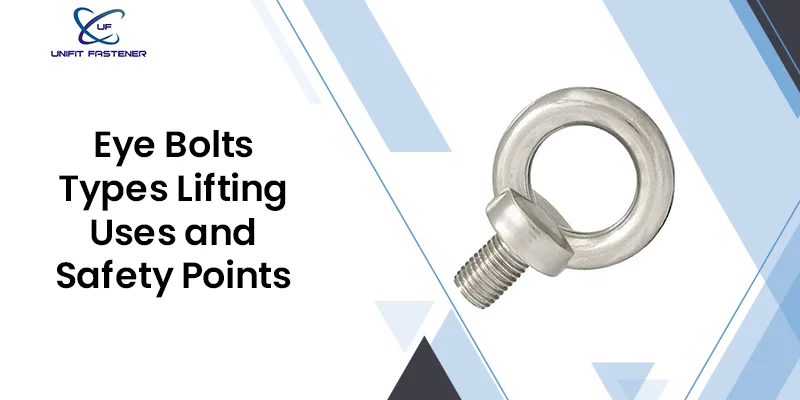
Eye bolts look simple: a threaded shank with a loop at one end. In lifting and load-handling work, that simplicity can be misleading. A shoulder eye bolt, plain eye bolt, machinery eye bolt and swivel lifting point are not interchangeable, and an eye bolt that is suitable for a straight pull may not be suitable for a side load.
This guide is written for industrial buyers, rigging teams, maintenance departments, OEMs and distributors sourcing eye bolts for the Middle East, United States, United Kingdom and Africa. It explains the main types, common industrial uses, material options and the safety information that should be checked before an eye bolt is placed into lifting service.
Quick Answer: For lifting, use only an eye bolt that is specifically rated and certified for the intended load direction and working load limit. Confirm thread engagement, seating, material, standard and inspection requirements. Do not use a generic hardware eye bolt as a lifting point, and do not side-load a plain eye bolt unless the manufacturer explicitly rates it for that use.
What Is an Eye Bolt?
An eye bolt is a bolt or threaded fitting with a circular or oval eye used as an attachment point. Depending on design, it may be used for lifting machinery, tensioning cables, securing equipment, attaching rigging or creating a removable connection.
The word “eye bolt†covers products with very different performance levels. Some are forged and load-rated for lifting. Others are intended only for tie-down, light restraint or non-lifting attachment. A purchase order should therefore identify the intended use, not just the diameter and thread.
1. Shoulder Eye Bolts
A shoulder eye bolt has a machined or forged shoulder between the eye and the threaded shank. When it is correctly seated against the load surface, the shoulder can help support certain angular loading conditions within the manufacturer’s rated limits. These are common on machinery, dies, fixtures and equipment that needs a removable lifting point.
Even with a shoulder, angular loading reduces capacity and introduces bending forces. The permissible angle, orientation and de-rating must come from the product manufacturer and the applicable lifting procedure. Never estimate a safe angle from appearance alone.
2. Plain or Non-Shoulder Eye Bolts
Plain eye bolts do not have the load-bearing shoulder used to support angular forces. In lifting service, they are generally intended for an in-line pull where the load acts along the axis of the threaded shank, subject to the manufacturer’s rating. Side loading can bend the shank or eye and should be avoided unless the exact product is designed and rated for it.
These eye bolts may also be used in non-lifting attachment, restraint or tension applications, where the engineering requirement can differ from a lifting application.
3. Machinery Eye Bolts and DIN 580-Type Lifting Eyes
Machinery eye bolts are threaded lifting points designed to screw into tapped holes in machines or components. DIN 580 is a familiar metric eye bolt designation on European and international equipment. Buyers should confirm thread size, material, rated capacity, seating surface and the exact standard/revision required by the equipment documentation.
The tapped hole is part of the lifting system. Full thread engagement, suitable parent material, clean threads and correct seating are essential. A rated eye bolt installed into damaged or insufficient threads does not create a safe lifting point.
4. Swivel Hoist Rings: When the Load Direction Changes
A swivel hoist ring is not the same product as a fixed eye bolt, but it is an important alternative where the lifting direction can change. The assembly can pivot and rotate so the lifting link aligns more naturally with the load, reducing the bending that can occur when a fixed eye is pulled from the side.
Where a lift involves multi-leg slings, changing angles or rotation, the lifting engineer may specify a swivel lifting point rather than a conventional eye bolt. Use the exact approved component rather than substituting based on thread size.
Eye Bolt Type Comparison
| Type | Typical purpose | Load-direction note | Buying focus |
|---|---|---|---|
| Shoulder eye bolt | Machinery lifting / attachment | May allow limited angular loading only within rating | WLL, angle limits, shoulder seating, thread |
| Plain eye bolt | In-line lifting or attachment where rated | Generally axial pull only for lifting | WLL, full seating, thread engagement |
| DIN 580 / machinery eye | Metric machinery lifting point | Follow standard/manufacturer load directions | Metric thread, standard, WLL, parent thread |
| Swivel hoist ring | Multi-directional lifting | Designed to align with changing load direction | Rated assembly, rotation/pivot, installation torque |
Lifting Uses vs Non-Lifting Uses
The same general shape appears in very different applications. Lifting uses include machinery handling, mould and die lifting, equipment installation and maintenance lifts. Non-lifting uses can include cable termination, guying, tensioning, tie-down or architectural attachment.
The safety distinction is critical: a product sold as an “eye bolt†is not automatically approved for overhead lifting. For lifting, procurement should require a rated product with the applicable standard, working load limit, traceability and certification required by the employer, project and local regulation.
Material Selection for Eye Bolts
Carbon and alloy steels are common where high strength is required and corrosion can be managed by coating or controlled environment. Stainless steel is selected where corrosion resistance is important. Grade 304 can suit many general applications, while 316/316L is often preferred in marine, coastal, desalination and chloride-exposed service.
For offshore, chemical, subsea or severe corrosion environments, projects may specify duplex, super duplex, Monel, Inconel or other alloys. High corrosion resistance does not automatically mean a lifting eye has the required strength or certification, so the material grade and the lifting rating must both be verified.
Eye Bolt Safety Points Before Every Lift
- Confirm the eye bolt is designed and rated for lifting, not only for tie-down or hardware use.
- Verify the working load limit for the exact size, material and load direction.
- Inspect the eye, shoulder, shank and threads for deformation, cracks, severe wear, corrosion or thread damage.
- Make sure the shoulder or seating face sits correctly against the load where the design requires it.
- Use adequate thread engagement in a suitable parent material and follow the manufacturer’s installation instructions.
- Keep the load in the rated plane/direction; do not force a sling against the side of the eye.
- Do not exceed the manufacturer’s permitted sling angle or apply an unapproved side load.
- Remove damaged or unidentified lifting points from service rather than guessing their capacity.
International Standards and Procurement Context
Metric machinery eye bolts may be specified to DIN 580 or another ISO/DIN-based standard, while US equipment may use inch-series threads and manufacturer-specific rated lifting hardware. UK and Middle East projects can contain a mixture of BS/EN/ISO/DIN and ASTM/ASME references depending on equipment origin. African mining, energy, port and industrial projects likewise use a mix of global standards.
For a procurement team, the rule is simple: buy to the equipment drawing and lifting specification. Do not convert a metric lifting eye to a similar inch thread or substitute a non-rated product because the nominal diameter appears close.
What to Include in an Eye Bolt RFQ
- Intended use: lifting, attachment, tie-down or another engineered purpose.
- Eye bolt type: shoulder, non-shoulder, machinery eye, DIN 580-type or custom drawing.
- Thread: metric or inch, diameter, pitch/TPI and required thread length.
- Material grade and any heat-treatment requirement.
- Required working load limit and permitted loading direction, where the product is for lifting.
- Standard, certification, proof testing, marking and traceability requirements.
- Surface finish or passivation/coating where specified.
- Quantity, destination and export packing requirements.
Sourcing Eye Bolts from an Industrial Fastener Manufacturer
For non-lifting attachment, an industrial fastener manufacturer may produce eye bolts in a wide range of materials and custom dimensions. For lifting applications, the supply requirement is more controlled: the selected eye bolt must comply with the applicable lifting standard, rating, testing and documentation.
Unifit Fastener manufactures bolts and fasteners across stainless steel, high tensile steel, duplex, super duplex and nickel alloys and lists eye bolts within its bolt range. Its website also references DIN 580 among supported bolt standards on stainless and alloy product pages. International buyers should submit the exact standard, load requirement and inspection scope so Unifit can confirm whether the requested product falls within its manufacturing and certification capability.
Buyer’s Final Checklist
- Separate lifting eye requirements from general attachment eye bolts.
- Specify the exact standard and thread, not just “M20 eye bolt†or “1-inch eye boltâ€.
- Confirm rated load, load direction and any angle de-rating for lifting service.
- Select material for both strength and environment.
- Verify thread engagement and seating requirements in the final assembly.
- Request marking, certificates and testing required by the project.
- Never substitute a generic eye bolt for a rated lifting point without engineering approval.
Frequently Asked Questions
A shoulder eye bolt has a load-bearing shoulder that can support certain angular loading within the manufacturer’s rating. A plain/non-shoulder eye bolt is generally limited to axial loading for lifting unless specifically rated otherwise.
No. Only use an eye bolt specifically designed, rated and certified for lifting. Generic hardware or tie-down eye bolts may not be suitable for overhead lifting.
DIN 580 is a widely recognised metric standard designation for lifting eye bolts used on machinery and equipment. Follow the current standard, manufacturer rating and equipment instructions for selection and use.
316/316L stainless steel is often considered for chloride exposure, while duplex or nickel alloys may be specified for more severe service. The lifting strength/rating must still be verified independently of corrosion resistance.
Provide the intended use, standard, thread, material, dimensions, working load/rating requirements, testing, marking and certification. For lifting, do not accept an unverified substitute.
Need a technical quote? Send your grade, standard, size, quantity, drawing (if custom) and destination.
Request a QuoteRelated resources: Anchor Bolts Selection Guide | Bolts Manufacturer