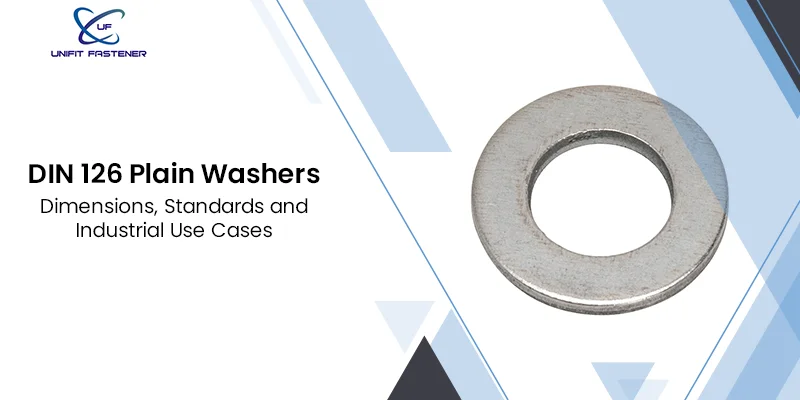
A plain washer is one of the smallest items on a bill of materials, yet a mismatch of a few millimetres can cause assembly problems across an entire batch. DIN 126 plain washers are commonly encountered on legacy drawings, imported machinery, construction specifications and international procurement lists. Buyers may also see ISO 7091 referenced as the corresponding modern product-grade-C plain washer standard.
This guide is intentionally narrow. Unifit already has broader articles on DIN fastener standards and the different types of washers. Here we focus on the exact search intent behind DIN 126 plain washers: what the designation means, the dimensions buyers should check, where these washers are used, how they differ from closer-tolerance washer standards and what to include in an international RFQ.
Quick Answer: DIN 126 refers to plain washers for metric fasteners with relatively generous product-grade-C tolerances and is commonly cross-referenced with ISO 7091. When buying, check nominal bolt size, inside diameter, outside diameter, thickness, material and the exact standard/revision on the drawing before substituting DIN and ISO designations.
What Is a DIN 126 Plain Washer?
A DIN 126 plain washer is a flat annular washer used under a bolt head or nut to provide a bearing surface, distribute contact pressure and protect the mating surface. The standard is associated with metric fastener assemblies and is widely recognised in older European and international documentation.
In modern purchasing, buyers may encounter ISO 7091 as the corresponding plain-washer reference for normal series, product grade C. Because legacy drawings and customer specifications can retain older DIN numbers for many years, the correct action is not to silently replace one designation with another. Confirm dimensional compatibility and the controlling project standard before substitution.
DIN 126 Dimensions: What the Three Key Numbers Mean
A plain washer is normally described by three dimensions: d1, the inside diameter or clearance hole; d2, the outside diameter; and h or s, the washer thickness. The nominal size refers to the mating metric bolt rather than the exact hole diameter. For example, an M12 washer has an inside diameter larger than 12 mm so the M12 bolt can pass through with the clearance allowed by the standard.
For SEO and buyer usability, the table below shows common reference dimensions associated with DIN 126 / ISO 7091-type normal-series plain washers. Use it as a selection aid only. Always verify the current standard, purchaser drawing and tolerance requirements before production.
| Nominal bolt size | Inside diameter d1 (mm) | Outside diameter d2 (mm) | Typical thickness (mm) |
|---|---|---|---|
| M5 | 5.5 | 10 | 1.0 |
| M6 | 6.6 | 12 | 1.6 |
| M8 | 9.0 | 16 | 1.6 |
| M10 | 11.0 | 20 | 2.0 |
| M12 | 13.5 | 24 | 2.5 |
| M16 | 17.5 | 30 | 3.0 |
| M20 | 22.0 | 37 | 3.0 |
| M24 | 26.0 | 44 | 4.0 |
| M30 | 33.0 | 56 | 4.0 |
| M36 | 39.0 | 66 | 5.0 |
DIN 126 vs DIN 125 / ISO 7089: Why the Difference Matters
Procurement teams often see DIN 126 and DIN 125 on different drawings and assume any flat washer of the same nominal size will work. That is risky. The standards belong to different dimensional and tolerance families. DIN 125/ISO 7089-type washers are commonly used where a closer, more controlled washer fit is required, while DIN 126/ISO 7091 product-grade-C washers are associated with broader tolerances suited to general assemblies.
The correct washer is the one shown on the engineering drawing or specified in the fastener schedule. A larger clearance hole may affect bearing area and alignment. A different outside diameter may change how the load is distributed on slotted holes, painted steel, softer materials or base plates. Thickness can also affect grip length and thread projection.
Typical Use Cases for DIN 126 Plain Washers
- General steel fabrication and structural assemblies where the project drawing specifies a product-grade-C plain washer.
- Machinery and equipment built to legacy DIN drawings.
- Construction and infrastructure packages using metric fasteners and European-origin specifications.
- Maintenance and replacement work where matching the original washer dimensions avoids fit-up changes.
- Industrial export orders where a buyer needs a recognised metric washer designation across multiple suppliers.
Choosing the Washer Material
The DIN number controls dimensions; it does not by itself tell you the correct material for every service environment. Carbon steel washers may be supplied plain, zinc coated or hot-dip galvanised depending on the project. Stainless 304 is common for general corrosion-resistant assemblies. Stainless 316/316L is often preferred for marine, coastal, desalination and chloride-containing environments. High-strength structural joints may require hardened washers to a different standard rather than a general-purpose DIN 126 washer.
Special environments can call for duplex, super duplex, Inconel, Monel, Hastelloy or other alloy washers. The washer material should be compatible with the bolt, nut, mating material, temperature, corrosion exposure and project specification.
Regional Specification Notes for International Buyers
DIN designations are especially common in European-origin machinery and remain familiar in UK, Middle East and African procurement even when an ISO successor exists. US projects may instead use ASME/SAE or ASTM-referenced washer requirements, although imported equipment can still carry DIN metric drawings.
For a mixed-standard project, avoid converting the entire fastener schedule by assumption. A package may use ASTM for material, ISO for dimensions and a client-specific coating specification. The safest RFQ reproduces the drawing designation and asks the manufacturer to flag any proposed equivalence before production.
What to Specify When Ordering DIN 126 Washers
- Standard designation: DIN 126 and any referenced equivalent required by the project.
- Nominal bolt size and required d1, d2 and thickness where shown on the drawing.
- Material grade: carbon steel, stainless 304/316, duplex or other specified alloy.
- Hardness or property requirement if the washer is part of a structural/high-strength assembly.
- Finish: plain, passivated, zinc plated, HDG, PTFE or another approved project finish.
- Quantity and packing method, including size/heat segregation for export shipments.
- MTC, PMI, dimensional report, coating certificate or third-party inspection if required.
Why a Washer Dimension Check Prevents Site Problems
Washers are frequently purchased in bulk, so a small mismatch multiplies quickly. An inside diameter that is too tight stops assembly. Too much clearance can reduce bearing area. An outside diameter that is too large may clash with welds, fillets or nearby components. A washer that is too thin can deform on an oversized or slotted hole, while a thicker washer can change available thread engagement.
Before a large export order, it is good practice to validate the nominal size, standard and sample dimensions against the drawing. For custom or obsolete requirements, a dimensional sketch can remove ambiguity.
DIN 126 Plain Washers from Unifit Fastener
Unifit Fastener manufactures and supplies washers in stainless steel, duplex, super duplex, nickel alloys and other materials, with DIN, ISO, ASTM, ASME and BS capability. Its SS 316 washer range specifically lists DIN 126 plain washers and ISO 7091 among supported standards, alongside EN 10204 3.1 MTC traceability and custom-size manufacturing.
For export buyers, the most useful enquiry is a complete requirement rather than only “DIN 126 washerâ€. Send the nominal sizes, grade, finish, quantity, certificates and destination. If the drawing is legacy or references both DIN and ISO numbers, include it so the dimensional basis can be confirmed before quotation.
Procurement Checklist
- Confirm whether the drawing truly calls for DIN 126, not DIN 125 or another washer standard.
- Verify d1, d2 and thickness for the nominal bolt size.
- Match washer material and finish to the bolt/nut assembly and environment.
- Use hardened or special washers when the joint standard requires them; do not substitute a general plain washer.
- Confirm MTC, inspection and packing requirements before order placement.
- Ask the manufacturer to document any DIN-to-ISO equivalence proposed for supply.
Frequently Asked Questions
DIN 126 is a designation for metric plain washers commonly found on legacy and international drawings. It is commonly cross-referenced with ISO 7091 for normal-series product-grade-C plain washers.
They belong to different dimensional/tolerance families. DIN 126 is associated with product grade C and broader tolerances, while DIN 125/ISO 7089-type washers are generally closer-tolerance flat washers. Follow the drawing rather than substituting by name.
Yes. Unifit lists DIN 126 among its supported SS 316/316L washer standards. Final dimensions, grade and finish should match the order specification.
The standards are commonly treated as corresponding references, but buyers should verify dimensional compatibility and project requirements before substitution, especially for legacy drawings.
Provide nominal size, material, finish, quantity, dimensional standard, certification/inspection requirements and delivery destination. Include the drawing when dimensions are critical.
Need a technical quote? Send your grade, standard, size, quantity, drawing (if custom) and destination.
Request a QuoteRelated resources: DIN Fastener Standards Guide | Types of Washers Guide