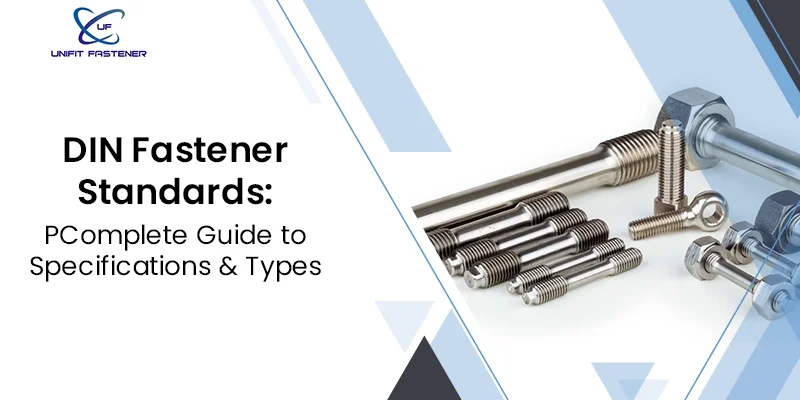
DIN fastener standards are internationally recognized specifications used for manufacturing bolts, nuts, screws, washers, threaded rods, and other industrial fastening components. These standards ensure dimensional accuracy, mechanical performance, quality consistency, and interchangeability across industrial applications.
DIN standards are developed by Deutsches Institut für Normung, the German Institute for Standardization. Over the years, DIN standards have become widely accepted across construction, engineering, automotive, oil and gas, manufacturing, and infrastructure industries.
Using standardized fasteners helps industries improve safety, reliability, compatibility, and maintenance efficiency.
What Are DIN Fastener Standards?
DIN fastener standards define the dimensions, tolerances, material specifications, thread design, and mechanical properties of industrial fasteners. These standards help manufacturers produce fastening products that are interchangeable and globally compatible.
DIN standards cover:
- Hex bolts
- Socket screws
- Nuts
- Washers
- Stud bolts
- Threaded rods
- Anchors
- Machine screws
Industries use DIN fasteners because they simplify installation and replacement processes.
Importance of DIN Standards in Industry
DIN standards are important because they ensure:
- Product consistency
- Reliable performance
- Global compatibility
- Quality assurance
- Safety compliance
- Dimensional accuracy
Without standardized fasteners, industrial systems may face compatibility issues and operational failures.
Common DIN Fastener Standards
- DIN 931 Hex Bolts
DIN 931 bolts are partially threaded hex bolts commonly used in machinery and structural engineering applications. - DIN 933 Hex Bolts
DIN 933 fasteners are fully threaded hex bolts widely used in industrial assemblies. - DIN 934 Hex Nuts
DIN 934 nuts are standard hex nuts compatible with multiple bolt standards. - DIN 125 Flat Washers
DIN 125 washers distribute load evenly and protect surfaces from damage during fastening. - DIN 912 Socket Head Cap Screws
DIN 912 screws are commonly used in machinery and precision engineering applications.
Types of DIN Fasteners
DIN fasteners are available in multiple product types including:
- DIN hex bolts
- DIN socket head screws
- DIN lock nuts
- DIN threaded rods
- DIN washers
- DIN machine screws
- DIN stud bolts
- DIN anchor fasteners
These fasteners are manufactured in various sizes and materials for industrial use.
Materials Used for DIN Fasteners
DIN fasteners are available in several materials depending on strength and corrosion resistance requirements.
Stainless Steel DIN Fasteners
Stainless steel DIN fasteners are used for corrosion-resistant applications in marine and chemical industries.
Carbon Steel DIN Fasteners
Carbon steel DIN fasteners are widely used for structural and construction applications.
Alloy Steel DIN Fasteners
Alloy steel DIN fasteners are suitable for high-temperature and high-pressure industrial systems.
Brass DIN Fasteners
Brass DIN fasteners are used in electrical and decorative applications.
Nickel Alloy DIN Fasteners
Nickel alloy DIN fasteners are preferred for highly corrosive industrial environments.
DIN vs ISO Fastener Standards
DIN and ISO standards are often compared because both are widely used in global industries.
| Feature | DIN Standards | ISO Standards |
|---|---|---|
| Origin | Germany | International |
| Usage | Industrial and European | Global |
| Compatibility | High | Very High |
| Standardization Scope | Detailed | Unified International |
Many DIN standards have gradually transitioned into ISO standards over time.
Applications of DIN Fasteners
DIN fasteners are widely used across multiple industries including:
Construction Industry
Structural bolts and nuts manufactured according to DIN standards help ensure safe construction practices.
Automotive Industry
Automotive manufacturers use DIN fasteners for assembly consistency and performance reliability.
Oil & Gas Industry
DIN fasteners are used in pipelines, pressure vessels, and drilling systems.
Heavy Engineering
Machinery manufacturers depend on DIN fasteners for dimensional accuracy and mechanical performance.
Power Generation Industry
Power plants use standardized fasteners to ensure operational safety and maintenance efficiency.
Benefits of DIN Fasteners
Interchangeability
DIN fasteners can be easily replaced because of standardized dimensions.
Improved Safety
Standardized fasteners reduce installation errors and operational failures.
Better Quality Control
DIN standards help manufacturers maintain consistent production quality.
Easy Maintenance
Maintenance teams can easily identify and replace standardized fasteners.
How to Select DIN Fasteners
When selecting DIN fasteners, industries should consider:
- Load requirements
- Corrosion exposure
- Operating temperature
- Pressure conditions
- Material compatibility
- Thread specifications
Choosing the correct DIN standard improves equipment reliability and long-term performance.
Frequently Asked Questions
What does DIN mean in fasteners?
DIN refers to Deutsches Institut für Normung, the German Institute for Standardization. DIN fastener standards define dimensions, tolerances, materials, threads, and performance requirements for industrial fasteners.
What is the difference between DIN 931 and DIN 933 bolts?
DIN 931 bolts are partially threaded hex bolts, while DIN 933 bolts are fully threaded hex bolts. The correct choice depends on the assembly design, grip length, and thread engagement requirements.
Are DIN fasteners compatible with ISO standards?
Many DIN standards have been replaced by or aligned with ISO standards, but dimensional details can vary. Engineers should always verify the exact standard number and project specification before substitution.
Which materials are used for DIN fasteners?
DIN fasteners are produced in stainless steel, carbon steel, alloy steel, brass, nickel alloys, and other materials depending on the required strength, corrosion resistance, and service environment.
Conclusion
DIN fastener standards are essential for ensuring quality, compatibility, and safety in industrial fastening systems. These standards provide dimensional consistency and reliable mechanical performance across multiple industries including construction, automotive, oil and gas, and heavy engineering. Understanding DIN specifications helps businesses select the correct fasteners for safe and efficient industrial operations.
Need help selecting DIN fasteners for your project? Contact Unifit Fastener for grade, material, and specification support.