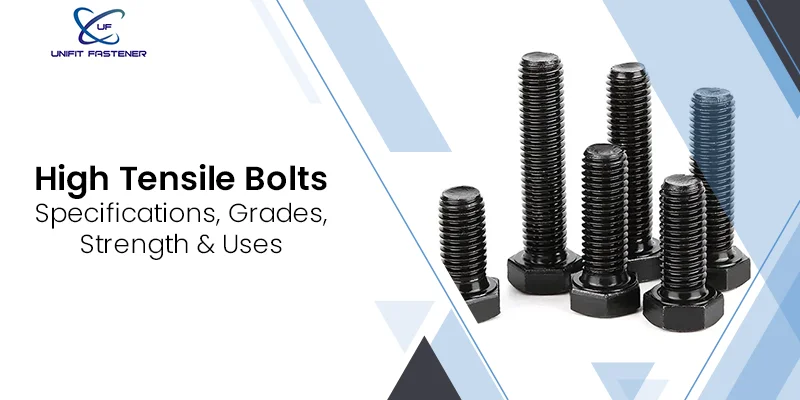
High tensile bolts are fasteners that are made from heat-treated carbon or alloy steel and are designed to resist pulling (tensile) forces significantly higher than a conventional bolt. Unifit Metalloys Inc., a leading high tensile bolts manufacturer and supplier in Mumbai, India, can provide high tensile bolts specifications that conform to both Indian (IS) and International (ASTM, DIN, ISO) standards with ISO 9001:2015 certified manufacturing. This guide addresses high tensile bolts specifications and grades, grade-wise tensile and yield strength, head markings, applications and choosing the right grade for your project. You will come across information regarding tensile and yield strength per grade, means of identification, applications in the industry, and guidance on choosing the appropriate grade.
What Are High Tensile Bolts?
High tensile bolts are made from medium or high-carbon steel or alloy steel, quenched and tempered to enhance their resistance to pulling force. “High tensile” is not a reference to hardness or surface finish, but to the amount of pulling stress the high tensile bolts strength where it can withstand without breaking. A Grade 8.8 or 10.9 bolt is different from a mild-steel bolt because it is subjected to this heat-treatment process, which makes it the preferred choice wherever a joint is required to withstand heavy structural, dynamic or vibration loads. A bolt's high tensile strength rating depends on the extent of the tensile pulling stress it can bear before it fails.
High Tensile Bolts vs. Standard & Stainless Steel Bolts
|
Property |
Standard/Mild Steel Bolts |
Stainless Steel Bolts |
High Tensile Bolts |
|
Typical tensile strength |
300–400 MPa |
500–700 MPa |
800–1400 MPa |
|
Corrosion resistance |
Low |
High |
Moderate (needs coating) |
|
Typical use |
Light-duty joints |
Marine, chemical, food-grade |
Structural, heavy machinery |
|
Cost tier |
Low |
High |
Moderate |
High tensile bolts have a much greater load capacity per unit size, although stainless steel bolts perform better in corrosive environments; that's why, in a straight high tensile bolts vs stainless steel bolts comparison, high tensile grades are the more common choice for structural and heavy-engineering applications, typically coated for corrosion resistance.
High Tensile Bolt Specifications
|
Specification |
Details |
|
Product Range |
High tensile hex bolts and high tensile stud bolts. |
|
Size Range |
M6 to M64 |
|
Thread Types |
The threads are UNC, UNF, metric coarse and metric fine. |
|
Dimensional Standards |
ASME B18.2.1 / ASME B18.3 |
|
Surface Finishes |
Zinc plating, Hot Dip Galvanising (HDG), Black Oxide and Phosphate |
|
Certification |
Dual Certified to both ASME and ASTM standards available |
|
Compliance |
Protection of equipment against corrosion and/or erosion, in accordance with PED and NACE MR0175 requirements, is available for relevant projects. |
|
Application |
Oil & gas, sour-service and other demanding industrial applications |
|
Fastener Range |
This certification and compliance can be offered on the fastener family level, depending on project needs. |
High Tensile Bolt Grades & Tensile Strength Chart
The most critical decision in specifying a high tensile bolt is the grade. Below is a table of tensile and yield strength for the entire range of products we make:
|
Grade |
Tensile Strength (MPa) |
Yield Strength (MPa) |
Material |
Typical Application |
|
4.6 |
400 |
240 |
Low carbon steel |
Light-duty, non-critical joints |
|
4.8 |
420 |
340 |
Low carbon steel |
General purpose |
|
5.8 |
520 |
420 |
Low/medium carbon steel |
Light structural |
|
8.8 |
800 |
640 |
Medium carbon steel, Q&T |
General industrial, machinery |
|
10.9 |
1040 |
940 |
Alloy steel, Q&T |
Automotive, heavy engineering |
|
12.9 |
1220 |
1100 |
Alloy steel, Q&T |
High-performance applications |
|
14.9 |
1400 |
1220 |
High-alloy steel, Q&T |
Extreme-load structural joints |
|
ASTM A325 |
830 |
660 |
Medium carbon steel |
Structural steel, bridges |
|
ASTM A490 |
1035 |
900 |
Alloy steel, Q&T |
Heavy structural steel, seismic zones |
How to Read High Tensile Bolt Head Markings
Each high tensile bolt has the grade and manufacturer's identification stamped on its head, for instance "8.8" or "10.9". The markings allow engineers and inspectors to be sure that the correct grade has been installed without a lab test. Metric grades (4.6 through 14.9) are identified by a pair of numbers separated by a decimal, representing tensile and yield strength ratios, and ASTM bolts (A325, A490) are identified by the standard designation, sometimes with radial lines. Wherever possible, check head markings before installing, particularly at critical structural joints.
Applications of High Tensile Bolts by Industry
We are as Unifit Metalloys are the most trusted manufacturer and supplier of high tensile bolts, which are widely used in Refineries, Oil & Gas, Power Generation, Pharmaceutical, and Pulp & Paper, industries, making them the biggest part of our fastener supply to these sectors. In addition to high tensile bolts uses, these bolts are installed on most construction and structural steelwork projects, all automotive assembly projects, most railway systems, wind turbine towers, heat exchanger systems and offshore oil drilling platforms, and anywhere else where joints are subjected to high static load, vibration and/or fatigue cycling.
How to Choose the Right High Tensile Bolt Grade
Choices for high tensile bolt grades should be made based on:
- The load type — static structural loads may be able to utilise 8.8; dynamic/impact loads are better suited to 10.9 or 12.9
- Vibration and fatigue exposure – higher grades have better resistance to loosening and fatigue cracking.
- Operating temperature — changes may be needed not only in the grade but in the material in very high temperatures or sub-zero temperatures.
- Corrosion environment — do not over-specify strength, but match the grade with an appropriate coating.
- A high price for getting a better grade - extra specification equates to extra expense - but no extra benefit in real-world terms.
Our engineering team is available to help customers correlate grade to application prior to ordering, which is not just to a specification sheet.
High Tensile Bolt Dimensions & Weight Chart
Bolt weight varies by diameter, length, and grade. For a complete size-wise and length-wise weight breakdown, refer to our dedicated ASTM A193 GR.B16 Bolts page, which is built to be used alongside this specification guide.
|
Length in Millimetres |
M 5 |
M 6 |
M 8 |
M 10 |
M 12 |
M 14 |
M 16 |
M 18 |
M 20 |
M 22 |
|
16 |
0.448 |
0.743 |
1.590 |
3.211 |
||||||
|
25 |
0.660 |
0.897 |
1.871 |
3.660 |
5.252 |
8.170 |
||||
|
40 |
0.881 |
1.230 |
2.470 |
4.533 |
6.410 |
10.288 |
12.107 |
16.667 |
20.747 |
|
|
45 |
0.958 |
1.340 |
2.671 |
4.840 |
6.859 |
10.504 |
12.821 |
17.241 |
21.739 |
|
|
50 |
1.030 |
1.450 |
2.870 |
5.155 |
7.299 |
11.261 |
13.624 |
17.857 |
22.727 |
28.409 |
|
55 |
1.560 |
3.071 |
5.464 |
7.740 |
11.628 |
14.409 |
18.868 |
23.810 |
30.120 |
|
|
60 |
1.670 |
3.270 |
5.774 |
8.183 |
12.255 |
15.244 |
20.000 |
25.126 |
32.051 |
|
|
65 |
1.781 |
3.472 |
6.083 |
8.621 |
12.626 |
16.026 |
21.008 |
26.455 |
34.014 |
|
|
70 |
1.890 |
3.671 |
6.394 |
9.058 |
12.987 |
16.835 |
22.124 |
27.778 |
35.461 |
|
|
75 |
2.000 |
3.873 |
6.702 |
9.506 |
13.228 |
17.606 |
23.256 |
29.070 |
39.063 |
|
|
80 |
2.111 |
4.072 |
7.013 |
10.000 |
13.889 |
18.248 |
24.510 |
30.303 |
40.000 |
|
|
90 |
4.472 |
7.634 |
10.917 |
14.925 |
19.841 |
26.042 |
33.113 |
41.667 |
||
|
100 |
4.873 |
8.251 |
11.820 |
16.340 |
21.459 |
27.778 |
35.714 |
46.296 |
Surface Coatings & Finishes for High Tensile Bolts
- Thicker zinc layer for outdoor and structural steel exposure (Hot-dip galvanising (HDG))
- Black oxide — gives some level of protection from corrosion, but doesn't alter dimensions, typical on manufactured bolts.
- Phosphating is used to improve paint adhesion and as a base for other coating methods.
- Dacromet/Geomet is a high-performance coating for automotive and critical fasteners that will not cause hydrogen embrittlement.
FAQs
Grade 10.9 is used for heavier structural and automotive loads due to its high tensile and yield strength of 1040/940 MPa as compared to grade 8.8, 800/640 MPa.
It is the resistance to pulling/tensile force of a bolt before failure, which is obtained by the alloy composition and by heat treating the bolt (quenching and tempering).
They are similar in strength range, but with different standards, test methods and marking systems; A325 is a US structural-bolt grade, 8.8 is a metric/ISO grade.
Yes. Hot dip galvanising is applied to high tensile bolts, but the process needs to be controlled to prevent hydrogen embrittlement where high grade bolts (above 10.9) are being used.
Standard alloy steel high tensile bolts will generally operate satisfactorily to approximately 300°C, but other alloys will be required for higher temperatures.
Yes, in most grades (800 – 1400 MPa high tensile bolts have higher tensile strength than the standard stainless steel bolts, which have tensile strengths of 500 – 700 MPa, but stainless steel has better corrosion resistance).
Need a technical quote? Send your grade, standard, size, quantity, drawing (if custom) and destination.
Request a Quote