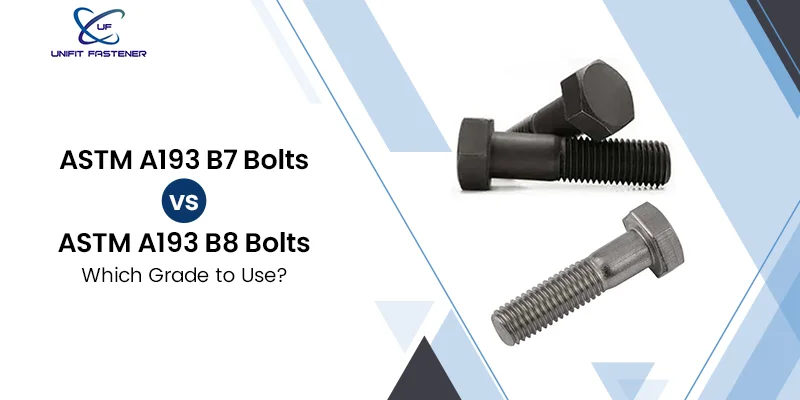
Fasteners play a vital role in the strength, stability and safety of industrial equipment, structures and piping systems. ASTM A193 is a broad-ranging specification for alloy steel and stainless steel bolts used in applications requiring high temperature and/or high pressure. ASTM A193 classification has several grades, many of which are utilized for fasteners, such as ASTM A193 Grade B7 and astm a193 b7 vs b8. While both are designed for harsh industrial settings, they are significantly different in material composition, strength, corrosion resistance and suitability for applications.
The objective of this comparison is to discuss the main differences between ASTM A193 Grade B8 and Grade B7 to assist engineers and buyers in determining which grade of fastener to use for particular operating conditions.
What is ASTM A193 Grade B7?
ASTM A193 Grade B7 is a chromium-molybdenum steel alloy grade steel fastener with high strength, heat treated to ensure that it has excellent mechanical properties. It is a widely-used material in applications where strength and reliability are paramount, such as in high-pressure and high-temperature settings. Because of its high load-bearing properties, Grade B7 is widely used in the oil and gas industry, power plants, oil refineries, pressure vessels and industrial pipe.
What is ASTM A193 Grade B8?
ASTM A193 Grade B8 is a stainless steel fastener grade that is produced from AISI 304 stainless steel. It is well known for its very good corrosion resistance, durability and durability in corrosive environments. To improve its mechanical properties and overall performance, Grade B8 fasteners are subjected to a solution heat treatment process. They are typically employed in chemical processing, marine, food processing and other industries where rust and oxidation resistance are desired.
Chemical Composition of B7 vs. Grade 8
| Element | Grade B7 Composition (%) | Grade B8 Composition (%) |
|---|---|---|
|
Carbon (C) |
0.37 – 0.49% |
≤ 0.08% |
|
Manganese (Mn) |
0.65 – 1.10% |
≤ 2.00% |
|
Phosphorus (P) |
≤ 0.035% |
≤ 0.045% |
|
Sulfur (S) |
≤ 0.040% |
≤ 0.030% |
|
Silicon (Si) |
0.15 – 0.35% |
≤ 1.00% |
|
Chromium (Cr) |
0.75 – 1.20% |
18.00 – 20.00% |
|
Molybdenum (Mo) |
0.15 – 0.25% |
— |
|
Nickel (Ni) |
— |
8.00 – 11.00% |
Mechanical Properties Comparison: B7 vs. Grade 8
| Grade | Tensile Strength (ksi, min) | Yield Strength (ksi, min) | Elongation (%, min) | Reduction of Area (RA %, min) | Hardness |
|---|---|---|---|---|---|
| B7 | 125 | 105 | 16 | 50 | Rc 28-32 |
| Grade 8 | 150 | 130 | 25 | 35 | Rc 33-39 |
ASTM A193 Grade B7 vs Grade B8 Comparison
| Property | Grade B7 | Grade B8 |
|---|---|---|
| Material Composition | Chromium-Molybdenum Steel | AISI 304 Stainless Steel |
| Corrosion Resistance | Low; requires coatings or plating | High; naturally resistant |
| Tensile Strength | 125 ksi (860 MPa) | 75 ksi (515 MPa) |
| Yield Strength | 105 ksi (725 MPa) | 30 ksi (205 MPa) |
| Hardness | HRC 35 max | HRB 92 max |
| Heat Treatment | Quenched and Tempered | Carbide Solution Treated |
| Common Applications | High-pressure and high-temperature environments | Corrosive and marine environments |
| Cost | Generally lower | Higher due to stainless steel material |
| Magnetic Properties | Magnetic | Non-magnetic |
| Weight | Heavier due to alloy content | Lighter compared to B7 |
Which Grade Should You Choose?
The choice of ASTM A193 B7 or B8 bolts depends on the operating environment, the strength required, and budget considerations.
Choose ASTM A193 B7 When:
- Strong and load bearing is needed.
- The project is considered an important one in terms of the cost.
- The application is at moderate to high temperatures.
- The fasteners are employed in the oil and gas, power generation or pressure vessel sectors.
- There is limited corrosion exposure or protective coatings can be used.
Choose ASTM A193 B8 When:
- The most important requirement is corrosion resistance.
- The application is used in marine, offshore or chemical environments.
- There is a potential food processing or sanitary service issue.
- Must be compatible with stainless steel.
- Resistance to rust and oxidation is a must.
Conclusion:
There are several ASTM bolts to choose from, which include ASTM A193 B7 bolts, B8, each designed for different applications. ASTM A193 B7 is a high-strength, cost-effective option, B8 is a highly corrosive resistant option and B16 is a high strength and performance at high temperature option. Knowing these differences contributes to safe, reliable, long-lasting bolted connections. Finned Tubes offers high-quality ASTM A193 B7, B8 to international standards, offering reliable fastening solutions for oil and gas, petrochemical, power generation and other high stress industrial applications.
Frequently Asked Questions
ASTM A193 Grade B7 is an alloy steel fastener known for high strength, while Grade B8 is a stainless steel fastener known for excellent corrosion resistance.
ASTM A193 Grade B7 is stronger than Grade B8, offering higher tensile and yield strength.
Yes, ASTM A193 Grade B8 is made from AISI 304 stainless steel.
ASTM A193 Grade B7 is manufactured from heat-treated chromium-molybdenum alloy steel.
Grade B8 offers better corrosion resistance because of its stainless steel composition.
ASTM A193 B7 bolts can be used in marine environments if properly coated, but Grade B8 is generally preferred due to its superior corrosion resistance.