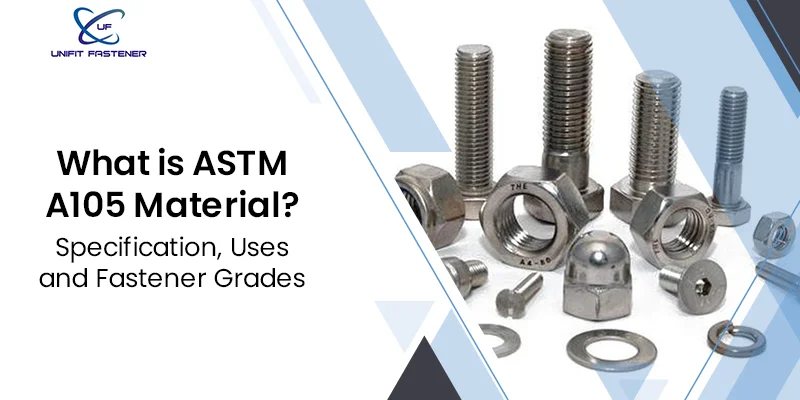
ASTM A105 is a carbon steel specification for pressure piping components in the form of forgings. It specifies flanges, fittings, valves and other similar parts suitable for use under ambient to moderately high temperature conditions.
The standard is contained in the ASME B16.5, B16.47 piping code frameworks and related piping code frameworks. A105 is a standard chemical and mechanical specification called out on a drawing/datasheet when a forged part must have this specification fulfilled and the part must be forged and inspected to the rules of ASTM A105.
ASTM A105 Material Chemical Composition
| Element | Composition (%) |
|---|---|
| Carbon | 0.35 max |
| Manganese | 0.60 – 1.05 |
| Phosphorus | 0.035 max |
| Sulfur | 0.040 max |
| Silicon | 0.10 – 0.35 |
| Copper | 0.40 max |
| Nickel | 0.40 max |
| Chromium | 0.30 max |
| Molybdenum | 0.12 max |
| Vanadium | 0.08 max |
Two cumulative limits also apply: the sum of Cu, Ni, Cr, Mo, and V must not exceed 1.00%, and Cr plus Mo combined must stay at or below 0.32%. The equivalent designations are UNS K03504 and Werkstoff Nr. 1.0460.
A105 Material Mechanical Properties
| Property | Value |
|---|---|
| Tensile Strength (min) | 70 ksi / 485 MPa |
| Yield Strength (min) | 36 ksi / 250 MPa |
| Elongation (min) | 22% |
| Reduction of Area (min) | 30% |
| Hardness (max) | 187 HBW |
These values apply to the forging in normalized, normalized and tempered, or annealed condition depending on section thickness. Heat treatment condition is tied to the forging size and the applicable clause in the specification.
Heat Treatment and PWHT Note: Forgings above 4 inches in controlling thickness require normalizing or normalizing and tempering under ASTM A105. For welded assemblies using A105 components, post-weld heat treatment (PWHT) is typically required per ASME B31.3 for certain thickness ranges and service conditions. Confirm PWHT requirements with your welding engineer before fabrication.
Where is A105 Material Used
A105 carbon steel is the default spec for forged pressure components across several industries. Its combination of strength, weldability, and machinability at non-cryogenic temperatures makes it the practical choice in most general piping work.
Common applications:
- Pressure vessel nozzles and flanges
- Gate, globe, and check valve bodies
- Pipe fittings: elbows,tees,reducers, and threaded plugs
- Oil and gas wellhead and manifold components
- Power plant steam and condensate piping
- Petrochemical and refinery process piping
Most procurement specs in these sectors default to A105 for forged carbon steel pressure parts unless a low temperature or high alloy requirement pushes the spec to something else.
A105 Fastener and Product Forms
ASTM A105 material is also used for fastener stock and round bar in pressure-rated bolting and structural applications. Product forms available from Unifit include:
- Studs and stud bolts
- Hex bolts and heavy hex bolts
- Anchor bolts
- Threaded bars and rods
- Hex nuts and heavy hex nuts
For flange bolting per ASME B16.5 or B16.47, A105 studs are commonly paired with A194 Grade 2H heavy hex nuts. This combination covers most ambient and elevated temperature pressure service requirements.
Request a quote for ASTM A105 studs, hex bolts, anchor bolts, and threaded bar, available in standard and custom lengths.
Contact Unifit Metalloys for stock confirmation and pricing.
A105 Material vs A350 LF2
These two grades get compared often enough that the distinction is worth being precise about.
| A105 | A350 LF2 | |
|---|---|---|
| Service Temperature | Ambient to elevated | Low temperature / sub-zero |
| Impact Testing | Not required | Mandatory Charpy testing |
| Typical Use | General pressure piping | Cold climate, cryogenic piping |
| Carbon Content | 0.35% max | 0.30% max |
A350 LF2 is a low temperature carbon steel grade. The key addition over A105 is mandatory Charpy V-notch impact testing, which confirms the material's toughness at sub-zero temperatures. A105 has no such requirement.
If the design temperature stays at or above -20°F (-29°C), A105 is the correct choice. For pipelines in cold climates, LNG service, or any cryogenic-adjacent application, A350 LF2 is required. Specifying A105 in a low temperature application is a compliance issue. Specifying A350 LF2 where A105 would do adds cost without technical benefit.
Sourcing A105 Round Bar and Fasteners from Unifit
Unifit Metalloys supplies ASTM A105 forgings and fasteners with full EN 10204 3.1 traceability to engineering teams, EPC contractors, and procurement departments across India, the Middle East, and Southeast Asia. For available sizes and grades, visit our ASTM A105 Carbon Steel Round Bars page, and for full technical data to use in your procurement documents, refer to our A105 Material Specification page. For pressure-rated plugs and bushings machined from this grade, see our Threaded Plugs page.
Frequently Asked Questions about A105 Material
No. A105 has no mandatory impact testing and isn't qualified for sub-zero service. For design temperatures below -20°F (-29°C), specify A350 LF2, which requires Charpy V-notch testing for verified low-temperature toughness.
Standard supply includes an EN 10204 3.1 mill certificate showing heat number, chemical composition, and mechanical test results (tensile, yield, elongation, hardness) traceable to the specific batch
Yes. A105 studs are routinely paired with A194 Grade 2H heavy hex nuts for ASME B16.5/B16.47 flange bolting, covering most ambient to elevated temperature pressure service without additional qualification.
Not by default. Standard A105 doesn't include the hardness controls or supplementary testing NACE MR0175/ISO 15156 sour service requires. Confirm with your supplier whether NACE-compliant A105 is available before ordering.