When confronted with specifications such as ASTM A193 B8, B8M, Class 1, Class 2 and material grades of SS 304-316 it is easy to feel overwhelmed when deciding on the right stainless steel stud bolts. To engineers, procurement managers and project supervisors, a wrong decision does not only mean wasted funds but it can have disastrous effects such as corrosion breakage, pressure leakage, security risks, and unplanned shutdowns that end up halting entire processes.
This guide will touch on the key requirements in choosing stainless bolts, and you would have the information to make the right decision that will contribute to the quality and durability of your projects. At the end, you will be in a position to make the appropriate decisions of the kind of stainless bolts that will not only match the purpose of your project but also with the test of time.
What Are Stainless Steel Stud Bolts and When to Use Them
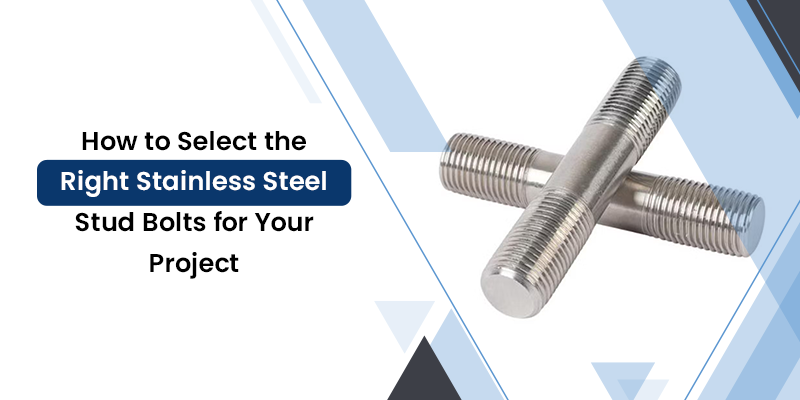
A stud bolt is not similar to a regular machine bolt in terms of design and usage. On a machine bolt, one end has a head and the other end has threads whereas a stud bolt is simply a threaded rod that has no head, it is often threaded on both sides and clamped with two nuts. This design of a headless type has a number of unique benefits that make stud bolts the choice of application.
The main benefit of stainless steel stud bolts is that they can be tensioned on both sides of the joint at the same time to provide a higher seal integrity of high-pressure joints. In relation to joining two flanges on a pipeline or pressure vessel, the possibility to force the tension on both sides is a guarantee of proper compression of gaskets and elimination of leaks in extreme working conditions.
Incorporation of stainless steel stud bolts is in favor of carbon steel substitutes where the avoidance of corrosion is paramount. Even coated bolts of carbon steel finally give in to corrosion and rust in corrosive environments. Stainless steel has inbuilt corrosion resistance that is not reliant on the coating on the surface thus it has a long period of reliability in tough environments.
The steel stud bolts are commonly used in:
- pipeline flanging connections where the flow of the hydrocarbons or chemicals in high pressure occurs.
- refineries and chemical plants with a high level of safety regulations in pressure vessels.
- power-generation facilities that require the use of heat exchangers, and the temperature is often high.
- equipment installation in offshore platforms where there is always saltwater exposure.
Interpretation of the Essential Specifications: ASTM A193 B8 and Material Grades
ASTM A193 standard is the gold standard of high temperature and high pressure bolting application. You meet the designation ASTM A193 B8 and you are on a given grade under this standard. The B8 means that it is Type 304 stainless steel (18% chromium, 8% nickel) which has been treated with carbide solution. This heat treatment process solubilizes chromium carbides which may form during the welding operation or under high temperature exposure and does not affect the corrosion properties or mechanical characteristics of the material.
It is also important to understand the designation of the class. ASTM A193 B8 bolts come in two classes:
- Class 1 is solution-treated material with tensile strength that is 75 ksi (515 Mpa) minimum, yield strength of 30 ksi (205 Mpa) and a top hardness of 223 HBW. It is the standard specification of most applications where the main issue is corrosion resistance and moderate strength is needed.
- Class 2 is further strain hardened (cold worked) following solution treatment with much greater mechanical properties; the minimum tensile strength of 125 ksi (860 MPa) and yield strength of 100 ksi (690 MPa). The class used is determined when the load in bolts has to be higher to ensure compression of the gasket under high pressure application or when the joint is subjected to external loads.
Material Selection Guide: SS 304 Stud Bolt vs 316 vs B8M
The choice of materials can probably be considered as the most crucial step in selecting stainless steel stud bolts. The flawed grade in one setting will result in the untimely failure whereas the correct grade will provide decades of solid service. Now, we shall discuss the main alternatives:
SS 304 / ASTM A193 Grade B8 is the horse of the stainless steel fastener business. This austenitic stainless steel is made of 18% chromium 8% nickel and offers great overall resistance against corrosion at a very affordable price. SS 304 stud bolt will be very effective in atmospheric exposure, less severe chemicals around, food processing plants, and general industry. It is resistant to oxidation and most organic chemicals and is therefore fit in most applications where chlorides are not an important factor.
Grade B8 is the default option when it comes to numerous projects due to its cost-effective nature. Nevertheless, it is also essential to know its shortcomings. Typically, Type 304 is prone to pitting and crevice corrosion especially in high chloride or environments with a high chloride content greater than 200 ppm and this results in sudden failure.
SS 316 / ASTM A193 Grade B8M is an upgrade that is uniquely designed to suit marine and chloride-containing environments. There is a significant enhancement in the resistance to pitting corrosion and crevice corrosion in chloride environments when 2-3% molybdenum is added to the base composition (18% chromium, 10-14% nickel). This causes Grade B8M to be the required one in offshore platforms, desalination plants, coastal plants, pulp and paper mills which use chlorine bleaching, and other places where saltwater can touch or spray.
Grade B8M price premium is usually between 20-40 percent of Grade B8 and the reason is that the investment pays back by removing premature failures, lowering upkeep expenses and increasing the service life in corrosive conditions.
Other Grades: There are other grades that are worthy of special use. ASTM A193 B8T incorporates Type 321 stainless steel that consists of titanium stabilization to prevent sensitization and precipitation of carbide during high temperatures (800-1500degF). The grade is also required in applications where the corrosion resistance may be affected by sensitization due to long periods of exposure to high temperatures.
Material Comparison
| Common Name | ASTM Designation | Material Composition | Best For |
| SS 304 | ASTM A193 B8 | 18% Cr, 8% Ni | General chemical plants, atmospheric exposure, food processing |
| SS 316 | ASTM A193 B8M | 18% Cr, 10% Ni, 2% Mo | Marine environments, high chloride, offshore, coastal facilities |
| SS 321 | ASTM A193 B8T | Titanium stabilized | High-temp stability, prevents carbide precipitation |
Thread Types and End Configurations for Stud Bolts
The arrangement of threads has a considerable influence on the functions and usage of stainless steel stud bolts. Since these differences exist, it is important to understand them in order to be able to define precisely what product will best fit your needs.
Fully Threaded Studs:The most common flange connection is fully threaded Studs. The threads are placed up the length of the rod and those offer maximum flexibility in positioning nuts and can be used to adjust to flange thickness differences or gasket compression needs. They are always applied in the ASME B16.5 flange connections when both the flanges are drilled throughout.
Tap End Studs:In this type, each end has a different thread length with one end specially made to screw into a blind tapped hole. The tap end usually accepts a Class NC5 or Class UNRC 3A thread fit, which is interfering with and causes the stud to not back out when tightening the nut on the other end. The nut end has a common Class UNRC2A that fits with easy installation of the nut. Tap end studs are needed because one of the flanges contains tapped holes instead of through- holes, or where the equipment is to be mounted on equipment with threaded mounting holes.
Double End Studs:These have threads on both ends separated by an unthreaded shank at the center. This type has a number of benefits: since the unthreaded section of the tool can pass through holes in thin-walled parts with no thread engagement, the shank is smooth, therefore reducing the concentration of stress, and the design can be more tightly controlled in their clamping length. Gasket materials that are soft and where it is important to have controlled compression will demand that double end studs be used.
Thread Pitch: Special attention should be given to Thread Pitch that has a direct impact on the sealing performance when it is used in high-pressure applications. With stainless steel stud bolts there are two series of threads dominant:
Coarse Threads (UNC: In diameters up to 1 inch, coarse Threads (UNC) are used. These offer quicker installation and they have more tolerance to thread damage or contamination.
8-Thread Series (8UN) becomes the standard for ASTM A193 B8 bolts with diameters above 1 inch. Having a thread pitch of 8 threads/in. (diameter independent) gives this thread pitch better sealing and achieves more localized control of the tension of the bolts and more homogeneous stress to the gasket surface. ASME B16.5 standards of pressure-retaining connection specifically call out the 8UN series.
Critical Factors to Consider When Selecting Steel Stud Bolt
The effectiveness of stud bolt choice involves consideration of a number of factors that are closely related and define long-term performance and safety.
Yield Strength Requirements should be in accordance with the loading conditions of your application. Many applications in which gasket seal is the main factor of concern use class 1 stainless steel stud bolts with yield strength of 30 ksi. Nonetheless, high-pressure applications including those that use spiral-wound gaskets or ring-joint gaskets which necessitate high compressive forces necessitate Class 2 material with 100 ksi yield strength. Poor specification of strength will result in poor gasket compression, leaks, and joint failure. It should be calculated based on the gasket pressure needed, flange design and operating pressure as per ASME PCC-1 guidelines.
Hardness Considerations are often neglected yet they are very essential in ensuring that the equipment is not damaged. To prevent the damage of flange faces and stud holes during installation or operating loads the stud bolt must not be significantly harder than the material used in the flange. The concern is met with maximum hardness limits in ASTM A193, although it can be ensured by additional hardness testing of received material.
Galling Riskis a major problem of stainless steel fasteners. Cold-weld and friction Stainless steel has a tendency to cold-weld under pressure and friction and therefore thread seizes during installation or removal. Such galling is more common in the case of stainless-on-stainless thread engagement and with the rate of installation and the lack of lubrication. Mitigation plans are as follows:
- Use of anti-seize lubricants that have molybdenum disulfide or copper.
- Adding PTFE or Xylan coating which gives intrinsic lubricity.
- Regulation of installation torque rate to minimize the heat generation.
- In high-grade applications Grade B8M should be used instead of B8 because molybdenum content decreases the tendency of galling.
Galvanic Corrosionpertinent issues will arise when dissimilar metals come into contact with one another in the presence of an electrolyte (moisture). When stainless steel studs are attached to carbon steel flanges without isolation, a galvanic cell is formed in which the corrosion of the carbon steel (more anodic) takes place. This hastened corrosion can affect the integrity of the joints in a few months in wet or humid climates. Some solutions involve the isolation kit which involves non-conductive sleeves and washers, the flanges and studs should be made of compatible materials, or use of protective coatings to form a kind of electrical isolation.
Application-Specific Selection: Pressure, Temperature, and Environment
Various operating conditions require various stud bolt specifications. Knowing the effects the parameters of your particular application have on your choice of material will not only save you over-engineering (wasted money) or under-engineering (you could fail).
High Temperature Servicepresents the versatility of stainless steel. Stainless steel stud bolts of grades to ASTM A193 have mechanical properties that span an utterly wide temperature range: to cryogenic service at -325degF and continuous service at 1500degF in some grades. Grade B8 (304) works at temperatures up to about 1400degF whereas Grade B8M (316) is used in temperatures up to the same range with greater creep resistance. In cases where the applications surpass such limits, Grade B8T (321) which is titanium stabilized helps in eliminating sensitization and retaining strength.
The temperature does not only influence the choice of the material but also the practice of the installation. Cyclic loading of the bolted joints is caused by thermal expansion when the equipment is heating and cooling. Thermal effects are considered by proper bolts tensioning, and higher initial preload is usually needed to ensure that gasket compression is maintained throughout the thermal cycle.
High Pressure Applications are direct requirements on tensile strength and stress area. Pressure doubles the force trying to cause the separation of flanges and higher tension in bolts is needed to ensure integrity of seals. The calculation involves:
- Stress needed in gasket seating (depends on the type of gasket)
- Operating pressure and size of flanges.
- Number and size of bolts
- Yellow steel yields strength.
- Safety factors according to the ASME codes
At pressures that are higher than 600 psi, the Class 2 material is normally required to provide the required bolt loads without reaching 50-60 percent of yield strength, a good engineering practice to prevent stress corrosion cracking.
Corrosive Environment Assessment requires one to know which corrodants exist in your application because every chemical agent attacks the stainless steel in a different way. The depth of corrosion analysis must not only have the main chemicals that touch bolts but also follow up the contaminants that may have been left by trace and which may hasten the corrosion process. The next step is to consult corrosion charts and consult with materials engineers: you want to match the grade of the stud bolt with the precise profile of chemical exposure your equipment will be exposed to:
- Organic Acids: Grade B8 (304) is sufficient in terms of resistance.
- Chlorides: Grade B8M (316) required, may be upgraded at 1000 ppm or beyond to duplex stainless.
- hydrogen sulfide: low-carbon grades Special: low-carbon grades or Alloy 625 may be sour service.
- Caustics: B8M grade of caustics of correct concentration and temperature.
| Application Factor | Recommended Stud Bolt Spec | Why? |
| Standard Outdoor / Humidity | A193 B8 (SS 304) | Cost-effective rust resistance for non-chloride environments |
| Marine / Salt Spray | A193 B8M (SS 316) | Molybdenum resists pitting from chlorides |
| High Pressure Valve | A193 B8 Class 2 | Higher tensile strength maintains seal under pressure |
Quality Standards and What to Look for in Stainless Steel Stud Bolt Manufacturers
The first step of quality assurance is with the choice of suppliers. By engaging licensed stainless steel stud bolt manufacturers like Unifit Fastener who know how to use and enforce stringent quality requirements, you would be saving your project against low quality materials which could cause disastrous failure.
Mill Test Reports (MTRs) are the most important records of any stainless steel fastener. The certificates confirm chemical composition by spectrographic analysis as well as mechanical properties of the material such as tensile strength, yield strength, elongation, and hardness. Each lot of studs must be accompanied by MTRs that can be traced to the heat (melt) of steel, which was used to make. In the absence of MTRs, then you have no testable evidence that the material is being used to anything other than ASTM A193 requirements.
Quality of threads has a great influence on performance and life. A thread rolling, created not through cutting the material but by setting aside the material, provides a better fatigue strength since the grain structure is the shape of the thread and the surface strength is enhanced through work hardening. Cut threads, which may be required in large diameter or special threads, cause discontinuous grain structure and stress risers that decrease fatigue life by 2030%. The thread rolling of standard size is done by manufacturers of quality and thread dimension is controlled to fit ASTM A194 nuts.
Marking Requirements under ASTM A193 mandate that each stud display the grade symbol (B8, B8M, etc.) and manufacturer's identification mark on at least one end. This is marked so that they can be verified and traced by the field. Lack of proper marking should also send alerts regarding the genuineness and quality.
ISO 9001 Certification proves that the manufacturer has a quality management system taking a documented procedure in the production control, inspection, testing, and continuous improvement. Although certification does not ensure quality, it shows that organizations are committed to quality and customer satisfaction in the process.
Common Selection Mistakes and How to Avoid Them
Learning from common mistakes prevents expensive mistakes that may affect the safety and project schedule.
Mistake 1: Using Class 1 bolts where Class 2 strength is required. This is where standard materials are selected without Calculation of ASME PCC-1 load, this leads to low gasket compression and failure of the joint at the operating pressure.
Mistake 2: Assuming all "stainless" is the same. Replacement of 304 stainless steel with 316 stainless steel in marine conditions results in pitting and stress corrosion cracking occurring very fast.It is always essential to insist on material certifications to ensure that the grade is that of the material.
Mistake 3: Failure to pay attention to the matching nut specification.When ASTM A193 studs are used with incompatible ASTM A194 nuts (e.g. B8M studs with anything but Grade 8M nuts), galvanic corrosion and stripping off of threads occurs.
Mistake 4: Over-torquing unlubricated stainless bolts. When "dry" threads are installed, they gall (cold welding), and are ruined and the bolt cannot attain the preload it needs.Avoid failure to insist on anti-seize or official lubricants.
Mistake 5: Not verifying material after delivery. It is not only through paperwork, but also by conducting Positive Material Identification (PMI) and hardness testing on the important deliveries that there is a risk of installation of non-compliant or counterfeit materials.
The Bottom Line
To find the correct stainless steel stud bolts, you need to follow a methodology; the first step is to examine your environment and identify the corrosive substances, temperature limits, and pressure demands; the next step is to choose the correct grade (B8 for general use, B8M for chloride environments) depending on the assessment of the environment; the third step is to determine the required class (Class 1 to general applications, Class 2 to high pressure service) according to the analysis of the required load on the bolts; and after that, to ensure the quality of manufacturers, certifications,
When you are dealing with such critical applications as high pressure, extreme temperatures, or corrosive environments, a good consultation with seasoned engineers and collaboration with reputable manufacturers like Unifit Fastener is the key which will provide you with not only products but also experience that will guard your investment and staff. The time it took to get the specifications of stainless steel stud bolts right is compensated by the factor of safety, reliability, and service life that is seen through the life of your equipment.
Unifit Fastener is one of the the most trusted stainless steel stud bolt manufacturers and suppliers with accurate engineered fastening solutions, which are of international quality. Our advanced standards of quality control, total MTC documentation and expertise-based on applications assure dependable performance in harsh industrial environments. The collaboration with such an established manufacturer as Unifit Fastener will ensure safety, durability, and value in the long term.