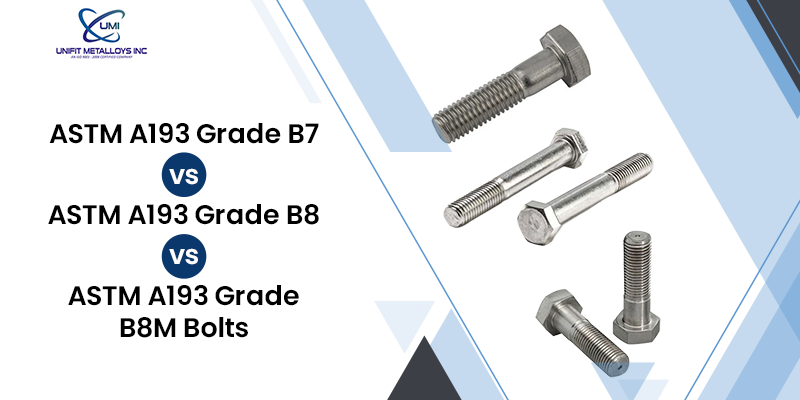
Wrong bolt grade. Two terms that are capable of halting a refinery, passing a pressure vessel inspection or corroding an offshore flange system within less than a season. In high pressure and high temperature service, the choice of fasteners is no longer a procurement consideration, but a design consideration.
ASTM A193 provides three grades that encompass almost all industrial bolting applications. B7 which is used in strength and heat, B8 which is used in general corrosion resistance, and B8M which is used in chloride-heavy conditions. Whether it is defining pressure vessel fasteners, ordering high temperature bolts to re-fit a boiler, or making certain that ASME B16.5 bolting compliance on a new flange connection, it is the logic behind the selection you are going to use to get it right the first time.
What Is ASTM A193?
ASTM A193 is the standard of ASTM International which regulates alloy and stainless steel bolts of high temperature or high pressure. It discusses chemical make-up, mechanical, heat treatment and dimensional needs of bolts, stud bolts and threaded rods applied in pressure-rated equipment in the oil and gas, petrochemical, power generation and chemical processing industries.
ASTM A193 specifications is not applicable to both structural and general-purpose fasteners, however it is intended to be used where structural integrity is required: flanged connections, pressure vessels, heat exchangers, boilers, and valve bonnets. Every specified grade is combined with a respective ASTM A194 nut to create a complete and tested assembly of bolts. The B7, B8 and B8M three grades in this guide take care of the vast majority of the industrial procurement in the world.
ASTM A193 Grade B7 Fasteners: The Workhorse of Industrial Bolting
ASTM A193 grade B7 fasteners are also a type of fasteners made of AISI 4140 or 4142 chromium-molybdenum alloy steel, which is quenched and tempered to form a tempered martensite microstructure. The outcome is high tensile strength, good toughness, and a very high fatigue resistance, the factor that makes B7 the first, second, and third choice in the petrochemical and power industries.
Mechanical Properties
At 2-1/2 inches or larger minimum tensile strength is 125 ksi. Minimum yield is 105 ksi. The upper limit of hardness is limited to 321 HB (35 HRC) which limits the tendency to hydrogen embrittlement and stress corrosion cracking in sour service conditions.
Temperature Range and Applications
B7 alloy steel stud bolts has good performance to a temperature of 900°F (482°C) and chromium-molybdenum alloy gives creep strength to withstand continuous high-temperature loading. B7 can be found on steam pipelines, pressure vessels, boilers, compressor casings and ASME B16.5 flanges of Class 150 to 2500. According to the ASTM A193 standards, the appropriate combination of nuts is ASTM A194 Grade 2H heavy hex.
One exception: B7 is a carbon alloy steel and does not have an intrinsic corrosion resistance. Where corrosive environment, indicate a protective coating – or change to a stainless grade.
ASTM A193 B8 Fasteners vs ASTM A193 B8M Class 1: Choosing the Right Stainless Grade
In cases where the main force is the corrosion resistance, the decision is limited to two stainless grades: B8 (Type 304) and B8M (Type 316). It is not necessarily only a question of metallurgical difference, in the unsuitable environment, it will cost much more to specify B8 instead of B8M than the cost difference in the bolt.
Grade B8: AISI 304 Stainless
ASTM A193 B8 fasteners are Type 304 stainless that is carbide solution-annealed. Class 1 (only solution-annealed) provides tensile strength of 75 ksi minimum with corrosive strength maximum. Class 2 imparts strain hardening to attain tensile of 100–125 ksi at the expense of some grain-boundary corrosion resistance. B8 is the correct choice of food processing, pharmaceutical and general chemical service – where there are no substantial levels of chlorides. The exposure of Type 304 to chloride bearing media and pitting, crevice corrosion and stress corrosion cracking ensues quickly.
ASTM A193 B8M Class 1: AISI 316 Stainless
ASTM A193 B8M Class 1 Type 316 stainless – The same Type 316 austenitic base used in B8, except 2–3% molybdenum. That one alloying component is the distinction between a bolt that lives offshore or on service at a chemical plant and one that does not. Molybdenum significantly enhances the pitting and crevice corrosion resistance in chloride containing environment and this makes B8M the mandatory specification in offshore platforms, coastal installations, desalination plant and subsea connections.
ASTM A193 B8M Grade 1 fasteners are carbide solution treated; Grade 2 also strain hardened to provide higher load fasteners. Nut pairing: ASTM A194 Grade 8M. Designers who wish to meet ASME B16.5 bolting criteria in corrosive service must default to B8M – the only reason to use B8 is to be sure that the requirement is low-chloride, and uphold a conscious cost compromise.
Side-by-Side Specification Comparison: B7 vs B8 vs B8M
Use the table below to align grade selection with your design codes like ASME B16.5, ASME BPVC Section VIII, or NACE MR0175 at a glance.
| Grade | Base Material | Min Yield (ksi) | Max Temp (°F) | Typical Application | Nut Pairing |
|---|---|---|---|---|---|
| B7 | AISI 4140/4142 Cr-Mo Alloy Steel | 105 | 900°F | Pressure vessels, flanges, pipelines, refineries | ASTM A194 2H |
| B8 Class 1 | AISI 304 Stainless Steel | 30 | 1000°F+ | Food processing, pharma, general corrosion environments | ASTM A194 8 |
| B8 Class 2 | AISI 304 SS (Strain Hardened) | 65 | 800°F | High-pressure SS flanges, raised face connections | ASTM A194 8 |
| B8M Class 1 | AISI 316 Stainless Steel | 30 | 1000°F+ | Offshore, marine, chloride, chemical processing | ASTM A194 8M |
| B8M Class 2 | AISI 316 SS (Strain Hardened) | 65 | 800°F | High-pressure service in corrosive environments | ASTM A194 8M |
Need to specify the right grade for your project? Request a quote from Unifit Fastener and our technical team will confirm the correct grade, class, and nut pairing for your ASTM A193 specifications.
Conclusion: Match the Grade to the Service Demand
The choice of grades is reduced to three questions: How hot? How strong? How corrosive? B7 provides maximum strength and heat resistance up to 900°F and is used in non-corrosive applications as a standard of flanged joint bolting in oil, gas and power plants. B8 introduces Type 304 stainless, which is corrosion resistant and is applicable in pharmaceutical, food and general chemical service where chloride exposure is not a consideration. B8M advance with Type 316 stainless, molybdenum additions, and it is being required in offshore and marine and any other chloride containing environment. Compare your choice to ASME B16.5 requirements in bolting, design temperature and any NACE or project sour-service requirements – the correct choice of grade at the beginning is the cheapest choice to make about a pressure system.
Ready to source the right grade for your project? Contact Unifit Fastener for a fast quote on ASTM A193 grade B7, B8, and B8M stud bolts and threaded fasteners, or download our product data sheet for full mechanical and dimensional specifications.
Frequently Asked Questions
Can B7 and B8 be used interchangeably?
No. B7 and B8 are quenched and tempered Cr-Mo alloy steel and austenitic stainless respectively. They vary in tensile strength, thermal expansion and corrosion resistance. Replacement of grades without engineering check can cause joint leakage, galvanic corrosion on the flange face or mechanical breakdown. Replacement must always be checked on the original equipment design basis and the relevant ASME standards.
What ASTM A194 nut pairs with B7 bolts?
ASTM A194 Grade 2H heavy hex nuts. This B7 / 2H combination is the accepted standard of high pressure, flanged joint, bolting in oil, gas, and petrochemical service – called-up by the majority of engineering specifications ASME B16.5 Class 600 and above.
When should I specify B8M over B8?
Wherever there is chloride: marine or coastal air, sea water, salty solution or chloride-containing process water. The molybdenum of Type 316 (B8M) offers significantly greater values of pitting and crevice corrosion resistance as compared to the Type 304 base of B8.
Does ASTM A193 cover both stud bolts and hex bolts?
Yes, bolts, stud bolts, (double-end studs) and threaded pressure equipment rod. In the case of flanged connection, the common form is the stud bolt (fully threaded stud with two heavy hex nuts) according to the ASME B16.5 bolting practice.