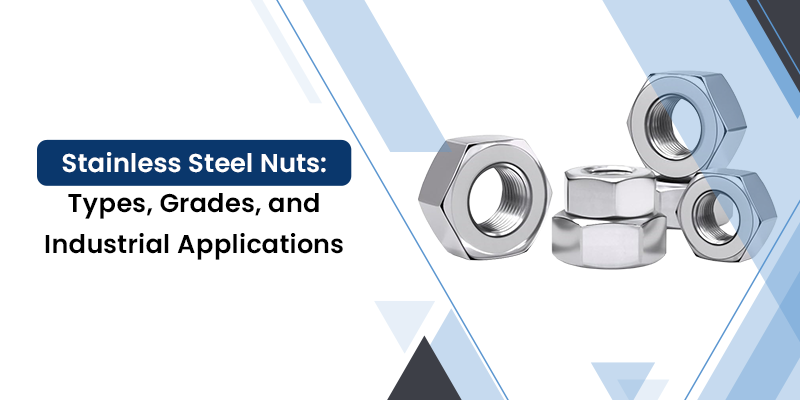
Nuts are much more than merely accessories in fastener assemblies, and they are of crucial importance in the determination of structural integrity and operational safety. The appropriate grade and type of stainless steel nut is what can ensure that the eventual failure modes of catastrophic failures such as galling, thread seizure or corrosion-based breakdown are averted. Be it marine applications or chemical processing facilities, high temperature processes, or any other application that requires fasteners, it is the ins and outs of both stainless steel nuts that can either guarantee the success of the implementation or costly losses in downtime. It is a complete reference guide to the engineers, procurement experts and project managers who are trying to find their way around the confusing world of stainless steel fastening systems.
What Are Stainless Steel Nuts and Why They're Essential
A stainless steel nut is the female component of a threaded fastening system, which clamps the nuts and spreads the loads of clamps on the joint surfaces. In comparison to carbon steel alternatives, stainless steel nuts have better corrosion resistance because of chromium (at least 10.5%) that creates an inertive passive oxide layer on the surface.
The principle of mating pairs is a very basic one-compatible bolt and nut grades eliminate galvanic corrosion and provide homogenous material behaviors when subjected to stress. The industries that are highly reliant on such components are:
- Construction: Structural works, curtain work and infrastructural development.
- Marine: Fittings to boats, offshore platforms and seashore installations that are to be in contact with salt water.
- Automotive: Engine units, exhausts, and chassis units.
- Food Processing: Clean and sanitary food preparation requiring resistance to corrosion as well as facile sterilization.
Due to the aesthetic value and hygienic quality of stainless steel, it is unreplaceable in a place where functionality is as important as the appearance.
Types of Stainless Steel Nuts: Hex, Lock, Wing, Acorn, and Specialty
The stainless steel nuts come in a variety of designs that are designed to satisfy particular mechanical, environmental and functional demands. Appropriate selection of type of nut is critical in providing secure fastening, load distribution, shock absorbing and installability in various applications. The most used stainless steel types of nuts and their common application are listed below.
- Hex Nuts are the industry workhouse which is equipped with six sided geometry that offers the best wrench engagement to general fastening requirements in both machines and construction industry.
- Nyloc/Lock Nuts use nylon inserts or deformed threads to generate friction to ensure that they will not loosen in high vibration such as automotive suspension and industrial machine applications.
- Wing Nuts have sticking tabs that can be used without tools with their hands to tighten, and these tabs can be used in temporary installations, movable assemblies, and places where they have to be disassembled frequently.
- Cap Nuts (stainless acorn Nuts) are practical and safe - the domed tops of the caps shield sharp thread ends, which provide aesthetic finishing to railings, furniture and decorative purposes and prevent injuries.
- Flange Nuts incorporate a broad washer type base which spreads the loads across more surface area, useful especially when oversized holes are used or when there otherwise is a requirement to resist vibration without an independent washer.
Understanding Stainless Steel Grades for Nuts: 304, 316, 321, and More
The Austenitic stainless steel family (300 series) is the most popular in nut manufacturing because of the high formability, weldability and corrosion resistance. Standard Stainless Steel 304/304H/304L Nuts have general use, and the high-end grades such as Stainless Steel 316/316L Nuts and Stainless Steel 321 Nuts are used to solve particular environmental problems.
‘L’ designations are used to mean low carbon content (≤0.03%), which improves the weldability and minimizes the formation of carbide. There are improved high-temperature creep resistance grades of H that have higher carbon. The heavy hex nuts used in pressure vessels are under specifications ASTM A194 Grade 8 and 8M, whereas the chemical compositions are characterized by AISI (304,316, 321).
Grade Stainless Steel 304 Nuts: Properties and Applications
Stainless Steel 304/304H/304L Nutsare made of a mixture of some 18-percent chromium and 8-percent nickel (18/8 stainless), and this type of steel is the most commonly used in all parts of the world. This alloy is a perfect overall corrosion resistance at a cost effective level and so it is the default option in non-aggressive environments.
Uses are in the fields of indoor furnishing assemblies, architectural hardware, general construction fastening and automotive trim parts. The versatility of the grade is attributed to its balanced characteristics in that it has adequate strength that can be used in the majority of the applications in addition to good formability and good weldability. Where the exposure to marine environments or other types of chemical contact are not expected, 304 nuts offer the best cost-effectiveness and do not harm the reliability.
Grade Stainless Steel 316 Nuts: Marine and Chemical Applications
Stainless Steel 316/316L Nuts incorporate 2-3% molybdenum, dramatically enhancing resistance to pitting and crevice corrosion in chloride-rich environments. This addition transforms performance in aggressive conditions, earning the "marine grade" designation.
Superior chloride resistance makes 316 nuts essential for boat fittings, dock hardware, offshore oil platforms, chemical processing equipment, and pharmaceutical manufacturing facilities. While commanding a premium over 304 grade, the investment proves cost-effective when preventing corrosion-related failures in harsh environments. The 316L variant's reduced carbon content further improves welding characteristics and intergranular corrosion resistance.
High-Temperature Grades: 310, Stainless Steel 321 Nuts, and 347
Standard 304/316 grades cannot be used in sustained high temperature service exceeding 800degF temperature because they precipitate carbide that will result in intergranular corrosion and creep deformation.
- Stainless Steel 321 Nuts has titanium stabilization that inhibits the formation of chromium carbide along the grain boundaries in thermal cycling. This renders them suitable in exhaust manifes, furnace parts and expansion fittings.
- Stainless Steel 347/347H Nuts made of stainless steel replace niobium (columbium) with titanium, and provide the same stabilizing properties as well as higher intergranular corrosion resistance in weld assemblies.
- Stainless Steel 310/310S Nuts with a high level of chromium (25) and nickel (20) combined material, which is known to have the highest level of oxidation and retention of strength at higher temperatures than other types, these Nuts are usually used in furnace hardware, heat exchangers, and kiln components.
Matching Stainless Steel Bolts and Nuts for Optimal Performance
Galling is a serious form of adhesive wear in which stainless steel threads are cold-welded together during tightening; it is prevented by material compatibility between stainless steel bolts and nuts. This is due to the fact that the protective oxide coating of stainless steel is destroyed during friction resulting in metal to metal contact.
Solutions include:
- Mixed hardness combination: By using somewhat different grades (316 nut and 304 bolt) a hardness difference is produced.
- Anti-seize compounds: Lubricants that are made of nickel control seizing of threads.
- Controlled torque: According to the specifications of the manufacturer, it is not over-tightened.
Appropriate torque values are important- stainless fasteners need 20-30% smaller torque than those made of carbon steel because of bigger friction coefficients.
Industrial Applications: Where Different Nut Types and Grades Excel
<The fastener performance is mostly determined by the corrosive resistance of the fastener to certain corrosive agents and thermal stresses in the field. Food grade hygiene to the high pressure requirements of deep sea production, the subsequent grades are the industry standards of their respective sectors.
- Food & Beverage :Stainless Steel 304/304H/304L Nutsand 316/316L variants are hygienic as mandated by the FDA, and they are also resistant to harsh wash-down agents.
- Oil/ Gas: Stainless Steel 316/316L Nuts and Stainless Steel 317/317L Nuts are used in off-shore platforms as corruption resistant to hydrogen sulfide and saltwater.
- Aerospace: In both engine and exhaust systems, Stainless Steel 321 Nuts and 347/347H grades are preferred because of their high thermal cycling capability.
- Water Treatment: It is necessary to treat water that contains chlorine with a minimum of 316 grade to avoid stress corrosion cracking.
Selection Guide: Choosing the Right Stainless Steel Nut for Your Project
The correct choice means a methodical analysis of the mechanical and environmental factors that the joint is going to experience during the service life. Applying a systematic stage-by-stage process would ensure that the selected hardware avoids systemic complications such as galliaging, stripping or early oxidation.
- Step 1: Environment: Ascertain the environment, be it either indoor, outdoor, marine or chemical in order to determine the base grade requirements.
- Step 2: Temperature: austenitic grades should be used on cryogenic applications, and stabilized 321/ 347 or high-nickel 310 should be applied on high-heat applications.
- Step 3:Nut Type: Choose lock nuts to be used to reduce vibration, stainless acorn nuts to be used to enhance the looks and stainless steel bolts nuts and washers to be used to have enhanced load distribution.
- Step 4: Compatibility: Check thread pitch (UNC/UNF) and compare material grades to eliminate galling and achieve adequate load transfer.
The Bottom Line
Although stainless steel nuts might seem to be a simple matter, the consequences they have on the structural stability, safety, and the long-term viability of operations are massive. Choosing between Stainless Steel 304/304H/304L Nuts, 316/316L, or special high-temperature alloys 321, 347/347H, wholly relies on exposure to the environment, extremes of temperature, and contact with chemicals. Knowledge of these differences, and correct matching of stainless steel bolts and nuts, not only saves wear and tear in expensive failures, but also offers a dependable service in time-tried applications in the toughest industrial use. In cases of critical fastening requirements, consult metallurgical experts who will study your requirements and advice on the best grades and configuration.
Unifit Fastener. is a reputableStainless Steel Nuts manufacturer and supplier of accurately engineered nuts which meet the international standard and the rigorous industrial demands. Unifit Fastener is committed to providing material integrity, dimensional accuracy, and uniform quality, which are important in providing fastening solutions that can perform in the long term in sensitive applications.