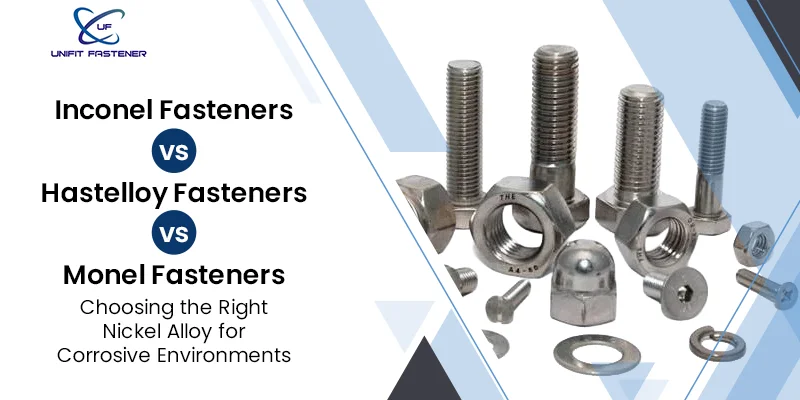
Standard 316 stainless steel fasteners fail to perform to expectations quickly in harsh industrial settings such as subsea pipelines and chemical reactors as well as jet engines assemblies. The failure modes that the stainless cannot resist are chloride induced stress corrosion cracking, high temperature oxidation, and attack by reducing acids. It is there that nickel alloy fastenerscan be used as the engineering solution of choice.
At Unifit Fastener we are distributors of nickel alloy fasteners to the specifications of NACE, ASTM and ASME, and the material selection questions in which we most frequently answer affirmatively are those that revolve around three families of alloys: those of the nickel-chromium alloys (often referred to as Inconel by his trade name), those of the nickel-molybdenum-chromium alloys (Hastelloy), and those of the nickel-copper alloys (Monel). Although all three are much superior in performance to the stainless steel in the usual demanding conditions, each family was designed to handle a particular set of challenges. The choice of the alloy may result in untimely breakdown of fasteners, unexpected closures, and expensive maintenance.
This guide explains the composition, key grades, and ideal uses of each nickel alloy family so you can specify the right fastener for your operating environment.
Inconel Fasteners: High-Temperature Strength and Oxidation Resistance
Nickel-chromium alloys are commonly based on nickel-chromium-iron (Ni-Cr-Fe) chemistry and are often marketed under the registered trade name Inconel. Their high chromium content forms a strongly bonded oxide layer on the alloy surface, helping resist oxidation and carburization at elevated temperatures. This family is typically selected when heat is the primary engineering challenge.
Key Grades for Fastener Applications
Alloy 600 is a solid-solution-strengthened Ni-Cr-Fe alloy with good oxidation resistance up to about 1175°C (2150°F). It is often specified for furnace components and heat-treating fixtures.
Alloy 625 (UNS N06625) is one of the most versatile grades for fastener applications exposed to combined mechanical, corrosion, and thermal loads. It offers high tensile strength, excellent weldability, and service from cryogenic temperatures to approximately 982°C (1800°F), making it a common specification for chemical processing and offshore applications.
Alloy 718 (UNS N07718) is a precipitation-hardenable alloy with very high strength and excellent creep resistance at high temperatures. Alloy 718 is normally supplied in the age-hardened condition to ASTM B637, providing ultimate tensile strengths above 1,380 MPa. It is widely used for high-stress fasteners in aerospace and turbine applications.
Alloy X-750 is also age-hardened and commonly used in gas turbine and nuclear engineering applications where high-temperature relaxation resistance is important.
Typical Industries
- Aerospace: turbine blades, combustion liners, and high-temperature bolting
- Oil and gas: wellhead components and subsea fasteners under combined pressure and heat
- Chemical processing: reaction vessels and heat exchangers in oxidizing service
- Power generation: steam turbine fasteners and superheater components
For a full list of available grades and thread forms, see our Inconel fastener range, including 625 and 718 specifications.
Hastelloy Fasteners: Superior Resistance to Aggressive Chemicals
The Hastelloy family is built on a nickel-molybdenum-chromium (Ni-Mo-Cr) base, sometimes with tungsten additions for enhanced stability. This composition gives Hastelloy alloys a rare ability to handle both oxidizing and reducing chemical environments, a range of chemical protection that stainless steel or nickel-chromium alloys alone cannot always provide.
Molybdenum is the distinguishing alloying element. It greatly improves resistance to pitting, crevice corrosion, and attack by reducing acids such as hydrochloric acid (HCl) and sulfuric acid (H2SO4) across wide concentration ranges. Chromium adds protection in oxidizing media.
Grade C-276 vs. Grade C-22
Hastelloy C-276 (UNS N10276) is arguably the most commonly specified corrosion resistant alloy in chemical processing. It is resistant to pitting, stress corrosion cracking, and decreasing atmospheres at temperatures of nearby 1040degC (1900degF). More importantly, it also is resistant to formation of grain-boundary precipitates in heat-affected areas of welds, and is therefore effective in as-welded condition, critical when specifying flanged joints and bolted assemblies.
Hastelloy C-22 (UNS N06022) provides even stronger resistance to oxidizing media such as wet chlorine, hypochlorite solutions, and ferric chloride, though it is slightly less resistant than C-276 in highly reducing environments. Engineers often choose C-22 when the process stream contains mixed acid chemistries, oxidizing contaminants, and chlorides.
Typical Industries
- Chemical processing: reactor vessels, scrubbers, and acid piping systems
- Oil and gas: sour gas (H2S) environments, downhole completions, and gas processing
- Pharmaceutical and petrochemical: autoclave fasteners and high-purity process equipment
- Flue gas desulphurisation: chimney liners and ducting fasteners in wet sulfuric acid service
Browse our Hastelloy fastener range, including C-276 and C-22 grades in bolt, nut, and threaded rod forms.
Monel Fasteners: Marine-Grade Toughness in Seawater and Brine
The nickel-copper (Ni-Cu) alloy family, commonly known by the trade name Monel, uses a different corrosion-resistance strategy. With high nickel content, typically 63-70%, and high copper content, typically 28-34%, Monel alloys offer excellent resistance to seawater, brackish water, hydrofluoric acid, and many non-oxidizing acids. They also retain excellent toughness at sub-zero temperatures.
Key Grades: Monel 400 and K-500
The laborer in the family is Monel 400 (UNS N04400). It also works well in the high velocity seawater, which is known to accelerate the corrosion in most grades of stainless and is among the few which can combat the hydrofluoric acid in all concentrations, including the boiling point. Its distinct ability renders it to be unrestricted in some refinery and chemical plant processes.
To allow precipitation hardening of the material, Monel K-500 (UNS N05500) makes additions of aluminium and titanium to achieve tensile and yield strength many times higher than grade 400, with the same level of corrosion resistance. The grade of choice here being K-500 where marine corrosion resistance and mechanical strength are needed including oil and gas marine fasteners, pump shafts, and valve stems.
Typical Industries
- Marine and offshore: hull fasteners, seawater piping, and propeller shafts
- Desalination: evaporator tubing fasteners and brine heater components
- Acid processing: hydrofluoric acid alkylation unit hardware
- Oil and gas: wellhead components in marine environments
See our Monel fastener range, including 400 and K-500 grades for marine and desalination applications.
Side-by-Side Comparison: Inconel vs Hastelloy vs Monel
The table below summarizes the key differentiators across the three alloy families to help engineers make a fast first-pass selection.
| Trade Name (Family) | Base Composition | Max Service Temp | Key Resistant Environments | Typical Fastener Forms | Pitting Resistance |
|---|---|---|---|---|---|
| Inconel (Ni-Cr-Fe) | Nickel-Chromium-Iron | ~982°C (1800°F)+ | High-temperature oxidation, mixed corrosion, aerospace service | Bolts, studs, nuts, washers | High |
| Hastelloy (Ni-Mo-Cr) | Nickel-Molybdenum-Chromium | ~1040°C (1900°F) | Reducing acids, chlorides, wet chlorine, HCl, H2SO4 | Bolts, hex nuts, threaded rod | Very High |
| Monel (Ni-Cu) | Nickel-Copper | ~480°C (900°F) | Seawater, brine, hydrofluoric acid, marine atmospheres | Bolts, nuts, U-bolts, shafts | Moderate |
Note: Maximum service temperatures are indicative for structural fastener applications. Actual limits depend on the specific grade, load conditions, and exposure media. Always consult material data sheets for precise design values.
If you already know your operating environment, jump straight to our nickel alloy fasteners range to compare available grades and forms.
Standards and Specifications
Specifying nickel alloy fasteners by trade name alone is not enough for procurement. The table below correlates alloy family with common ASTM and AMS product forms. Custom thread forms are available in all grades, including ASME B18.2.1 inch series and ISO 4014-4018 metric series.
| Alloy (Family) | Rod / Bar | Sheet / Plate | Pipe / Tube | Forgings & Additional Standards |
|---|---|---|---|---|
| Alloy 625 - Inconel | ASTM B446 | ASTM B443 | ASTM B444 | Forgings: ASTM B564 | Fastener bar: AMS 5666 |
| Alloy 718 - Inconel | ASTM B637 | ASTM B670 | - | Age-hardened condition; AMS 5662 / AMS 5664 |
| Hastelloy C-276 | ASTM B574 | ASTM B575 | ASTM B622 | Fittings: ASTM B366 | Wire: ASTM B573 |
| Hastelloy C-22 | ASTM B574 | ASTM B575 | ASTM B622 | Same product forms as C-276; specify UNS N06022 |
| Monel 400 | ASTM B164 | ASTM B127 | ASTM B165 | Forgings: ASTM B564 | Strip: ASTM B127 |
| Monel K-500 | ASTM B865 | - | - | Age-hardened; ASTM B865 rod, bar, and wire |
Contact Unifit Fastener to confirm available stock, lead times, and non-standard thread form options against your project specification.
Selection Guide by Industry and Environment
The most reliable way to choose a nickel alloy fastener grade is to begin with the main environmental threat rather than the alloy family name. The following selection logic applies to common industrial cases.
Oil and Gas: Subsea and HPHT Service
Alloy 625 is widely specified for wellhead, Christmas tree, and subsea completion fasteners exposed to high pressure, high temperature, and sour gas production fluids containing H2S. Its high strength, resistance to chloride stress corrosion cracking, and compatibility with cathodic protection systems make it a common choice under NACE MR0175 / ISO 15156 corrosion-resistant alloy requirements.
Chemical Processing: Reactor and Vessel Bolting
Nickel-molybdenum-chromium grades, especially C-276, are preferred when the process media contains strong reducing acids such as hydrochloric acid, sulfuric acid at intermediate concentrations, or phosphoric acid. C-276 fasteners are used across chemical reactor flanges, heat exchanger tube sheets, and scrubber internals because of their resistance to pitting and crevice corrosion in chloride-bearing acid service.
Marine and Seawater Applications: Offshore and Desalination
Where saltwater immersion, marine atmospheric corrosion, or brine service is the leading threat and extreme temperatures are not present, nickel-copper alloys often provide the best balance of corrosion performance and cost. Alloy 400 is standard for seawater piping fasteners and desalination plant components. Alloy K-500 is specified when higher tensile strength is required, such as marine pump fasteners and offshore structural bolts.
Aerospace and High-Temperature Industrial Service
Above 700°C (1300°F), fasteners must combine tensile strength, creep resistance, and oxidation resistance. Precipitation-hardenable nickel-chromium grades such as Alloy 718 provide maximum strength, while Alloy 625 is selected where combined strength and corrosion resistance are required.
Installation note: Nickel alloy fasteners are prone to galling during torquing, especially in stud bolt and nut assemblies. Molybdenum disulfide or nickel-based anti-seize is strongly recommended for Inconel, Hastelloy, and Monel stud and bolt applications. This does not reduce corrosion performance and is important for maintaining flange joint serviceability.
For custom-engineered specifications, see our specialist alloy fastener enquiry page.
Frequently Asked Questions
Can Monel fasteners be used at high temperatures?
Continuous service above about 480°C (900°F) is not normally recommended for Monel alloys. At higher temperatures, the corrosion protection associated with the copper-rich chemistry can degrade and mechanical properties may be affected. For seawater corrosion resistance combined with higher-temperature service, nickel-chromium grades such as Alloy 625 are usually more suitable.
What alloy is best for chloride pitting resistance?
Grade C-276 is a standard choice for very high pitting resistance in chloride-bearing process streams. Its high molybdenum content gives it significantly better resistance to pitting and crevice corrosion than stainless grades and many other nickel alloy families.
What is the main difference between Inconel and Hastelloy fasteners?
Inconel alloys are primarily selected for high-temperature service, where chromium content helps resist oxidation and carburization above 700°C. Hastelloy alloys are designed for aggressive chemical service, where high molybdenum content resists pitting and attack by reducing acids such as HCl and H2SO4. When both heat and aggressive chemistry are present, Alloy 625 is often used as a crossover specification.
The Bottom Line
The right nickel alloy fastener depends on the dominant threat in your operating environment: temperature and oxidation point toward the Inconel family, reducing acids point toward the Hastelloy family, and seawater or marine exposure points toward Monel. In multi-threat applications, Alloy 625 is often the most versatile choice for oil and gas, chemical processing, and offshore service.
Need Help Selecting the Right Nickel Alloy Fastener?
Unifit Fastener also has a technical team that is dedicated to oil and gas, chemical processing, marine, and aerospace corrosion-resistant and high-temperature alloy fasteners. You may require off-the-shelf stock or a solution-designed nickel alloy bolts to ASTM, ASME, or NACE, and we may be able to assist you. Contact us today to discuss your requirements.