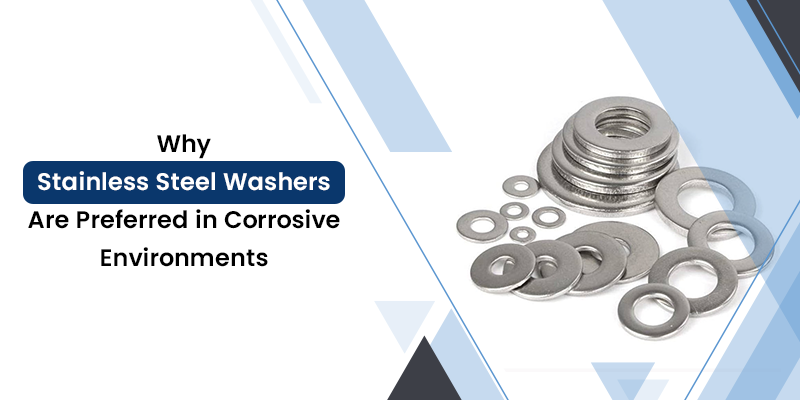
When it comes to matters of design and maintenance of industrial equipment, the attention for corrosion prevention is usually given to the bolt or the base material. The washer is often a second thought, a space filler of some sort chosen just because it has to fit. But in corrosive scenarios the washer may tend to break first in the joint assembly. Hence, a washer is much more important than it seems. To the OEM engineers and maintenance personnel in industries like chemical processing, marine operation and food production, learning about the importance of stainless steel washers in ensuring reliability of the systems is very essential. A washer is not just a distributor of load, it serves as a seal about the bolt hole and a shield between the fastener and the substrate. When a washer corrodes, it becomes thinner. This depletion of material dimension results in the depletion of preload (clamping force). After the loss of preload, the joint becomes prone to loosening of vibration, fatigue failure, and leakage. Corrosion is not a cosmetic concern, it is a mechanical one. It is not just a question of whether or not it is the saline environment of an off-shore rig or the caustic wash-down cycles of a pharmaceutical plant, all that is needed is the right choice of washer material is a basic engineering decision that determines the life of the entire assembly.
What Makes Corrosive Environments Challenging for Steel Washers
In order to pick the right washer, it is important that one should be aware of the exact mechanisms through which corrosion attacks bolted joints. The geometry and location of washers specifically expose it to uniqueness.
- Crevice Corrosion: This is the most common mode of failure. A narrow crevice is formed at the bottom of the bolt head and the washer or between the washer and the flange. Here liquid stagnates in this crevice. Oxygen in this liquid is used up causing an acidic environment which readily attacks the metal. The washers contain two flat mating surfaces, and thus they practically increase the risk of crevice corrosion at the joint.
- Pitting and Thickness Loss: Localized corrosion pits the metal.3 This is because as rust scale develops and later exfoliates, the effective thickness of the washer reduces. Bolt stretch is the stretch of bolts in a rigid bolted joint, which is measured in fractions of millimeters. Bolt stretch, which makes the nut finger-loose without necessarily turning, can be eradicated by the slightest decrease in the thickness of the washer by exfoliation of rust scales.
The Science Behind Stainless Steel Washers Corrosion Resistance
The permanence of the stainless steel washers is not because of some chemical modification applied, but a natural chemical phenomenon called passivity.
The Chromium Catalyst
The steel has to contain a minimum of 10.5 percent Chromium in order to be considered stainless. This particular percentage is the breaking point of the alloy chemistry. On exposure to the atmosphere, the chromium is reactive to create an ultra-thin, non-porous film of chromium oxide that is dense and is strongly attached to the surface (unlike iron oxide (rust), which is voluminous and porous).
The "Self-Healing" Advantage
Self-healing of the layer by engineers is one of the most important properties, in case a washer is scratch or abraded, or cut during high-torque installation, the exposed chromium immediately reacts with the ambient oxygen to regrow the passive layer. This is referred to as re-passivation and occurs almost immediately and the internal structure of the fastener is never subjected to corrosive elements at length.
Internal Protection vs. Surface Coatings
Whereas zinc-plated or galvanized washers do provide a reasonable level of protection, it is based on a sacrificial coating. When that coating peels, flakes, or wears away, the underlying base carbon steel is entirely exposed to rapid oxidation. Conversely stainless steel is stainless across its whole cross-section. It does not have a porcelain-like coating of protection.
Thermal Stability
In addition to being moisture-resistant, stainless steel washers have the structural integrity of thermal extremes:
- High Temperatures: they are resistant to scaling and can be used in high temperatures where the conventional carbon steels would be soft or oxidized.
- Cryogenic Levels: most stainless grades (such as the 300 series) do not have the ductile-brittle transition and are therefore used in liquid nitrogen or in aerospace.
Comparing Stainless Steel Grades: 304 vs 316 vs 410
The choice of the right amount of stainless steel grade is a tradeoff between environmental exposure, mechanical needs, and cost. They are all stainless, but the chemical make-up of each of the grades determines where it will perform well-and where they may not.
- Grade 304 (A2): Grade 304 is the general-purpose grade most popular, and used as the fastener grade most commonly in the industry, commonly known as 18/8 stainless steel. It is highly resistant to oxidizing acids and common moisture in the atmosphere. This grade is non-magnetic and very ductile and this characteristic makes this grade preferred in kitchen equipments, architectural finishing and in inland construction works.
- Grade 316 (A4): Grade 316 has a trace of about 2 per cent molybdenum an addition that has gone a long way in increasing the resistance to chloride pitting corrosion. Grade 316 is also the only choice that could be used in applications within a radius of five miles of coastal sites, or in applications that are prone to de-icing salts or industrial chemicals to avoid premature structural failure.
- Grade 410: Grade 410 is a martensitic stainless steel, as compared to austenitic 300 series. It has a sufficient amount of chromium to resist mild corrosion without containing nickel, and is therefore magnetic. The main benefit of it is that it is hard and can be heat-treated to become of high tensile strength. Grade 410 is also ideal in heavy-duty washers or self-drilling screws where the fastener has to be more difficult than the material being cut.
| Grade | Composition Key | Corrosion Resistance Level | Best Use Case |
| 304 (A2) | 18% Cr, 8% Ni | Good | General outdoor, automotive |
| 316 (A4) | 16% Cr, 10% Ni, 2% Mo | Excellent | Marine, Chemical, Medical |
| 410 | 11.5% Cr, No Ni | Moderate | High-strength screws, Hardened parts |
Why Stainless Steel Washers Outperform Coated Steel Washers
Although carbon steel washers that have zinc or galvanized coating have a lower initial cost, they typically are a phenomenology of buy it twice. The basic contrast is on the surface protection and the intrinsic properties.
- Longevity and Reliability: Coated washers depend on one fine layer skin, which is sacrificial. This is a particularly weak barrier that can be easily scratched by a single wrench slip or high-torque installation to reveal the core of the conduit which is just mere carbon steel. Even though they are breached, in aggressive environments, such points result in quick oxidation and the formation of rust scale. According to industry gurus in Lebo Metal, the result of this corrosion is that the washer is deprived of thickness and loses preload of bolts, and the joint may break. Stainless steel is corrosion-resistant to the core and therefore, the integrity of its structure is preserved over decades, despite abrasions on its surfaces.
- Cost vs. Value:To the buyers, it is the real measure of the Total Cost of Ownership (TCO). Changing a rusted washer of lower cost would seem cheap, but the labor and time taken in the system and the damage to the costly machinery are out of the world. The stainless steel reduces these lifecycle costs because it does not require regularly replacing it.
- Aesthetics and Professionalism: Outside of the mechanics, stainless steel gives it a professional look and feel. It eliminates the ugly streaks of rust that are otherwise seen with galvanized fasteners and maintains the aesthetic beauty of high performance engineering undertakings.
Critical Applications for Stainless Washers in Corrosive Settings
Engineering is a high-stakes sector and therefore, the washer selection is often dependent on the harshness of the environment. Industry intelligence (Sachin Shim) suggests that the strength of stainless steel is crucial in the industries where the structural collapse of materials may cause disastrous downtime.
- Marine, Offshore: Saltwater, the final test of metals. The seawater containing high chloride level results in pitting of the less superior materials in offshore oil rigs or coastal docks. Here the industry standard is the stainless 316 washers which offers the required Molybdenum kick off to survive under submerged or spray-filled conditions.
- Chemical Processing: It is an environment where there is a continuous exposure to aggressive acids, alkalis, and solvents. Stainless steel washers make sure that the structural integrity of piping systems and reactor vessels is ensured even in the presence of volatile reagents.
- Food and Beverage: In addition to corrosion, this industry requires hygiene. The stainless washers are resistant to frequent wash-down cycle with caustic cleaning agents and high pressure steam without deterioration, thus ensuring that the sanitary regulations are observed strictly.
- Wastewater Treatment: The sewage plants handle the humidity and hydrogen sulfide gas. Such circumstances are very corrosive to carbon steel and this is the reason why stainless steel is indispensable in the durability of pumps, valves and filtration systems.
Types of Stainless Steel Washers for Different Environments
As much as the choice of grade is important, the choice of the geometry is important. The form of the washer defines the manner of control of load and environmental stress.
- Flat Washers: Stainless steel flat washers are general purpose workhorses in case of general load distribution. They are designed to conform to ASME / DIN standards which extend the bearing area of a bolt head so that the fastener does not pull through the substrate causing damage.
- Fender Washers: Fender washers have a much larger outer diameter compared to the center hole, and are used with thin-gauge material.6 The clamping force is distributed over a greater area and thus in use with a soft plastic material or a thin sheet of metal that is prone to corrosion-weakened areas.
- Spring/Lock Washers: Spring washers have tension in them, so that they do not loosen in machinery that is continually subjected to vibration, like an industrial mixer or a marine engine.8 The spring around the component is made of stainless steel, to prevent rusting through.
- Sealing Washers: Sealing washers are made of stainless steel and are bonded to an EPDM rubber backing, they are used in roofing or in pressurized enclosures. The stainless steel component contributes to the structural strength whereas it is the EPDM that forms a watertight seal to keep moisture out of the bolt hole.
Selection Criteria: Matching Washer Grade to Environment
Proper engineering means that the material used must correspond to the chemical resistance of the site where it is installed. According to Sachin Shim in his technical guides, a wrong decision may result in either the so-called crevice corrosion or untimely failure.
- Ocean distance (a critical industry thumb rule): When your project is within 5 miles of salt water, Grade 304 will not be adequate because of salt-spray misting. Grade 316 (A4) cannot be compromised here to eliminate chloride pitting.
- Chemical Exposure: A compatibility chart should be used at all times. Although stainless steel is resistant to many solvents, certain acids (such as high levels of hydrochloric or sulfuric) need special high-nickel alloys.
- Galvanic Corrosion Hazards: Take caution with “dissimilar metal. When a wet environment (i.e. using a stainless steel washer on wet surface made of aluminum or carbon steel) is used, a battery effect can appear in which the weaker metal tends to corrode at a faster rate. Where it is necessary to mix metals always place insulating spacers.
- Temperature Extremes: To ensure toughness, the 300-series is used even in the cryogenic applications (e.g. liquid nitrogen storage). In the case of high-heat exhaust or furnace, make sure that the grade is able to withstand scaling at high temperatures.
Installation Practices to Maximize Corrosion Protection
Even the best stainless steel washer would not work in case it is installed incorrectly. Unifit Metalloys stresses the fact that the handling of a technician has a lot to do with the life of the fastener.
- Contamination of tools: All tools made of carbon steel should not be used on stainless washers. This action causes particles of free iron to be deposited on the stainless surface which will later grow up into rust spots, something that violates the passive layer. It must use stainless steel or chrome plated tools.
- Galling Management (Cold Welding): Stainless steel can be affected by galling which is the seizing of threads or surfaces during the tightening with high torque. This friction-induced "welding" should always be prevented by using high-quality anti-seize lubricant (such as nickel-based compounds).
- Surface Cleanliness: Make sure that the mating surface is grit and debris free. Clean installation does not leave deep gouges which may flood the chromium oxide self-healing layer.
- Torque Accuracy: Adhere to calculated torque standards. Over-tightening will not only be dangerous in its ability to strip the threads; it may actually deform the washer, leaving micro-cracks in which moisture may accumulate.
The Bottom Line
Stainless steel washers are not mere hardware, they are a basic investment in the safety, reliability and longevity of critical infrastructure. The engineers are able to do away with the latent costs of maintenance and downtime by using the science of the chromium oxide coating and choosing the right grade, be it the all purpose 304, the marine grade 316, or even the hardened 410. Although the initial cost may be more expensive than coated models, the overall lifecycle value cannot be matched. In high-performance engineering, compromise should never be done on quality; you should use stainless steel to make your projects out to last.
Being a major stainless steel washers manufacturer and supplier, Unifit Fastener is obliged to provide excellent performance fastening solutions in accordance with strict ISO 9001:2015 specifications. We have a complete line of washers of both 304 and 316, as well as our design and specialized alloys which are designed to withstand the harshest corrosive conditions. The accuracy, stability, and quality of long-term structural integrity of your projects in various regions across the globe rely on our ability to deliver precision, durability, and reliability to your projects.