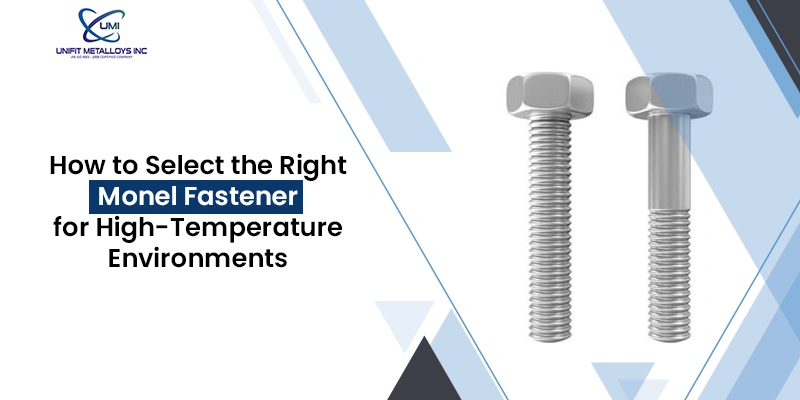
The Monel fasteners including Monel bolts, Monel nuts, Monel screws, Monel studs, Monel threaded rods, Monel washers and Monel rivets are all made of a nickel-copper alloy that makes them corrosion resistant and mechanically strong. These hardware solutions can withstand salt water and other adverse chemicals, cryogenic environments and shrug off heat up to circa 1000 degF. This is the reason why Monel fasteners are mostly applicable in marine equipment, heat exchangers, valves, pumps and other process equipment.
The process of selecting the appropriate fastener in a challenging task includes not only selecting an arbitrary bolt but also weighing grade, size, thread form, torque needs and service situation. The following is a tabular guide on how engineers, fabricators and procurement teams can adopt the appropriate fastener in high temperature settings of the Monel 400 and K-500 alloys.
Properties of Monel alloy
Monel alloys are primarily nickel and copper which makes the material highly resistant to corrosion, especially in seawater. Monel fasteners resist corrosion in marine environments and are supplied as heavy hex bolts paired with heavy hex nuts. The same nickel-copper chemistry allows Monel fasteners to stay tough at elevated temperatures. These properties make Monel hardware well suited for equipment exposed to salty atmospheres, acidic liquids or fluctuating high temperatures.
Beyond corrosion resistance, Monel has impressive mechanical characteristics. It has good toughness, excellent mechanical properties and high ductility. In practical terms, these features allow fasteners to handle significant loads without brittle failure. For example, the Monel 400 bolts can achieve tensile strengths around 70 ksi (kilopounds per square inch), making it suitable for high-stress joints. Monel K-500 adds precipitation-hardening elements to improve strength further. Monel also offers useful magnetic properties for situations where non-magnetic hardware is needed, broadening its appeal beyond ordinary stainless steels.
Difference between Monel grades (Monel 400 bolts, Monel k500 bolts and R405)
Choosing the right Monel bolts or Monel screws often starts with selecting the appropriate alloy grade. Monel fasteners are available in three grades: Monel 400, Monel R405 and Monel K-500. Understanding their differences helps match the fastener to your operating environment:
Monel 400 bolts (UNS N04400) – It is a solid solution of nickel and copper offering a balance of corrosion resistance and strength. The alloy performs well across a broad temperature range, handles exposure to acids and alkalis and remains ductile. In high-temperature environments, Monel 400 bolts are preferred when corrosion is severe but extreme mechanical loading is moderate.
Monel K500 bolts (UNS N05500) – It is a precipitation-hardened version of the alloy that adds aluminium and titanium to the nickel-copper base. This increases yield and tensile strength significantly while preserving corrosion resistance. Monel K500 bolts or studs are therefore chosen when joints are subject to high stresses or heavy vibration.
Monel R405 – It is a free-machining grade created by adding sulfur. This grade is often used for fasteners requiring precise machining but is less common in structural bolting.
Types of Monel fasteners and their Applications
Monel hardware is not limited to one shape or function. It includes bolts (hex, heavy hex, eye, U-bolts, carriage, flange), nuts (hex, heavy hex, square, jam, wing and Nylock), screws (hex cap, socket cap, button head, mushroom head, wood screws and self-drilling), stud bolts (threaded studs, tap-end, double-end, flange bolting and weld studs) and a range of washers (flat, spring-lock, square, ogee, self-locking and fender). Each form is designed for a specific joint configuration:
- Monel bolts: Hex or heavy hex bolts are the default choice for high-temperature flanged connections. The heavy hex head offers a larger bearing surface, distributing clamping force uniformly.
- Monel screws: It is used when space is limited or when connecting into tapped holes. Socket-head cap screws provide high clamping force and maintain strength under heat.
- Monel threaded rods: It is ideal for equipment where nuts must be removed frequently. Its sizes range from M4 to M45 for threaded rods and both left- and right-hand threads and finishes like mill, brushed or polished are available.
- Monel Studs: Monel Studs come in double-end, tap-end or fully threaded forms. They are widely used as fasteners in marine, chemical processing, and other highly corrosive environments where long-term strength and corrosion resistance are critical.
- Monel nuts: High-strength Monel hex nuts offer superior durability in corrosive environments.
- Monel washers: These washers distribute load and resist loosening. Their wall thickness ranges from 0.002 to ½ in. and inside diameters from 0.062 to 12 in., and they perform from cryogenic conditions up to 1000 °F.
- Monel rivets: although not covered in detail, rivets provide permanent joining solutions for sheet-metal assemblies where welding may not be desirable.
Dimensions and Manufacturing Standards of Monel Fasteners
Mismatched sizes/ threads are the cause of failing joints. M1.2 to M48 bolts, M4 to M45 threaded rod and M2 to M20 nuts are in stock. The length of bolts and pitch of thread used should be identical to the mating parts when ordering fasteners to be used in a high-temperature service. Assemblies of heavy type might need unusual lengths or tailored threads; under these circumstances Monel fasteners can be produced to a diameter of 4 inches.
Standards are equally important. Heavy hex bolts to ASME B18.2.1 are typically paired with ASME B18.2.2 heavy hex nuts and flat washers. Selecting fasteners built to recognised standards guarantees interchangeability and a baseline level of performance.
Choose Monel Fasteners According to the Industrial Requirements
Selecting hardware for high-temperature conditions demands careful evaluation of the operating environment. Different applications impose distinct challenges, for example, marine environments require resistance to salt water, whereas chemical processing plants need fasteners that withstand aggressive acids.. Temperature, humidity and corrosive media must all be considered. Below are some common scenarios and suggested fastener types:
| Application | Environment conditions | Recommended fastener type | Typical sizes |
|---|---|---|---|
| Marine hardware and offshore equipment | Saltwater, high humidity | Monel bolts offer excellent seawater corrosion resistance | 6–20 mm diameters |
| Chemical processing | Acidic or alkaline fluids | Monel nuts and Monel washers resist chemical attack | 8–16 mm diameters |
| Oil & gas production | High pressure, extreme temperatures | Monel washers, threaded rods or studs handle thermal cycling and pressure | 4–18 mm diameters |
| Aerospace | Low temperature, corrosive atmosphere | Monel screws are favoured for weight savings and corrosion resistance | 3–12 mm diameters |
Beyond these examples, heat exchangers, valves, pumps and process vessels rely heavily on Monel fasteners. Always evaluate the specific chemicals, pressures and temperatures in your system before choosing a product.
Assessing Mechanical and Thermal Requirements of Monel Fasteners
When designing joints for high-temperature service, pay attention to both mechanical strength and thermal expansion. Monel fasteners are mechanically stronger. Monel 400 offers tensile strengths up to about 70 ksi. Monel K-500 can offer even higher strength, making it suitable for high-load or high-vibration applications. However, temperature fluctuations cause expansion and contraction, potentially loosening a joint if the wrong fastener is used. Large heavy-hex bolts provide greater bearing area and clamping force. Pairing them with washers and heavy-hex nuts spreads the load and mitigates loosening.
Torque is also critical. The torque chart below shows how torque differs between lubricated and dry threads:
| Nominal Diameter Inches | Threads Inches | Torque ft-lb Lubricated | Torque ft-lb Dry |
|---|---|---|---|
| 1/4" | 20 to 28 | 3.1-3.5 | 4.2-4.7 |
| 5/16" | 18 to 24 | 6.4-7.1 | 8.5-9.4 |
| 3/8" | 16 to 24 | 11.3-12.8 | 15.1-17.1 |
| 7/16" | 14 to 20 | 18.1-20.3 | 24.2-27.0 |
| 1/2" | 13 | 27.6 | 36.9 |
| 9/16" | 12 to 18 | 39.9-44.5 | 53.2-59.3 |
| 5/8" | 11 to 18 | 55.1-62.4 | 73.4-83.2 |
| 3/4" | 10 to 16 | 98-109 | 131-145 |
| 7/8" | 9 to 14 | 158-174 | 210-232 |
| 1" | 8 to 14 | 236-265 | 315-353 |
| 1-1/4" | 7 to 12 | 411-455 | 548-607 |
| 1-1/2" | 6 to 12 | 715-805 | 954-1073 |
Considering Manufacturing Techniques and Quality Assurance of Monel Fasteners
Fastener quality directly influences joint reliability. There are several manufacturing techniques: CNC machining, cold forging and hot forging. Cold forging refines grain structure and yields strong, uniform fasteners; hot forging allows larger diameters and custom shapes. CNC machining produces precise threads and features for screws and studs.
The testing methods include corrosion testing, proof load testing, macro etch testing, and specific inspections like magnetic particle inspection (MPI), tensile testing, visual inspection, positive material identification (PMI), hardness testing and proof tests. Quality documentation may include raw material certificates, third-party inspection reports and EN 10204 3.1B test reports.
Evaluating the Price Differences of Monel Fasteners
Though Monel hardware is rather costly as compared to carbon steel or standard stainless steel, the high service period compensates for the extra expense. Prices differ depending on the size and the region; when comparing the costs in the UK and South Africa, one can notice a difference because of exchange rates and logistics. Look at the cost of downtime, replacement and maintenance when budgeting, cheaper fasteners that can corrode or fail at high temperatures are usually costly in the long-term.
Tips for the Maintenance of Monel Fasteners
The choice of good fasteners is just one of the solutions; maintaining them is what ensures that joints are safe through age. Wear, corrosion or loosening should be regularly inspected. Washing using soft detergents does not harm the surface. Stress cracks or loosening are avoided by the proper installation that is neither too tight nor slack. Conduct a regular check where feasible to identify issues before time runs out. When dealing with high-temperature issues, it is better to employ lubricants that resist high temperatures so as to prevent galling and retain the appropriate torque.
Selecting a reliable supplier like Unifit Metalloys Inc
Projects that require high temperatures necessitate stability and accountability. Purchase fasteners from known manufacturers who have specialized in nickel alloy fasteners. Unifit Metalloys Inc. is the reliable supplier of Monel Fasteners that warehouses all types of Monel bolts, screws, studs, threaded rods, nuts and washers. Our products are all certified with ISO 9001:2008, and they are in accordance with ASME B18.2.1/B18.2.2 along with the relevant DIN or ISO standards. Get in touch with us on any details or enquiry.
The Bottom Line
Operating in hot conditions requires fasteners that are not prone to corrosion, creep or looseness. Monel fasteners are bolts, nuts, screws, studs, threaded rods, washers or rivets; they provide a combination of corrosion resistance, mechanical strength and thermal stability that is winning. Knowing the characteristics of the alloy, understanding the grading of alloys, selecting the right type of fastener, checking the dimensions, meeting the standards, assessing the operating climate and keeping the assembly, engineers create a reliable connection that can withstand the environment with high temperatures.
By collaborating with the established and reputable suppliers like Unifit Fastener. that offer certified material and extensive tests, one can be assured that his Monel hardware will give long-term service even in the most extreme conditions.