Most of the time, the fasteners are used in high-temperature environments to face the extreme heat, pressure, and chemical corrosiveness. A wrong fastener can cause deformation, cracking, and premature failure. So it’s important to select the right fastener material to ensure the component's safety and high performance in harsh conditions. Among the many fasteners, the hastelloy fasteners are known for its amazing strength, corrosion resistance, and reliability under severe operating conditions. In this blog, we will get to know why engineers prefer hastelloy fasteners for high-temperature projects like hastelloy C276 fasteners, the key material, chemical composition, selection factor, and major use of these fasteners, and what the best practices are to make them for long-term performance.
What Are Hastelloy Fasteners?
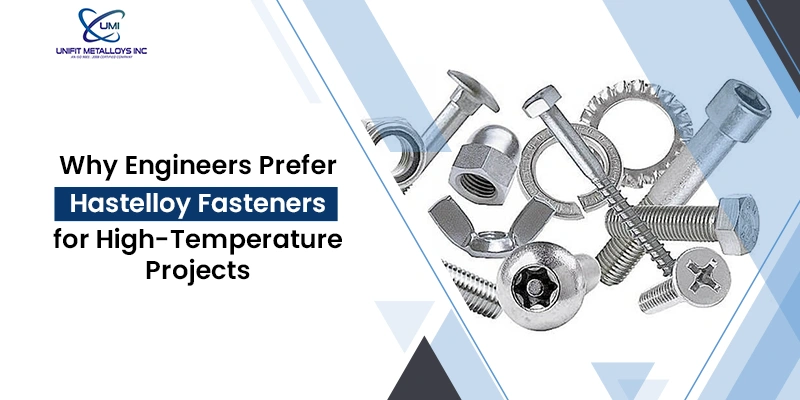
Hastelloy is a family of sophisticated nickel-molybdenum-chromium alloys that have great resistance against corrosion and are exceptional in the high temperature environment. Hastelloy fasteners like screws, nuts, studs, bolts, threaded rods and fasteners are designed to resist high temperatures, acids, high pressure, and other severe industrial chemicals. It is due to this durability that engineers utilize hastelloy fasteners in the case where stainless steel, carbon steel or even other nickel alloys cannot provide the necessary level of safety and reliability. These fasteners are designed to provide long life operation in high performance systems so that they are more likely to be used in high-performance industrial work.
Specifications of Hastelloy Fasteners
To know more about the specifications of Hastelloy Fasteners, read the given table below.
| Category | Details |
|---|---|
| Standards | Manufactured as per DIN, ASTM, BS, and other global standards |
| Specifications | Conforms to ASTM/ASME A/SA 193 & 194 and IS standards 1364, 1367, 3757, 6639, and 3640 |
| Size Range | Available from M4 to M100 and 3/8″ UNC up to 4″ UNC |
| Length | Offered in lengths up to 1 meter |
| Grades | Hastelloy C276 (UNS N10276), Hastelloy C22 (UNS N06022), Hastelloy B2 (UNS N10665), and Hastelloy C4 (UNS N06455) |
Hastelloy Fasteners Chemical Properties
Explore the detailed chemical makeup of Hastelloy Fasteners in the table below.
| Alloy | Co | Cr | Mo | W | Fe | Si | Mn | C | Ni | Others |
|---|---|---|---|---|---|---|---|---|---|---|
| B-2 | 1* | 1* | 30 | - | 2* | 0.1* | 1* | 0.01* | Balance | - |
| B-3 | 3* | 1.5 | 30.5 | 3* | 1.5 | 0.1* | 3* | 0.01* | 65 min. | Ti-0.2* |
| C-4 | 2* | 16 | 16 | - | 3* | 0.08* | 1* | 0.01* | Balance | Ti-0.7* |
| C-2000 | 2* | 23 | 16 | - | 3* | 0.08* | - | 0.01* | Balance | Cu-1.6 |
| C-22 | 2.5* | 22 | 13 | 3 | 3 | 0.08* | 0.5* | 0.01* | Balance | V-0.35* |
| C-276 | 2.5* | 16 | 16 | 4 | 5 | 0.08* | 1* | 0.01* | Balance | V-0.35* |
| G-30 | 2* | 30 | 5.5 | 2.5 | 15 | 1* | 1.5* | 0.03* | Balance | Nb-0.8*, Cu-2* |
| N | 0.2* | 7 | 16 | 0.5* | 5* | 1* | 0.8* | 0.08* | Balance | Al+Ti-0.5*, Cu-0.35* |
| W | 2.5* | 5 | 24 | - | 6 | 1* | 1* | 0.12* | Balance | V-0.6* |
Hastelloy Fasteners Mechanical Properties
| Tensile Strength | Yield Strength | Elongation at break | Hardness, Brinell |
|---|---|---|---|
| 680 MPa | 300 MPa | 50% | 210 |
Popular Grades of Hastelloy Fasteners
The hastelloy fasteners come in different grades and sizes; according to them, they are used in different industries. The table below shows the popular grades and their common application usages.
| Hastelloy Grade | Key Properties | Common Applications |
|---|---|---|
| Hastelloy C276 | Exceptional corrosion resistance in harsh environments | Chemical processing, petrochemical plants, offshore equipment, flue-gas systems |
| Hastelloy C22 | Strong resistance to oxidizing chemicals and environments | Waste treatment, chemical reactors, pollution control systems |
| Hastelloy B2 / B3 | Excellent resistance to hydrochloric acid and reducing environments | Acid production, pickling lines, chemical processing involving HCl |
| Hastelloy X & G-Series | Superior high-temperature stability and oxidation resistance | Industrial furnaces, gas turbines, aerospace components |
Equivalent Grades of Hastelloy Fasteners
| Fasteners STANDARD | BS | WERKSTOFF NR. | UNS | GOST | AFNOR | JIS | EN |
|---|---|---|---|---|---|---|---|
| Hastelloy C22 Fasteners | - | 2.4602 | N06022 | - | - | NW 6022 | NiCr21Mo14W |
| Hastelloy C276 Fasteners | - | 2.4819 | N10276 | XH65MBY | - | NW 0276 | NiMo16Cr15W |
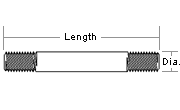
STM B574 Hastelloy Alloy Bolts Weight Calculator
Key Reasons Engineers Prefer Hastelloy Fasteners
- Temperature endurance
Hastelloy bolts are also strong, and they do not lose strength even in very high temperatures. They are creep resistant, have a high tensile strength and remain structurally stable; hence are applicable in furnaces, reactors, and thermal processing systems. - High-quality Corrosion Resistance
These clamp connections are resistant to severe forms of corrosion such as pitting, crevice corrosion, and stress corrosion cracking (SCC). They have high stability in the presence of strong acids such as hydrochloric acid, sulfuric acid, the seawater, and the oxidizing conditions. - Mechanical Stability During Thermal Cycling
Stainless steel wears out upon repeated heating and cooling, but Hastelloy does not. It is rigid and resistant to cracking. - Longer Service Life in Extreme Environments
Hastelloy fasteners are inexpensive with low maintenance requirements, and are also highly reliable and provide long life even in the worst-case industrial environment.
Which Industries use Hastelloy Fasteners?
The Hastelloy Fasteners are used in various industries according to their needs and grades. Below are the different industries that use hastelloy fasteners for their projects.
- Chemical Processing
Hastelloy fasteners are commonly applied in the chemical plants where the equipment is also subjected to strong acid, chlorides and solvents that are aggressive. Their pitting, crevice and stress corrosion cracking resistances are extraordinary and this qualifies them to be used in reactors, heat exchangers, storage tanks, and pipelines. - Oil and Refining Systems
Hastelloy screws and bolts are used in upstream, mid-stream, and downstream operations, so that they can withstand the high pressure, sour gas conditions, and high temperatures. They find popular application in valves, pumps, separators and offshore drilling gear. - Power generation and Flue gas system
The Hastelloy fasteners are used in power plants where the systems are exposed to hot gases, steam and corrosive byproducts. They guarantee boiler, desulfurization flue-gas and high-temperature turbine reliability. - Marine & Offshore Structures
Hastelloy fittings are resistant to sea water corrosion and saline environments, hence are ideal for offshore installations, desalination systems, shipping components and shipboard cooling. - Furnaces and Aerospace
Hastelloy fasteners are important in jet engines, combustion chambers, exhaust systems and industrial furnaces because of their high thermal stability and creep resistance, where materials are required to meet constant high temperatures. - Controlling Pollution Equipment
Hastelloy fasteners are also used in environmental systems such as scrubbers, incinerators and waste treatment units since they are able to withstand gases, chemical fumes in the environment, and high moisture environments without being damaged.
How to Select the Right Hastelloy Fastener?
The choice of Hastelloy fastener is essential to safety, efficiency, and long-term reliability in the harsh industrial conditions. Engineers consider a number of technical considerations prior to selecting the right type of fastener and grade. The following are the major considerations that will be used in choosing fasteners.
Temperature Range
The initial one is to know the highest and lowest operating temperatures. Hastelloy fasteners should be able to resist high temperatures without losing their strength. Grades such as Hastelloy C276 bolts and Hastelloy X are selected to provide high temperature applications such as boilers, furnaces, and turbine systems.
Corrosion Type
Various industries are exposed to different forms of corrosion and selection of the appropriate grade is dependent on the environment. Engineers determine fasteners exposure to acidic media, chlorides, oxidizing chemicals, seawater, pitting, crevice corrosion or SCC. Hastelloy C22 is suited in oxidizing conditions whereas the B-series grades are selected to serve in hydrochloric acid service.
Pressure & Load Requirements
Fasteners should not be distorted under mechanical stresses, vibration, and pressure. In order to make sure the fastener is stable in long-term operation, particularly in reactors, pipes, and offshore rigs, tensile strength, creep resistance and fatigue properties are checked by engineers.
Grade Selection:
All Hastelloy grades have their own benefits.
The most popular is C276 which is used due to its overall corrosion resistance.
C22 is used in oxidizing conditions.
B2/B3 is selected in case of strong reducing acids.
X is desired in case of extreme heat.
The right grade guarantees performance as well as cost-effectiveness.
Size, Threading & Standards
Lastly, the engineers determine the size, the threading, and the specification of the system depending on its design. Good fit, mechanical strength and safety are guaranteed by compliance to ASTM, ASME, DIN, ISO and BS standards. Proper threading and size is required to achieve leak proof and vibration free installations.
Conclusion:
One of the safest options that can be made when high-temperature, high-stress, and high-corrosion industrial conditions are considered is Hastelloy fasteners. They offer unparalleled stability in the face of time, thermal and hostile chemical conditions making them an ideal choice when engineers can not afford to sacrifice on safety or performance. Hastelloy is used in chemical plants, refineries, power systems, offshore facilities, and insures them of long service life and serviceability.
When you need reliable and high quality Hastelloy fasteners to use in your next project, the Unifit Fasteners team can assist you to select the right grade and specification that fits in your application requirements.