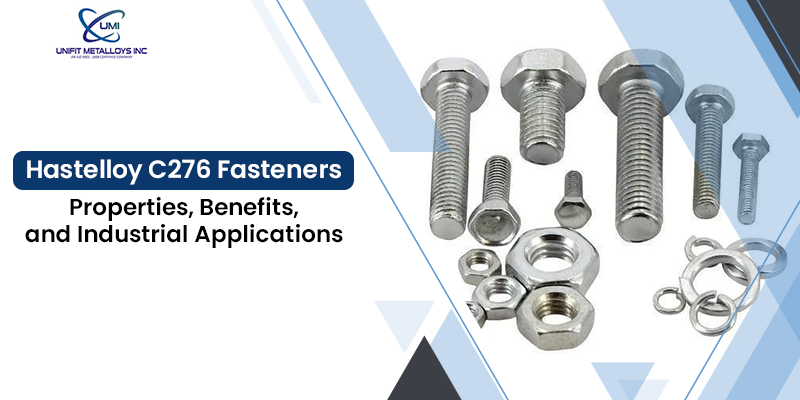
The hi-tech bolting materials made of Alloy C276 are Hastelloy C276 fasteners which is a nickel-based superalloy of chromium, molybdenum, and tungsten. This composition alone ensures that the hastelloy C276 fasteners are highly resistant to pitting, crevice corrosion and stress corrosion cracking even in the most motivational industrial environment. The mechanical integrity of hastelloy C276 bolts and nuts is high-temperature and even in sulfuric acid, hydrochloric acid, phosphoric acid, seawater, and chlorinated solutions; unlike normal stainless steel fasteners.
Chemical Composition of Hastelloy C276
The performance of Hastelloy C276 fasteners is rooted in their precise alloy composition. The table below summarizes key elements:
| Element | Content (%) |
|---|---|
| Nickel | Balance (~57%) |
| Molybdenum (Mo) | 15.0 – 17.0 |
| Chromium (Cr) | 14.5 – 16.5 |
| Iron (Fe) | 4.0 – 7.0 |
| Tungsten (W) | 3.0 – 4.5 |
| Cobalt (Co) | 2.5 max |
The low carbon levels are of particular significance - they reduce the amount of carbide that is forced to precipitate at the grain-boundaries when welding is performed, and enable Hastelloy C276 fasteners to be utilized in as-welded assemblies with no subsequent post-weld heat treatment.
Mechanical Properties of Hastelloy C276
The following table outlines the key mechanical properties of the material:
| Property | Value |
|---|---|
| Tensile Strength (MPa) | ≥ 690 MPa (100 ksi) |
| Yield Strength (MPa) | ≥ 310 MPa (45 ksi) |
| Elongation | ≥ 40% |
| Hardness | ≤ 90 HRB |
| Density | 8.89 g/cm³ |
| Melting Range | 1325 – 1370°C |
Key Features of Hastelloy C276
- Excellent Corrosion Protection: Provides predictable and reliable performance over a highly diverse environment of oxidizing and reducing chemicals.
- Broad Acid Resistance: Exhibits high resistance to the degradation by sulfuric, hydrochloric, phosphoric, nitric and acetic acids.
- Higher Chloride Tolerance: Offers the best protection in localized types of corrosion including pitting and crevice corrosion even in extremely chloride-laden environments.
- Good Weldability: This alloy is able to withstand the welding process without any post welding heat treatment due to its low content on carbon.
- Thermal Stability: It has a high ability to maintain its mechanical strength and structural performance under both high and low operating temperatures.
Industrial Applications of Hastelloy C276 Bolts and Fasteners
Here are the applications of Hastelloy C276:
- Chemical Processing Plants: A typical specification of C276 fasteners is used in chemical reactors, pressure vessels, heat exchangers and piping flanges that are subjected to continued exposure to strong acids and chlorinated compounds. Their availability ensures that they do not halt high value process equipment unintentionally.
- Oil and Gas Industry: Offshore platforms and subsea equipment are exposed to concurrent mechanical stress, seawater and sour gas(H2S). Hastelloy C276 bolts are installed in critical joints, wellhead assemblies, and pipeline flanges in which the failure of the material plays a major role in safety issues.
- Marine and Offshore Applications: Salt water corrosion is among the most severe types of material corrosion. C276 fasteners are used to offer lasting security in marine scrubbers of exhausts, seawater cooling systems, and structural components that are underwater.
- Pharmaceutical and Food Processing: Pharmaceutical manufacturing systems that require hygiene grades will require material that is resistant to chemical cleaning components as well as the product contamination. are designed to fulfill such needs and are frequently employed in combination with Hastelloy C22 piping systems in which an additional requirement is the higher oxidizing resistance.
- Pollution Control and Power Generation: The elements of the waste treatment, thermal power plant, and flue gas desulfurization (FGD) can be used in various mixed acid and chloride environments. Flue gas scrubbers, absorbers and pollution control ducting are commonly specified to be fitted with Hastelloy C276 fasteners.
- Pulp and Paper Industry: The bleaching and pulp digestion activities subject equipment to chlorinated chemicals under high temperatures. C276 fasteners are superior to normal materials in digesters, bleach washers and paper recovery units.
Trusted Hastelloy C276 Manufacturer in India
To source Hastelloy C276 fasteners of the best quality, Unifit Fastener is one of the reliable suppliers and manufacturers of the product with a long record of providing the most accurate solutions concerning the use of bolts and other items. Their product line has a complete line of C276 bolts, nuts, washers, screws, and threaded rods, which are produced in line with the standards of ASTM, ASME and NACE. Unifit Fastener guarantees complete traceability of materials and certified Mill Test Certificates, and therefore the company becomes a suitable associate in vital service applications in chemical, oil and gas, marine and pharmaceutical industries.
Frequently Asked Questions About Types of Washers
What is the difference between Hastelloy C276 and C22 fasteners?
They are both nickel based molybdenum chromium alloys although Hastelloy C22 contains more chromium and has better resistance to oxidizing conditions. C276 is more adaptable to mixed acid and reducing medium. This decision will be based on the corrosive agents of your process.
Are Hastelloy C276 fasteners magnetic?
No. Hastelloy C276 is non-magnetic annealed and this is significant in some instrumentation and underwater uses.
Can Hastelloy C276 fasteners be used in sour gas service?
Yes. C276 fasteners are of NACE MR0175 sour gas (H 2 S service) and are common in oil and gas services with high H 2 S content.
What size range is available for C276 fasteners?
Hastelloy C276 fasteners come in a vast variety of sizes - M6 / 1/4" on one end to M100 / 4" and larger on the other end to fasten heavy industry. Prequisite custom lengths, thread pitches and configurations are available.
How should Hastelloy C276 fasteners be installed?
Normal torqueing processes are used. Work-hardening nature of the alloy makes the use of lubricated threads and medium-controlled torque to prevent galling. Anti-seize alloys that are nickel compatible are preferable.