ASTM A194 Overview
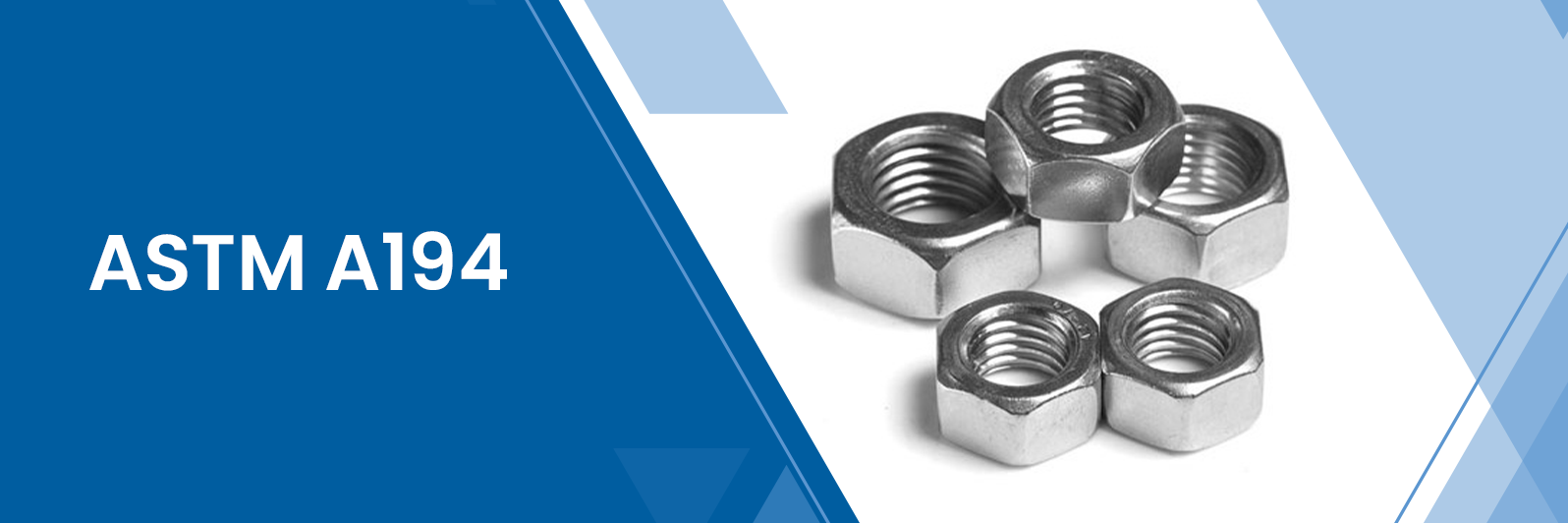
The ASTM A194 specification accommodates carbon and alloy steel nuts, with the most commonly used ones being 2H, 2HM, 3, 4, 6, 7, 7M, 8, 8M, 8T, 16, etc. These nuts are destined to be used along with ASTM A193 bolts to be applied in high-pressure or high-temperature service or both.
This specification has a broad selection of carbon, alloy and martensitic stainless steel nuts that come in sizes as small as 1/4 inch up to 4 inches, or metric sizes of M6 to M100 nominal. It is also an austenitic stainless steel nut ranging in size between 1/4 inch to M6 nominal and upward. The nuts are specifically developed to be used under high pressure, at a high temperature, or both. Replacement of grades without the consent of the buyer is prohibited.
The moulds in which the nuts are made are to be hot-wrought. The material can also be further processed using centreless grinding or cold drawing. Austenitic stainless steel can either be strain hardened and annealed or be solution annealed. Where annealed and strain-hardened austenitic stainless steel is ordered in compliance with Supplementary Requirement S1, the purchaser must make sure that Section 8.2.2, Supplementary Requirement S1 and Appendix X1 are well understood.
Request QuoteTable of Contents
ASTM A194 Nut Grades
| Grade | Material | UNS Number |
|---|---|---|
| 2H | Carbon Steel | – |
| 2HM | Carbon Steel | – |
| 3 | Ferritic Stainless Steel Type 501 | S50100 |
| 4 | Carbon, Molybdenum Steel | – |
| 6 | Ferritic Stainless Steel Type 410 | S41000 |
| 7 | Chromium Molybdenum Steel Type 4140, 4142, 4145, 4140H, 4142H, 4145H | – |
| 7M | Chromium Molybdenum Steel Type 4140, 4142, 4145, 4140H, 4142H, 4145H | – |
| 8 | Austenitic Stainless Steel Type 304 | S30400 |
| 8M | Austenitic Stainless Steel Type 316 | S31600 |
| 8T | Austenitic Stainless Steel Type 321 | S32100 |
| 16 | Chromium Molybdenum Vanadium Alloy Steel | – |
Send Your Enquiry
Manufacture Process
The manufacturing of stainless steel for all categories of Grade 6 and Grade 8 nuts shall be done through one of the following processes:
- Electric furnace (separate degassing and refining optional)
- Vacuum induction furnace
- Either of the latter by electroslag remelting (ESR) or consumable-arc remelting (VAR).
The steel manufacturer will have sufficient control to remove too much inhomogeneity, nonmetallic inclusions, piping, porosity, and other flaws.
Grade 1 and 2 nuts will be hot- or cold-worked or cut from hot-forged or hot-rolled bars or cold-drawn bars.
Any Grade 1 and 2 nuts that have been made or machined out of bar shall be stress relieved at a minimum of 1000°F (538°C) with the exception of:
- Nuts made by hot forging
- Nuts made of hot-forged or hot-rolled bar.
- Machined nuts made of hot-forged/hot-rolled and cold-finished (maximum 10% reduction in area) bar.
- Machined nuts made out of cold-drawn and annealed bar (at least 1000°F [538°C])
Hot-forged or machined nuts of grades 1 and 2, which are produced by hot forging or machining of hot-forged or hot-rolled bars, do not need stress relief.
Grades 2H, 2HM, 3, 6, 6F, 7, 7M and 16 nuts will be hot or cold forged or machined from hot-forged, hot-rolled or cold-drawn bars and heat treated to obtain the desired mechanical properties. These grades will be heated in a uniform manner to the correct austenitising temperature, quenched with conditions which are substantially uniform, and tempered as required.
- All grades 2H, 2HM, 3 and 7M will be liquid quenched.
- Grade 6 and 6F will be drowned in liquid or inert gas.
- Grade 16 will be heated to 1700-1750°F (925-955°C) and oil quenched.
Nuts machined from bar heat treated to this specification require no re-heat treatment.
In Grade 2HM and 7M nuts, ultimate stress relief in the presence of minimum tempering temperature shall be done after completion of all the forming, machining, and tapping. This is the last stress-relieving operation, which could be the tempering operation.
The Grade 6 and 6F nuts will be tempered for at least one hour at the stated temperature.
Grades 8, 8C, 8CLN, 8M, 8F, 8P, 8N, 8MN, 8R, 8S, 8LN, 8MLN, 8MLCuN, 8ML4CuN, and 9C nuts will be hot- or cold-forged or machined from hot-forged, hot-rolled or cold-drawn bars.
Grades 8A, 8CA, 8CLNA, 8MA, 8TA, 8FA, 8PA, 8NA, 8MNA, 8RA, 8SA, 8LNA, 8MLNA, 8MLCuNA, 8ML4CuNA and 9CA nuts will be hot- or cold-forged, or machined from hot-forged, hot-rolled or cold-drawn bars and shall be carbide-solution treated. This means that it is heated long enough to dissolve chromium carbides and cooled at a rate that does not allow re-precipitation.
Minimum Tempering Temperature
| Grade | Minimum Tempering Temperature, °F (°C) |
|---|---|
| 2H | 850 °F (455 °C) |
| 2HM | 1150 °F (620 °C) |
| 3 | 1050 °F (565 °C) |
| 6 and 6F | 1100 °F (595 °C) |
| 7 | 1100 °F (595 °C) |
| 7M | 1150 °F (620 °C) |
| 16 | 1200 °F (650 °C) |
Chemical Composition
| Grade | Description / UNS | C | Mn | P max | S max | Si | Cr | Ni | Mo | Ti | Nb | N | Cu | Se | V | Al |
|---|---|---|---|---|---|---|---|---|---|---|---|---|---|---|---|---|
| 1 | Carbon | 0.15 | 1.00 | 0.040 | 0.050 | 0.40 | — | — | — | — | — | — | — | — | — | — |
| 2, 2HM, 2H | Carbon | 0.40 | 1.00 | 0.040 | 0.050 | 0.40 | — | — | — | — | — | — | — | — | — | — |
| 5 | (501) S50100 | 0.10 | 1.00 | 0.040 | 0.030 | 1.00 | 4.0–6.0 | — | 0.60–0.65 | — | — | — | — | — | — | — |
| 6 | (410) S41000 | 0.08–0.15 | 1.00 | 0.040 | 0.030 | 1.00 | 11.5–13.5 | — | — | — | — | — | — | — | — | — |
| 6F | (416) S41600 | 0.15 | 1.25 | 0.060 | 0.150 | 1.00 | 12.0–14.0 | — | — | — | — | — | — | 0.15 min | — | — |
| 7G, 7M | Chromium-Molybdenum | 0.38–0.48 | 0.75–1.00 | 0.035 | 0.040 | 0.15–0.35 | 0.80–1.10 | — | 0.15–0.25 | — | — | — | — | — | — | — |
| 8, 8A | (304) S30400 | 0.08 | 2.00 | 0.045 | 0.030 | 1.00 | 18.0–20.0 | 8.0–11.0 | — | — | — | — | — | — | — | — |
| 8C, 8CA | (347) S34700 | 0.08 | 2.00 | 0.045 | 0.030 | 1.00 | 17.0–19.0 | 9.0–13.0 | — | 10 × C min, 1.10 max | — | — | — | — | — | — |
| 8M, 8MA | (316) S31600 | 0.08 | 2.00 | 0.045 | 0.030 | 1.00 | 16.0–18.0 | 10.0–14.0 | 2.0–3.0 | — | — | — | — | — | — | — |
| 8T, 8TA | (321) S32100 | 0.08 | 2.00 | 0.045 | 0.030 | 1.00 | 17.0–19.0 | 9.0–12.0 | — | 5 × C min, 0.70 max | — | — | 0.10 | — | — | — |
| 16 | Molybdenum Vanadium | 0.36–0.47 | 0.45–0.70 | 0.035 | 0.040 | 0.15–0.35 | 0.80–1.15 | — | 0.60–0.65 | — | — | — | — | — | 0.25–0.35 | 0.15 |
Mechanical Properties
Hardness Test
Requirements:
Each of the nuts will comply with the hardness requirements in Table 2. Grades 1, 2, 2H, 2HM, 3, 7, 7M and 16 sample nuts treated as per 8.1.5 shall meet minimum hardness as provided in Table 2.
Tests (Grades 1, 2, 2H, 3, 7 and 16 and all forms of Grade 6):
The manufacturer shall conduct tests on the quantity of sample nuts as per the following table after all the heat treatments of the production.
Table 1: Number of Samples for Hardness Testing
| Lot Size | Samples |
|---|---|
| Up to 800 | 1 |
| 801 to 8000 | 2 |
| 8001 to 22,000 | 3 |
| Over 22,000 | 5 |
Moreover, the manufacturer shall conduct a hardness test in compliance with 8.1.5 on a single sample nut of each nominal diameter and series of each grade and heat number after all the manufacturing heat treatments are completed.
Number of Tests – Grades 2HM and 7M
Product conformance will be tested in compliance with either Specification A962/A962M or by Test Methods F606/F606M. There is an exception to the use of 100 per cent electromagnetic testing on hardness where qualified sampling on indentation hardness testing has been conducted. A witness electromagnetic test sample shall be of 100 pieces and be examined on each lot tested as per Practice E566.
In case any nut does not pass the hardness specification, the lot may be rejected, in which case it may be reprocessed and retested by indentation hardness or tested 100% by indentation hardness.
Table 2: Heat Treatment – Grades A
| Grade | Temperature, °F [°C] |
|---|---|
| 1 | 850 [455] |
| 2, 2H, 2HM | 1000 [540] |
| 3, 7, 7M | 1100 [590] |
| 16 | 1200 [650] |
Notes:
Nuts intended to be coated with zinc or cadmium are not subject to hardness requirements.
Special requirements apply for Grades 2HM and 7M including protection of markings and dimensional changes.
Proof Load Test
Requirements:
The nuts in Table 3 and Table 4 will support the loads of the proofs indicated in the tables. When specified, proof load testing of nuts produced to other sizes and shapes than those in Tables 3 or 4 must be done.
Evidence load tests will be performed with either a hardened mandrel or test bolt in compliance with Specification A962/A962M. The load tests used in case of disagreement are proof load tests and not hardness tests.
Number of Tests:
The number of nuts to be sampled and tested will be the one given by the manufacturer. The lot will be acceptable as long as the sample is subject to the proof load necessities.
Cone Proof Load Test
Requirements:
This test will be conducted in the event that the manufacturer and purchaser have visible surface discontinuities. Nuts in size from 1/4 to 1/2 in., inclusive, and M6 to M36, inclusive, shall be proof load tested.
A cone proof load will be calculated as per Specification A962/A962M.
Number of Tests:
The manufacturer will sample and test the quantity of the nuts to be utilised. The lot will be thought to be acceptable provided that the sample satisfies every test requirement.
FAQs About ASTM A194
What is the difference between ASTM A193 and ASTM A194?
ASTM A193 covers alloy and stainless steel stud bolts intended for high-temperature or high-pressure service, while ASTM A194 specifies nuts designed to be used with ASTM A193 bolting. In short, A193 is for bolts or studs, and A194 is for matching nuts.
What is the difference between ASTM A320 and ASTM A194?
ASTM A320 applies to alloy and stainless steel bolting for low-temperature service, ensuring toughness at sub-zero conditions. ASTM A194, on the other hand, is a nut specification mainly intended for high-temperature or general service applications. A320 bolting is often paired with suitable A194 nuts rated for low temperatures.
What is ASTM A194 GR B7 material?
ASTM A194 Grade B7 refers to heat-treated alloy steel nuts commonly used with ASTM A193 Grade B7 stud bolts. These nuts offer high strength, excellent load-bearing capacity, and are widely used in pressure vessels, flanges, and high-temperature piping systems.
What is ASTM A194 material?
ASTM A194 is a standard specification covering carbon steel, alloy steel, and stainless steel nuts for use in high-pressure and high-temperature service. It includes multiple grades designed to match various bolting standards used in petrochemical, power, and oil & gas industries.
What is the ASTM A194 equivalent to?
ASTM A194 nuts are often considered equivalent to ISO 4032, DIN 934, or BS 1768 nuts in terms of application, though mechanical properties and testing requirements differ. Exact equivalency depends on grade, size, and service conditions, so material comparison is recommended before substitution.